

Cyprus Insights/Buying Property in Cyprus
Buying Land and Building a Villa in Cyprus: Rules, VAT, Fees and a Worked Example (2026)

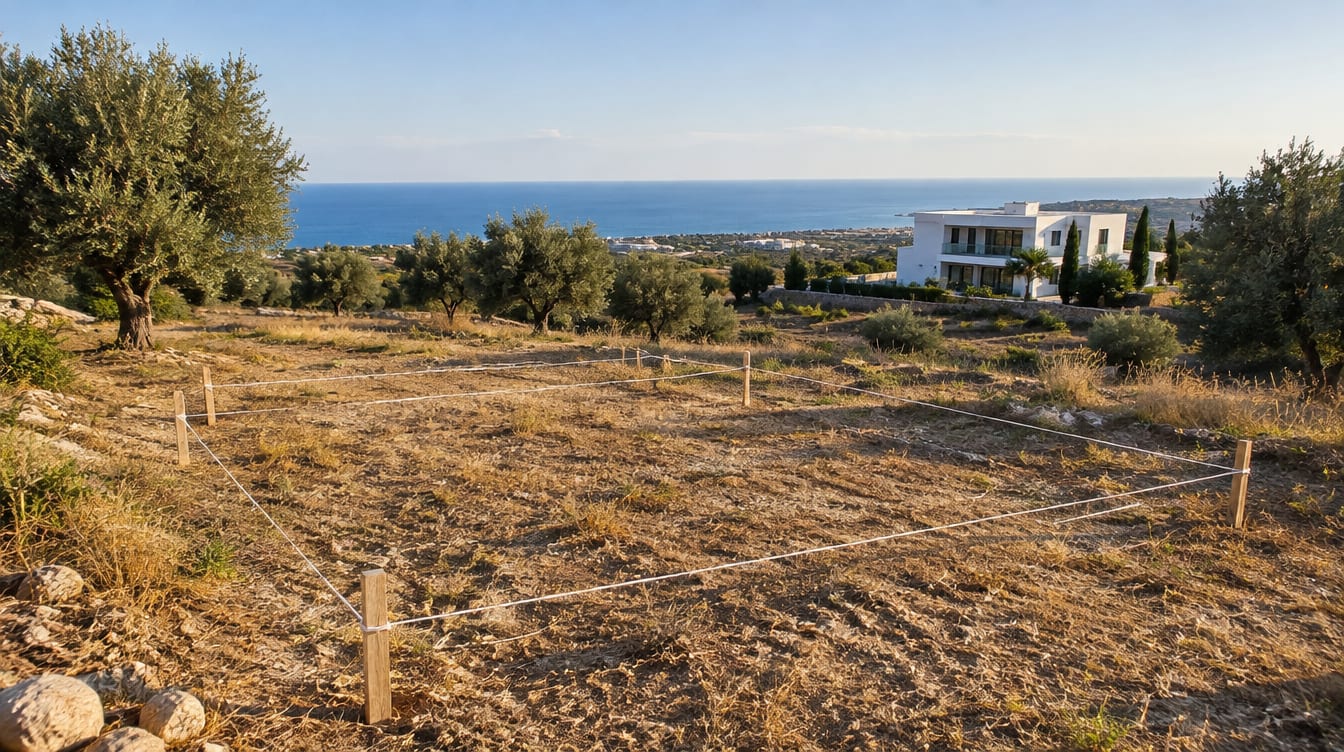
Short answer: EU and EEA citizens buy a plot in Cyprus without a permit. Buyers from other countries, including the UK and Switzerland, need the permission of the District Administration, which the Ministry of Interior describes for a plot of up to 4,000 m² on which to build the buyer's own home. Whether a house may be built on it is set by the plan of the zone or, outside the village boundary and without a published zone, by the planning authority's policy for single houses in the countryside, with a density coefficient of at most 0.10. The cost depends on the seller: a private individual sells without VAT and the transfer fee is due at half rate; if a company sells in the course of its business, 19% VAT is added and the transfer fee falls away. In the worked example below, a plot for 250,000 € with a 180 m² house costs 648,600 € in total, before fees, connections and a reserve.
Plot listings almost always lead with the price per square metre, and three assumptions regularly mislead. First: agricultural land is cheap and can somehow be built on. Second: "farmhouse" and "finca" are legal terms that secure a habitable house in the countryside. Third: a plot purchase always carries the same additional costs. The sections below test each assumption against the texts of the authorities: the law Cap. 109, the Policy Statement for the countryside and villages (June 2024, amended December 2024), the VAT law and the fee information of the Department of Lands and Surveys (DLS). The position is as of 29 October 2026, and the sources are listed at the end.
Buying Land in Cyprus as a Foreigner: Who Needs a Permit and How Much Land It Allows
The Law on the Acquisition of Immovable Property by Foreigners (Cap. 109) divides buyers into two groups. Citizens of the EU and the EEA are not "aliens" within the meaning of the law and buy without a permit. Citizens of other countries, including the UK and Switzerland, need the permit. British buyers find the details in buying property in Cyprus from the UK. The Ministry of Interior names two options for the permit: a plot or undivided land of up to 4,000 m² on which to build a dwelling for own use, or up to two units, that is two apartments, an apartment and a shop of up to 100 m², or an apartment and an office of up to 250 m². Married couples receive the permit jointly, and the limits apply to them together.
The application (form COMM 145) goes to the District Administration of the district in which the property lies. It carries no fee and, according to the Ministry, takes 2 to 3 weeks. Among the attachments are a survey plan, a copy of the title deed, the sale contract, evidence of the financial position and the passports. Companies controlled by foreigners need the permit as well. Because the sale contract is attached to the application and the DLS asks for the permit at registration, the review falls between contract and transfer. The DLS advises against paying the full price before the title deed is registered in your name.
Two figures from older guides. The often-quoted 4,014 m² (three donums) does not appear on the Ministry's page, which gives 4,000 m². Buyers also do not apply directly for a "permit of the Council of Ministers": the DLS describes the permit as permission of the competent authority to which the Council of Ministers has delegated its power, and the Ministry names the District Administration.
The planned law has not been passed. Cyprus Mail reported on 27 February 2026 on drafts that would close agricultural and rural zones and areas near military sites, ports, airports and beaches to buyers from third countries while allowing homes and shops; the Ministry of Interior proposed a holding period and a residence period of five years each. The committee was told that the law would not be retroactive: completed purchases and applications filed with the Land Registry would remain unaffected. On 3 September 2026 there were four drafts from DISY, AKEL and DIKO, and the government wanted to merge them with limits on plot and house size, without naming figures. According to the editorial of 27 October 2026, the Interior Committee has resumed deliberations after the parliamentary election in May and expects a comprehensive bill from the cabinet; the aim is to stop purchases through Cypriot companies as intermediaries and to protect agricultural and rural land. Check the legal position on the day you sign and have your permit position confirmed in writing. The steps of a purchase are described in how to buy property in Cyprus.
Building Land, Village Zone, Agricultural Land: What May Be Built on a Plot in Cyprus
Purchase price and building rights are two separate questions. Building rights are set in the zone plans and, where no zone applies, in the Policy Statement for the countryside and villages of the Town Planning and Housing Department (June 2024). Two figures decide how large a house may become: the density coefficient (floor area relative to plot area) and the coverage (footprint relative to plot area). Where a zone is published, its values apply. For areas without a zone, the Policy Statement gives these values:
| Location of the plot | Density coefficient | Coverage | Floors and height |
|---|---|---|---|
| Densely built village area with continuous building, inside the development boundary | 1.20 | 0.70 | 2 floors, 8.30 m (3 floors with 9.50 m only in exceptional cases) |
| Densely built village area without continuous building | 1.00 | 0.50 | 2 floors, 8.30 m |
| Loosely built area inside the village boundary | 0.90 | 0.50 | 2 floors, 8.30 m |
| Outside the village boundary, approved building plot | 0.60 | 0.35 | 2 floors, 8.30 m |
| Single house on a field parcel outside the development areas, no published zone | 0.10 | not stated | 2 floors, 8.30 m |
| As the row above, but in a state irrigation area or a land consolidation area | 0.06 | not stated | 2 floors, 8.30 m |
The calculation is simple: area times coefficient gives the maximum floor area. On 600 m² in a loosely built area inside the village boundary that is 600 × 0.90 = 540 m² of floor area, and at a coverage of 0.50 a footprint of at most 300 m². On a field parcel of 3,000 m², 0.10 gives a floor area of 300 m², and in an irrigation area at 0.06 only 180 m². Since the partial amendment of December 2024, the net area counts: coefficient and coverage are calculated on the area that remains after the parts given up for infrastructure under the order of the Minister of Interior. If a plot of 1,000 m² has to give up 100 m², for example, you calculate with 900 m².
Single house outside the village: the rules. The Policy Statement calls this an "isolated dwelling". The planning authority can grant a permit if these conditions come together:
- Age of the parcel. The parcel was registered in the land register on 1 December 1990 or arose from such a parcel by merger, boundary correction, approved division or transfer for public purposes.
- Size. Up to 4,000 m², one dwelling is possible. Above 4,000 m², up to four units are possible, each with at least 4,000 m² per unit.
- Parcels divided after 1990. They need at least 2,500 m², access to a public road or a right of way of at most 100 m in length and at least 6 m in width, and the original parcel had to adjoin a public road at least 4 m wide. At most ten units are possible per original parcel.
- Water. A sufficient and lasting public or private water supply must be secured.
- Exclusions. No permit is given in coastal and nature conservation areas, in protected landscapes, in industrial and commercial zones, in quarry zones and on parcels divided in state irrigation areas since 14 October 1994.
The minimum size that does not exist. Guides give minimum sizes of 4,000 or 6,000 m² for agricultural land. The Policy Statement lists 4,000 m² as the upper limit per dwelling, and the section on the isolated dwelling names no lower limit for parcels registered before 1 December 1990. For parcels divided later, 2,500 m² applies. A plot advertised as "agricultural land" may therefore be buildable if date, access, water and zone fit, or not buildable at all. The asking price does not show which case applies, and the price per m² says nothing about building rights.
What you can ask for before buying. The IPPODAMOS portal shows the plans and zones and accepts applications, among them the preliminary enquiry under article 25 of the planning authority (form EA8), the enquiry whether a planning permit is required (EA9) and the certificate of the planning authority. The DLS also advises asking the planning authorities whether the plot is affected by development plans such as a new road. Since 1 July 2024, building permits are issued through IPPODAMOS by the newly established local government organisations; before that, municipalities and District Administrations were responsible (Statistical Service Cystat). Terms such as donum and title deed are explained in the Cyprus property glossary.
Buying a Farmhouse or Finca in Cyprus: Village Houses in the Troodos and Rural Estates
Anyone searching for a "farmhouse" or a "finca" is looking for a house in the countryside with a garden and quiet. Legally, both words are empty. The 2024 Policy Statement does not use the term farmhouse in its text; it regulates the isolated dwelling, the village zone and the listed building. How a rural property is to be assessed therefore depends on which of these cases it falls under:
| Case | What applies | What to clarify before buying |
|---|---|---|
| House in the village centre, inside the development boundary | The values of the zone or the village values from the table above. In the traditional core, the design rules of chapter 10 of the Policy Statement apply. | Zone, design requirements and whether the house is registered as a listed building. |
| House or field outside the village boundary | The rules for the isolated dwelling. If the field does not meet the conditions for the isolated dwelling, a new build under this rule cannot be approved. | Registration of the parcel on 1 December 1990, access, water and the building permit of the existing house. |
| Listed or traditional building | Any change to a listed building needs the consent of the Minister of Interior, issued by the Director of the planning authority; for ancient monuments the permit of the Director of the Department of Antiquities. For owners who restore according to the principles of conservation, the Policy Statement names grants, the transfer of building density and tax relief. | Requirements, eligibility for support and whether your conversion plans would be approved, before you commit. |
| Farmstead with stable or outbuildings | If a building with another use stands on the plot, a single house remains possible if the existing building is covered by a building or planning permit. | Permits for every building on the parcel. |
Troodos. The Policy Statement lists most of the Troodos massif as an area of outstanding natural beauty. Residential zones and areas inside the development boundary are excluded. Outside them it allows traditional uses such as agriculture and forestry and small facilities needed for them. Further buildings are possible only under the rules of the relevant chapters or for special reasons with conditions. A village house in the Troodos inside the village boundary is therefore a different case from the field above the village, and the price per m² does not reflect the difference.
Ownership and title in the village. In its leaflet on buying property, the DLS names what buyers should clarify in advance: whether the plot is registered and really belongs to the seller, whether the registered area matches the actual one, whether mortgages, memos after court decisions, court orders for sale or another deposited sale contract are registered, whether the plot has legal access or is enclosed, whether a public stream, path or river crosses it and whether expropriation is threatened. For a building this includes the Certificate of Approval and the question whether it contains notes or conditions. If a completed building is not registered, the DLS advises finding out why. A new build can be registered only when the supervising engineer certifies completion and the building authority issues a certificate. What a title deed contains is shown in what is a title deed in Cyprus.
Two points apply especially to villages where land has been inherited over generations. First: if a share in a property is sold to someone who is not a registered co-owner, the DLS requires the written consent of the registered co-owners (form N254A) that they do not wish to buy at this price. If it is missing, the buyer must publish the planned transfer within 60 days in two official newspapers. Second: the Minister of Interior administers properties of Turkish Cypriot owners as Custodian under the law of 1991, and the law in principle allows only acts after which the owner remains the same. An entry in favour of a Turkish Cypriot owner is therefore a warning sign before a seller asks for a deposit.
VAT and Transfer Fees on a Plot: Why the Seller Shapes the Price
The VAT law treats the supply of immovable property as exempt in principle (Eighth Schedule). Taxable, among others, are buildings before first occupation and undeveloped building land intended for the erection of permanent structures, if the transfer takes place in the course of an economic activity. The standard rate is 19%. The DLS charges no transfer fee if VAT is charged on the same transaction (proof by a certificate from the Tax Department). In all other cases the scale applies: 3% up to 85,000 €, 5% from 85,001 € to 170,000 € and 8% above 170,000 €, on which the DLS grants a reduction of 50%. Stamp duty on contracts has been abolished since 1 January 2026.
A question follows that appears in no listing: is the seller a private individual, or does he act in the course of an economic activity? The example shows what this means at a net purchase price of 250,000 €.
| Item | Private individual sells | Company sells |
|---|---|---|
| Purchase price (net) | 250,000 € | 250,000 € |
| VAT 19% | 0 € | 47,500 € |
| Transfer fee, scale | 85,000 € × 3% + 85,000 € × 5% + 80,000 € × 8% = 13,200 € | not due |
| Transfer fee after 50% reduction | 6,600 € | 0 € |
| Total | 256,600 € | 297,500 € |
The difference is 40,900 €, or about 16% of the net purchase price. The DLS advises asking the seller whether VAT is charged and at what rate. Ask before the reservation and have the answer in writing. The rules for apartments and houses are covered in Cyprus property VAT explained.
VAT on the construction: the 5% rate applies to part of it. For the erection of a building on building land that serves as the main residence, the law (Annex V, Table C) names the reduced rate of 5%. It has narrow limits:
- It applies to the first 130 m² of buildable area, measured by the coefficient according to the building plans, and to a value of up to 350,000 €.
- The total value of the transaction may not exceed 475,000 € and the total buildable area 190 m², otherwise the reduction lapses completely under the text of the law. For persons with disabilities, 190 m² is the limit of the favoured area; for large families the area increases by 15 m² for each further child from the fourth.
- The beneficiary is a natural person aged 18 or over who uses the house as the main residence in the Republic and has not acquired another dwelling at the reduced rate.
- The declaration can be made during construction; it is accompanied by the building contract, the plans and evidence of use.
- Anyone who no longer lives in the house before ten years have passed must inform the Tax Department within 30 days and pay the difference to the standard rate, in proportion to the time in which the house was not lived in. Exceptions are death and transfer to an adult child who is entitled to the reduction.
Transitional rules (article 63 of the law) apply to building applications filed by 31 October 2023; law 109(I)/2026 allows the Tax Department to examine certain applications until 31 December 2026 if the planning authority was delayed. Anyone buying a plot now falls under the new limits. Whether the value of the plot counts towards the 475,000 € is not stated in the text of the law. Apply for the certificate from the Tax Department before construction starts and calculate with both possibilities.
Worked Example: Buying a Plot for 250,000 € and Building a 180 m² House
The example combines the rules from the sections above. The assumptions are freely chosen, so replace them with your own values. The buyer is an EU citizen (no permit under Cap. 109) who buys a plot of 3,000 m² from a private individual outside the village boundary, in an area without a published zone and outside state irrigation; purchase price 250,000 €; the parcel was registered in 1990, and access and water are secured. A house is built as the main residence with 180 m² of floor area in the sense of the coefficient (the VAT law calls it "buildable area"). The building contract is 360,000 € net, which is 2,000 € per m². This amount is an assumption; we found no official figure for construction cost per m². The density coefficient of 0.10 allows up to 300 m² of floor area on 3,000 m², so 180 m² fit.
| Item | Calculation | Amount |
|---|---|---|
| Plot | assumption | 250,000 € |
| Transfer fee | 13,200 € scale × 50% | 6,600 € |
| Building contract, net | 180 m² × 2,000 € (assumption) | 360,000 € |
| VAT 5% on the first 130 m² | 360,000 € × 130 ÷ 180 = 260,000 €; × 5% | 13,000 € |
| VAT 19% on the remaining 50 m² | 360,000 € × 50 ÷ 180 = 100,000 €; × 19% | 19,000 € |
| Total of the calculable items | 250,000 € + 6,600 € + 360,000 € + 13,000 € + 19,000 € | 648,600 € |
| For comparison: whole building contract at 19% | 360,000 € × 19% = 68,400 € against 32,000 € | 685,000 € |
At these assumptions the reduction saves 36,400 €. The split of the value by area share is an assumption; the Tax Department provides its own tool for the calculation and decides binding. If the value of the plot counts towards the 475,000 € limit, the reduction lapses and the 685,000 € line applies. If the same buyer purchases the plot from a company, the total rises by 40,900 € to 689,500 €, because the VAT of 47,500 € replaces the transfer fee of 6,600 €. Each additional 100 € per m² in the building contract means 18,000 € net and 19,600 € with VAT. The total comes to about 3,603 € per m² including the plot.
What the total does not include. Fees of the architect and engineer, permit fees, connections for electricity, water and sewage, outdoor works, a reserve and the interest on the capital tied up. We found no official figure for these items, and quotes replace any estimate. For orientation, our database lists for Paphos in October 2026 358 finished villas in 50 projects with a median of 5,247 € per m² (asking prices; the treatment of VAT differs from project to project). A comparison with the total above only works when both sides contain the same items and the same standard of finish. The additional costs of buying finished property are worked out in the cost guide, the choice between new-build and resale in new-build or resale in Cyprus and financing in the mortgage guide for foreign buyers.
Seven Checks Before the Deposit on a Plot
- Title and encumbrances. Obtain the title deed and the search certificate of the DLS and clarify mortgages, memos, deposited sale contracts and co-owners. Who should do this is explained in choosing a property lawyer in Cyprus.
- Access. Clarify whether the parcel legally adjoins a public road or is enclosed, and whether a stream, path or river crosses it.
- Zone and preliminary enquiry. Read the zone in the plan, submit the preliminary enquiry under article 25 through IPPODAMOS and have a registered architect confirm in writing the maximum floor area, footprint, height and setbacks.
- Water. Without a secured public or private water supply there is no permit for an isolated dwelling.
- Status of the seller. Ask in writing about VAT and, if VAT is charged, obtain the certificate of the Tax Department for the exemption from the transfer fee.
- Permit and payment plan. As a buyer from the UK, Switzerland or another third country, clarify the permit under Cap. 109. Deposit the sale contract with the DLS if points remain open, and do not pay the purchase price in full before registration. The power of attorney for buying from a distance is described in buying property in Cyprus remotely.
- Building permit and handover. Apply for the certificate for the reduced rate before construction starts and plan for the registration of the finished house: it requires a completion certificate from the supervising engineer and a certificate from the building authority. What to look for at handover is shown in snagging a new-build in Cyprus.
Land in Northern Cyprus: Why Many Search Results Do Not Belong to This Guide
In searches for "land in Cyprus", a large share of the listings comes from the north of the island, which the Republic of Cyprus does not control. The rules above apply to the territory of the Republic. In a notice of 13 December 2023, the DLS of the Republic of Cyprus states that the bodies in the occupied area cannot carry out valid transfers of ownership under UN Security Council resolutions 541 and 550. Dealing with the registered plot of another person can be a criminal offence under article 303A of the Criminal Code (up to seven years of imprisonment where there is intent to defraud), and judgments of Cypriot courts can be enforced in other EU states under the judgment of the European Court of Justice in Apostolides v Orams. The differences for buyers are covered in the difference between Cyprus and Northern Cyprus.
Finished villas with a large plot in the Paphos district
Zelemenos Village
Paphos · Tala
 Villa
Kamares Village
Paphos · Kamares Village
 Villa
Olympus Village
Paphos · Tsada
 Villa
Viewpoint Hills
Paphos · Peyia
 Villa
Coral Bay Villas
Paphos · Peyia
 Villa
Aquamarine Coastal Villas
Paphos · Geroskipou
Akakia
Paphos · Kamares Village
 Villa
Perneri
Paphos · Tala

Montes
Paphos · Tala
Yes, without a permit under Cap. 109, because citizens of the EU and the EEA are not aliens within the meaning of the law. Whether a house may stand on it depends on the position of the parcel in the plan.
With the permission of the District Administration. The Ministry names a plot of up to 4,000 m² for a dwelling for own use, or up to two units. The application with form COMM 145 carries no fee and takes, according to the Ministry, 2 to 3 weeks.
Outside the development areas only as an isolated dwelling under the Policy Statement, if parcel history, access, water and zone fit. The density coefficient there is 0.10 (0.06 in irrigation and land consolidation areas). The words "agricultural land" in a listing say nothing about this.
Area times coefficient: on 4,000 m² that is at most 400 m² of floor area at 0.10 and at most 240 m² at 0.06. Since December 2024, the area after the parts given up for infrastructure counts.
That depends on the seller. If a private individual sells, no VAT is charged, but the transfer fee under the scale with a 50% reduction is due. If a company sells in the course of its business, 19% is added and the fee falls away.
It applies to the first 130 m² and to a value of up to 350,000 €, as long as the total value does not exceed 475,000 € and the area 190 m² and the house is your main residence. The builder charges 19% on the rest.
None of the words is a legal term. What matters is whether the house lies in the village inside the development boundary, counts as an isolated dwelling outside it or is a listed building.
Until 27 October 2026 nothing had been passed. Reports name agricultural and rural zones as the target and say that completed or filed purchases should remain unaffected. Check the position on the day you sign.
This guide covers the Republic of Cyprus. For the north, the DLS of the Republic warns of civil and criminal consequences when buying plots that belong to Greek Cypriots.
Our Paphos listings include a project in Peyia with villa plots from about 520 m² to over 1,100 m² and a project near Coral Bay with plots up to 819 m², for buyers who want land without a building programme.
Sources (retrieved 29 October 2026): Ministry of Interior (gov.cy/moi: "Purchasing Property") and the law Cap. 109 (cylaw.org); Department of Lands and Surveys (portal.dls.moi.gov.cy: sale/exchange, fees, leaflet "Basic Information before the Purchase of Immovable Property", notice on plots in the occupied area); Town Planning and Housing Department (gov.cy/moi-tph: Policy Statement for the countryside of June 2024 and partial amendment of December 2024, planning permits through IPPODAMOS); VAT laws 95(I)/2000 as amended to 2026 and 42(I)/2023 and 109(I)/2026 (cylaw.org); Tax Department (gov.cy/mof-tax); Statistical Service Cystat (press release on building permits of 7 April 2026); law on Turkish Cypriot properties of 1991 (gov.cy); Cyprus Mail (27 February, 3 September and 27 October 2026). Not included: plot prices by district (the figures of private data providers contradict each other), construction cost per m² and permit duration (only estimates by marketplaces).
If you are comparing both routes, tell us your budget, the area and the plot size you want, and we will send finished villas that match, with prices per m². You can also browse villas in Paphos or the large villas in Cyprus collection. How much land typically comes with a villa is shown in how much land comes with a Cyprus villa.