


When buying property in Cyprus, an unfamiliar vocabulary piles up fast: condominium, specific performance, LTV, non-dom. We've already covered several of these in depth in standalone articles — here we don't repeat those explanations in full, but give a precise definition of every term plus a link to the deep-dive where one exists. This is a reference you can come back to, not another long read.
Documents and the Legal Process of Buying in Cyprus
How is a Cyprus lawyer different from a notary?
Cyprus follows the English common-law tradition inherited from British rule, so there's no continental-style notary system standing between buyer and seller. Instead, a lawyer (also called an advocate) carries out due diligence on the property, drafts the contract, and registers it with the Land Registry. That means legal responsibility for the transaction sits with the lawyer you personally choose, not a state notariat — exactly why picking an independent lawyer, rather than one recommended by the seller or developer, isn't a formality. More on how to choose one and what they actually check in our dedicated article.
What is due diligence?
Due diligence is the legal check your lawyer runs on a property before you sign anything: confirming there are no encumbrances, that the registered area matches the documents, that building permits are in order, and — for off-plan purchases — that the developer is financially sound. Skipping it to save time means accepting every risk it was designed to catch.
What is an encumbrance?
An encumbrance is any registered third-party claim on a property: a developer's mortgage, a court-ordered charge, an easement. Due diligence is precisely what surfaces these before you buy; an unresolved encumbrance is one of the main reasons a title deed can't be transferred to a buyer without further action from the seller.
What is a title deed, and why can issuing it take so long?
A title deed is the official Land Registry document confirming ownership of a specific property. On new developments, it's often not issued until months or years after purchase — only once the developer has split the whole complex into separate legal units. Until then, your rights are protected not by the title deed but by registering the sale contract (see the next entry). More on typical delays in our article on first-time buyer mistakes.
What is specific performance, and why register the contract with the Land Registry?
Specific performance is a rule of Cyprus law under which a sale contract registered with the Land Registry protects the buyer even without a final title deed: the seller cannot resell the property to someone else or put a new charge on it. Your lawyer must complete this registration within a set period after signing — one of the first things a lawyer checks when handling your transaction.
How does a reservation agreement differ from the SPA?
A reservation agreement is a preliminary deal that locks in a specific property for the buyer for 2–4 weeks against a small deposit, while due diligence is completed. The SPA (Sale and Purchase Agreement) is the binding contract itself, signed after due diligence and then registered with the Land Registry under the specific performance rule. The reservation deposit is usually credited against the purchase price once you move to the SPA.
What is snagging?
Snagging is the inspection of a finished property before final payment and handover, aimed at recording construction defects and requiring the developer to fix them before the last instalment is released. It matters most when you're buying remotely, without being able to inspect every stage in person — more on organising a remote handover in our article on buying property in Cyprus remotely.
What is a Power of Attorney for a remote purchase?
A Power of Attorney lets your lawyer or another trusted person sign documents and act on your behalf in Cyprus without you being physically present — standard practice for buyers who won't travel for every stage of the deal. It's issued by a notary in your country of residence and then apostilled. The full remote-purchase process, PoA included, is covered in a dedicated article.
What does off-plan mean, and how are payments protected?
Off-plan means buying before construction is finished, usually at a lower price than a completed unit, but with risk tied to timelines and the developer's solvency. Payments are protected by staging them against actual construction progress and by registering the contract with the Land Registry. Full breakdown in our article on how off-plan payments are protected.
Taxes and Fees When Buying Property in Cyprus
What is VAT, and when does it apply to a property purchase?
VAT applies to new-build property: 19% at the standard rate, or 5% at the reduced rate for a primary residence if certain conditions are met. Resale property isn't subject to VAT — transfer fees apply instead (see below). Full breakdown in our article on Cyprus property VAT.
What are transfer fees?
Transfer fees are paid by the buyer of a resale property when the title deed is registered in their name: 3% up to €85,000, 5% from €85,001 to €170,000, and 8% on anything above €170,000. A 50% reduction currently applies, so the effective rates are 1.5%, 2.5% and 4%. The fee doesn't apply if VAT has already been paid on a new-build. Full tier-by-tier calculation in our complete guide to Cyprus property taxes.
What is stamp duty?
Stamp duty was a fee on the sale contract itself, abolished from 1 January 2026 under Law 239(I)/2025. Contracts signed before that date still fall under the old rates (0.15–0.20% depending on the amount); for new transactions, the fee no longer applies.
What is CGT (capital gains tax)?
CGT is a tax on profit from selling property in Cyprus, charged at 20% of net gain. Since 1 January 2026 (for contracts signed from that date) the lifetime exemptions are up to €150,000 on a main residence you've lived in for at least five years, and a one-off €30,000 for any other property — up from €85,430 and €17,086 before. Details in our guide to Cyprus property taxes.
What is a TIC, and why does a foreign buyer need one?
A TIC (Tax Identification Code) is a Cyprus tax number required to buy property at all, open a bank account, and connect utilities. Your lawyer can obtain it before the deal closes — without a TIC, the contract can't be registered with the Land Registry.

Mortgages and Financial Terms in Cyprus
What is LTV (loan-to-value) for a Cyprus mortgage?
LTV is the ratio of loan amount to property value, expressed as a percentage. Banks typically approve 60–70% LTV for foreign buyers, meaning a cash deposit of 30–40% of the property's value. How LTV actually changes your monthly payment — and whether renting or buying comes out ahead, with real numbers — in our article on renting vs buying in Cyprus.
What is mortgage pre-approval?
Pre-approval is a bank's written confirmation that it will lend a specific amount, subject to full document checks. Get it before paying a reservation deposit — it removes the risk of losing that deposit if the bank ultimately declines the full amount you need.
Residency and Tax Status in Cyprus
What is the Golden Visa (Category 6.2), and how does it relate to buying property?
This is Cyprus's fast-track permanent residency programme for non-EU citizens, available with an investment of at least €300,000 in new property. Unlike a temporary residence permit, this status doesn't require living on the island full-time and extends to a spouse and minor children. Full requirements and process in our article on Cyprus residency for non-EU citizens.
What is non-dom tax status?
Non-dom (non-domiciled) is a special tax status for new Cyprus tax residents that exempts dividend and worldwide interest income from tax for 17 years. You get it automatically when you register as a tax resident, provided you weren't a Cyprus tax resident in prior years.
What is GeSY?
GeSY (the General Healthcare System) is Cyprus's state healthcare scheme, funded by mandatory contributions in exchange for access to public medicine. Participation is compulsory for residents who work or earn income in Cyprus; tourists and non-resident property owners aren't covered by GeSY and need separate private insurance.
Condominiums, Running Costs and Ownership Types in Cyprus
What is a condominium in Cyprus, and how does it differ from a US HOA or a UK leasehold scheme?
Most apartment complexes in Cyprus are legally structured as condominiums: each owner gets a separate title deed for their unit plus a share in the common parts of the building — stairwells, roof, pool, grounds. Day-to-day management sits with a management company, usually appointed by the developer rather than elected directly by owners — closer to how a US homeowners' association or a UK leasehold management company works than to a resident-run body. In practice, owners rarely vote to replace the appointed company.
What are service charges?
Service charges are the mandatory annual payments that fund the upkeep of a condominium's shared areas: cleaning, lift and pool maintenance, building insurance. The amount depends on the complex's infrastructure — from €500–600 a year for a standard apartment to several thousand euros for resort developments with golf courses and spas. These costs sit outside the purchase price and are usually left out of yield calculations.
How does freehold differ from other forms of ownership in Cyprus?
Freehold is full, unlimited-term ownership — the form the vast majority of foreign buyers in Cyprus get. It's a different system from the long-lease (leasehold) land arrangements common in some other countries: a freehold owner in Cyprus can sell, inherit, or rent out the property freely, with no land lease to renew.
What is plot ratio?
Plot ratio is the maximum buildable floor area allowed relative to the size of a plot, set by local planning rules. A property already built close to that limit leaves no legal room for an extension, a pool addition, or further structures later — worth checking in advance if you have plans like that.
What does joint ownership mean when buying as two people?
When two owners buy in equal shares — a married couple, for example — transfer fees are calculated separately on each half of the property's value, which, at certain price points, lowers the combined fee compared with registering the whole property to one owner, because of the tiered rate structure. The effect is worked through with real numbers in our guide to Cyprus property taxes.
Come across a term that isn't on this list? Get in touch — we'll add it to the glossary, or walk you through your specific situation.
Recommended properties
 Apartment · Villa · Townhouse
Limassol Greens
Limassol
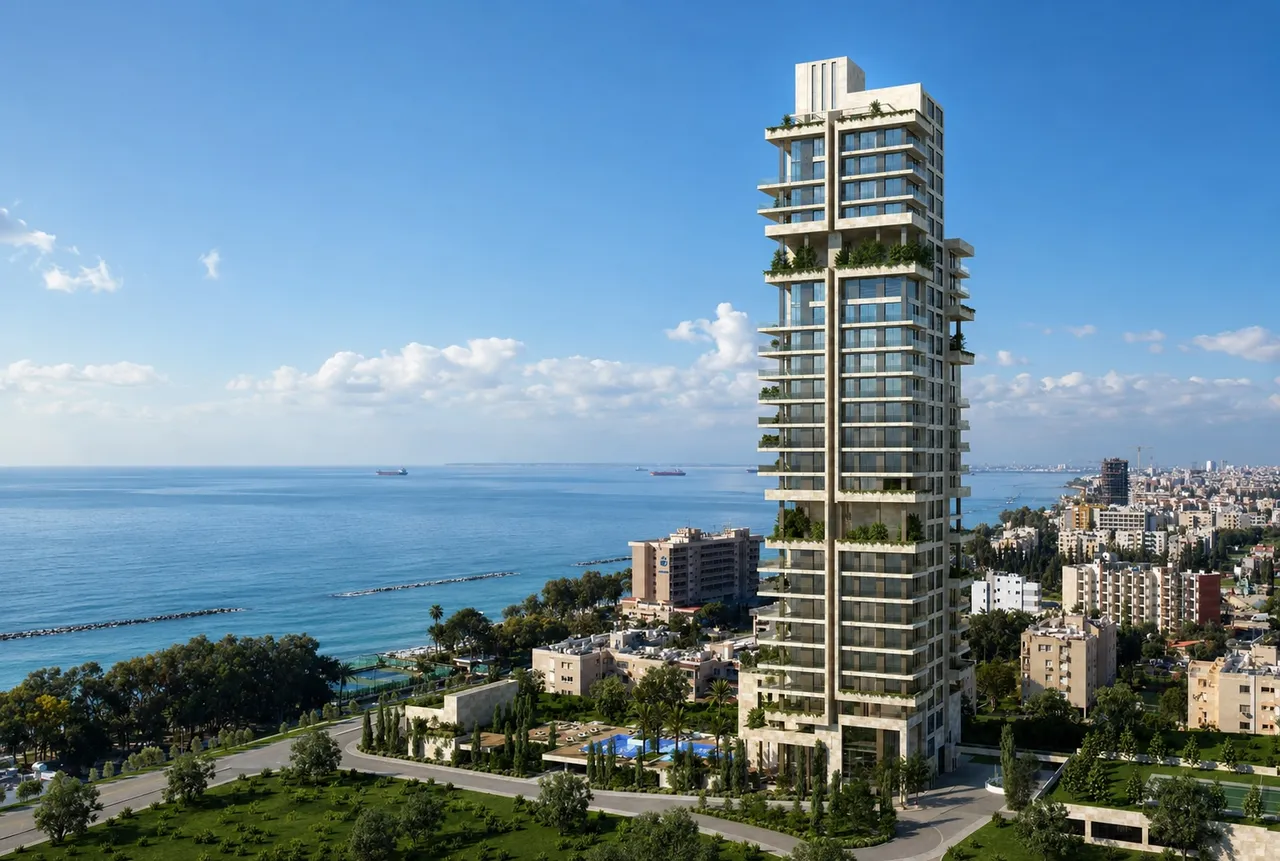 Apartment · Penthouse
Dream Tower
Limassol · Agios Tychonas

Aphrodite Gardens
Paphos · Kato Paphos

Line
Limassol · Potamos Germasogeias
 Villa · Terraced House · Apartment
Mamba
Paphos · Chlorakas · Chloraka
 Villas / Houses
Olympus Village
Paphos · Tsada