
Guides/Buying guides
Buying Property in Cyprus from Ireland: No Permit, Euro Transfers, Revenue Reporting, Irish Tax on a Sale and a Worked Cost

An Irish citizen is an EU citizen, so the Acquisition of Immovable Property (Aliens) Law, Cap. 109, asks for no Council of Ministers permission, and both countries use the euro, so no currency is converted. A €350,000 apartment costs about €371,965 in total as a new-build main residence at 5% VAT, €420,965 as a second home at 19% VAT and €365,065 as a resale, once transfer fees, a legal fee and registry charges are added (assumptions are marked below). Each instalment is a euro SEPA transfer from an Irish account, priced like a domestic payment, and since 9 October 2025 the Irish bank checks the payee's name against the IBAN before the money leaves. Revenue says you normally pay no Irish Stamp Duty on a foreign home, that you must fully declare all the money used to buy it, and that a later sale can be taxed in both countries: on a €100,000 gain the combined tax is €40,266.30 if Ireland only deducts the Cyprus tax from the gain, which is the outcome Revenue's treaty table points to, and €30,606.30 if Ireland credits it. The 2021 census counted 443 Irish citizens in Cyprus, 149 of them in Paphos district (sources read on 18 November 2026).
Buying property in Cyprus as an Irish citizen: no Council of Ministers permit
Section 2 of Cap. 109 defines the "alien" who needs permission as anyone who is not a citizen of the Republic, including a company controlled by aliens, a foreign company and a trust for an alien. It then lists who is outside the definition: an alien Cypriot, the foreign spouse of a Cypriot citizen, a citizen of an EU member state who holds Union citizenship under Article 20 of the Treaty on the Functioning of the EU, a citizen of an EEA state, and a legal person formed under the law of a member state with its registered seat, central administration or main establishment in an EEA state. Section 3(1) forbids an alien to acquire immovable property without the prior permission of the Council of Ministers, and section 3(5) makes a registration made in breach void. An Irish citizen falls outside the definition, so section 3 does not apply to the purchase. I read the Greek consolidated text on CyLaw, which lists amendments up to 161(I)/2011 and shows the old definition of "secondary residence" as deleted.
Three practical points follow. First, the text counts no properties: an EU citizen needs no permit and meets no numeric limit, as our guide to how many properties you can own in Cyprus explains, including one official Greek page that still mentions a secondary-residence rule from the accession period; ask the lawyer to confirm in writing that no such condition applies to your file. Second, a company changes the tax result: the reduced 5% VAT rate is for a person buying a main residence, and a company pays 19%, while the permit question stays the same. Third, the definition of a company controlled by aliens turns on whether half or more of its directors, votes or shares are held by aliens; Irish citizens are not aliens under section 2, and a lawyer should confirm any structure before you use it.
A reform is under discussion. Cyprus Mail reported on 22 October 2026 that the House Interior Committee was still examining amendments on property acquisition by foreign nationals and awaiting a comprehensive government proposal, with the chairman hoping to finish by the end of the year. The restrictions described in the reports I read, such as caps on plot and house size, concern third-country nationals, and I found no report that applies them to EU citizens. No bill had passed in those reports, so the final text and its start date will decide. The legal essentials of the other purchase steps are in Cyprus property law for foreign buyers; ownership gives an Irish citizen no residence status, and the registration steps are in our guide for Irish and EU citizens.
How a Cyprus property purchase runs for an Irish buyer, step by step
The order below follows the Land Registry's sequence as summarised in our law guide. The right-hand column shows what an Irish buyer prepares at each step, and the sections after the table work through the Irish side in detail. The full order of the legal steps, with the cost of each, is in our guide to how to buy property in Cyprus as a foreigner.
| Step | What happens in Cyprus | What the Irish buyer prepares |
|---|---|---|
| 1. Choose a lawyer and reserve | Your own lawyer checks the title, permits, mortgages and the Land Registry search certificate; the unit is held for you | An independent lawyer of your own choosing (see the lawyer guide linked below the table) |
| 2. Power of attorney (if you do not travel) | A special power of attorney names the unit, your attorney and the acts allowed | Signing before an Irish notary public, then the Irish apostille (section on signing from Ireland) |
| 3. Sale contract | Signed by you or your attorney; the seller adds a search certificate dated within five working days of signing | Proof of funds ready, and the first instalment in euros |
| 4. Deposit at the Land Registry | Your lawyer lodges the signed contract within six months of signing for €50 | Nothing to do; ask for the receipt |
| 5. Instalments or balance | A new-build is paid in stages with VAT at 5% or 19%; a resale is paid at transfer with a transfer fee | A euro SEPA transfer for each payment, with the name check |
| 6. Handover and title deed | A resale transfers at the Land Registry; a new unit has a deed only after the building has a certificate of approval and the Land Registry divides it | Keep the payment trail, the contract and the certificate of approval |
The independent lawyer matters more than any other choice in the table; choosing a property lawyer in Cyprus sets out what the fee should cover.
Sending euros from Ireland to Cyprus: charges, instant payments and the name check
Ireland and Cyprus are both in the euro area, so a payment from an Irish current account to a Cyprus account needs no exchange rate and no conversion margin. The Central Bank of Ireland, the Consumer Protection Commission and the European Commission describe the rules that apply to the payment itself. The table gathers them.
| Question | What the official page says | Source |
|---|---|---|
| Do cross-border euro payments cost more? | Banks must apply the same charges for domestic and cross-border electronic payments in euro | European Commission SEPA page (Regulation (EC) 924/2009 as amended) |
| How fast is a standard euro transfer? | A standard SEPA credit transfer can take up to one business day | Central Bank of Ireland explainer |
| Can I send an instant euro payment? | Since 9 October 2025 banks and relevant payment providers in Ireland and the euro area must send SEPA instant credit transfers in euro on request; the money moves within 10 seconds, at any hour, and the cost must not exceed that of a standard SEPA transfer | Central Bank of Ireland explainer |
| What is the name check? | Verification of Payee, in force from 9 October 2025 for instant and standard SEPA transfers, compares the name and IBAN you type with the recipient account and shows match, close match or no match | Central Bank of Ireland explainer |
| What if I make a mistake? | An instant payment cannot be cancelled once sent; you ask your bank for a recall, which can help in cases such as fraud, a technical error or a wrong IBAN, with no guarantee | CCPC instant payments page |
The name check protects a purchase in one specific way. The payee on a developer invoice should be the developer's company or the client account your lawyer names in writing, and a close match or no match is the signal to stop and phone your lawyer on a number you already hold. Pages read for this guide state no per-payment limit for instant transfers, so ask your bank for its limits before the first instalment and raise them in advance if a payment is larger. The documents Cypriot banks and lawyers ask for, and the mechanics of very large transfers, are in transferring large sums to Cyprus.
The Irish pages I read describe no permission or reporting step for sending your own money to a euro account in another member state; the tax declaration duty is on the Revenue side and is covered below. For cash, Article 80 of Regulation (EU) 2024/1624 limits cash payments to €10,000 for persons trading in goods or providing services from 10 July 2027, according to an extract of the EUR-Lex text. A purchase of this size is paid by bank transfer in practice, and a payment trail is what the next section needs.
Proof of funds for an Irish buyer: the documents behind each payment
Revenue's page on acquiring a foreign property says you must fully declare all the money used to buy it, and that if you took a loan you must also declare the money you use to repay the loan. The same papers answer the Cypriot lawyer and the bank, which ask where the money comes from. Our transfer guide describes the two questions: source of wealth is how you built your overall assets, and source of funds is where the specific payment comes from. Each bank decides its own list, and no official list of documents was read for this guide, so the table maps the usual funding situations to documents that normally exist in Ireland.
| Where the money comes from | Documents an Irish buyer can gather (typical, a bank decides) | What the file should show |
|---|---|---|
| Savings in an Irish account | Statements covering the months in which the balance built up, and the account holder's name | The account is yours and the balance has a history |
| Sale of an Irish home | The sale contract and the closing statement of the solicitor who acted on the sale | The amount received and the date it reached your account |
| Salary, pension or business income | Payslips or pension statements, and your Irish tax returns | The income that produced the savings |
| Borrowed money | The loan agreement and the repayment schedule | What you borrowed and what you repay; Revenue asks you to declare the repayment money too |
Move the money once, from one named account, and keep each payment's confirmation with the contract. Payments through a third party, or a transfer that cannot be traced to an account in your name, are what slow a Cypriot file. The mechanics of selling an Irish home to fund a move, including the Irish capital gains position on that sale, are in moving to Cyprus from Ireland, and this guide does not repeat them.
What a €350,000 Cyprus property costs an Irish buyer, with no currency conversion
Because the price, VAT and fees are all in euros, the cost is the Cyprus cost. Four rules from our cost and VAT guides set it. A new-build pays VAT of 19%, or 5% on the first 130 m² of a home that is the buyer's main and permanent residence, within €350,000 for the 5% part and €475,000 and 190 m² for the whole transaction. A resale pays a Land Registry transfer fee of 3%, 5% and 8% bands that are halved while the 50% reduction applies, and no VAT. A transaction pays VAT or the transfer fee, never both. Stamp duty is zero for contracts signed from 1 January 2026 (Law 239(I)/2025). The reduced VAT rate follows the use of the home and nationality plays no part: an Irish couple who keep their main residence in Ireland and buy a holiday apartment pay 19%, and the ten-year main-residence condition applies if they take 5%. Cyprus property VAT explained has the conditions and the claw-back, and the cost of buying property in Cyprus has the itemised list.
The example is a 120 m² apartment at €350,000 before VAT, the way our listings show prices ("+VAT"). The legal fee is a planning figure of 1% plus 19% VAT on the fee, and €300 is allowed for Land Registry charges, both as in our cost guide. Agent commission is normally paid by the seller or the developer.
| Cost line | New-build, main residence (5% VAT) | New-build, second home (19% VAT) | Resale, one buyer |
|---|---|---|---|
| Price | €350,000 | €350,000 | €350,000 |
| VAT | €17,500 | €66,500 | €0 |
| Land Registry transfer fee | €0 | €0 | €10,600 |
| Stamp duty | €0 | €0 | €0 |
| Legal fee, 1% plus 19% VAT (€3,500 + €665) | €4,165 | €4,165 | €4,165 |
| Land Registry charges (assumption) | €300 | €300 | €300 |
| Total | €371,965 | €420,965 | €365,065 |
| Extra on top of the price | €21,965 (6.3%) | €70,965 (20.3%) | €15,065 (4.3%) |
The arithmetic. VAT at 5% is 0.05 × €350,000 = €17,500 and at 19% is 0.19 × €350,000 = €66,500, a difference of €49,000, which is the amount that rides on the main-residence question. The resale fee is 1.5% × €85,000 = €1,275, plus 2.5% × €85,000 = €2,125, plus 4% × €180,000 = €7,200, which is €10,600 (the statutory scale gives €21,200 before the halving). The legal fee is €3,500 + 0.19 × €3,500 = €4,165. If a couple buy the resale 50/50, each pays the fee on a €175,000 share: €1,275 + €2,125 + 4% × €5,000 = €3,600, so €7,200 together and €3,400 less than one buyer holding the whole flat. The totals are €350,000 + €17,500 + €4,165 + €300 = €371,965, €350,000 + €66,500 + €4,165 + €300 = €420,965 and €350,000 + €10,600 + €4,165 + €300 = €365,065.
Worked example: paying a €371,965 purchase in six euro transfers from Ireland
The law fixes no payment percentages, and the contract decides them. The schedule below is an assumption for the 5% VAT route: 25% at signing, three stage payments of 15%, 25% at handover and a 5% retention until the title deed, each instalment with 5% VAT added. Each line is one euro SEPA transfer from an Irish account to the developer, with the name check before it is released.
| Payment (assumed schedule) | Share of price | Price part | VAT at 5% | Transfer to send |
|---|---|---|---|---|
| 1. Signing of the contract | 25% | €87,500 | €4,375 | €91,875 |
| 2. Foundations complete | 15% | €52,500 | €2,625 | €55,125 |
| 3. Frame complete | 15% | €52,500 | €2,625 | €55,125 |
| 4. Fit-out stage | 15% | €52,500 | €2,625 | €55,125 |
| 5. Handover with the certificate of approval | 25% | €87,500 | €4,375 | €91,875 |
| 6. Retention, paid when the title deed is issued | 5% | €17,500 | €875 | €18,375 |
| Total to the developer | 100% | €350,000 | €17,500 | €367,500 |
The sum is €91,875 + 3 × €55,125 + €91,875 + €18,375 = €367,500, which is 1.05 × €350,000. The lawyer's fee of €4,165 and the €300 of registry charges are paid separately, so the cash required over the life of the purchase is €367,500 + €4,165 + €300 = €371,965. Each of the six transfers to the developer, and each payment to the lawyer, goes through its own name check. I read no Irish bank fee schedule, so any charge the bank makes for a transfer is left out; the rule that a cross-border euro payment costs the same as a domestic one and that an instant payment costs no more than a standard one limits what a bank may charge. The handover instalment is the one to tie to the certificate of approval in the contract, as explained in buying with deposits and instalments protected off-plan.
Mortgage options for an Irish buyer of Cyprus property
Our mortgage guide puts the loan at roughly 70% to 75% of the price for an EU citizen living abroad, which means 25% to 30% in cash, from a short list of lenders, with most lenders requiring repayment by age 65 to 70 and the Central Bank of Cyprus average on new housing loans at 3.88% in September 2026 (4.16% in August), as reported by Cyprus Mail. A loan from a Cyprus bank is in euros, so an Irish borrower with euro income carries no currency mismatch, which the guide identifies as the extra risk for borrowers paid in another currency. The figures are orientation only, and each lender sets its own terms; read Cyprus mortgages for foreign buyers before you ask for an offer.
Two Irish points sit around the loan. Revenue's rule on declaring the money you use to repay a loan taken to buy a foreign property is in the section on Revenue below. And no Irish official page read for this guide speaks to borrowing against an Irish home to buy abroad, so ask the Irish lender whether its terms allow a top-up or a further advance for that purpose, and tell the Cyprus lawyer early because the loan agreement becomes part of the proof-of-funds file.
Signing from Ireland: power of attorney, notary and the Irish apostille
A buyer can sign through an attorney. Our power of attorney guide explains that the safe form is a special power of attorney naming one property, one attorney (normally your own Cyprus lawyer) and the acts allowed, that the Land Registry files a special power of attorney free of charge, and that a signature made abroad is certified by a Cyprus consular officer or by a notary in your own country, which in practice carries an apostille. Cyprus has been a party to the Hague Apostille Convention since 30 April 1973 (accession on 26 July 1972) and Ireland since 9 March 1999 (ratification on 8 January 1999), according to the Hague Conference status table updated on 30 June 2026.
On the Irish side, the Authentication and Apostilles Section of the Department of Foreign Affairs is the competent authority for Irish public documents. It says a stamp confirms only that a signature, seal or stamp is genuine, that powers of attorney are on its list of private documents that must be certified first by a qualified person (it points to a notary public), and that a document that fails a statutory requirement, with the Power of Attorney Act 1996 named as an example, can be refused. The exemption from legalisation under EU Regulation 2016/1191 that the page describes covers certain Irish civil-status and Garda documents and names no power of attorney. The Department issues physical stamps only and offers no digital service.
| Route | What it involves | Fee and time stated on the official page |
|---|---|---|
| Irish notary, then Dublin walk-in | Sign before a notary public, then take the original to 42-47 Mount Street Lower, Dublin 2 | €40 per Apostille stamp; counter open Monday, Tuesday, Thursday and Friday 9:30 to 12:30 and 2:30 to 3:30, closed Wednesday; target of thirty minutes |
| Irish notary, then Cork walk-in | Take the original to 1A South Mall, Cork | €40 per stamp; Tuesday and Thursday mornings 9:30 to 12:30 only |
| Irish notary, then post | Post the original to the Authentication Section, 80 St. Stephen's Green, Dublin 2, by registered post | €40 per stamp, card payment by phone; average processing 3 to 7 working days from receipt, excluding postage, returned by registered post |
| Sign in Cyprus on a viewing trip | Sign before a Cyprus certifying officer under Law 165(I)/2012, or the mukhtar with a second signatory, as in our guide | No apostille is involved; the fee for a certifying officer is not stated on a page read |
| Cyprus embassy in Dublin | Consular certification of a signature | Not confirmed: the old embassy consular page now redirects to the ministry home page, so I could not read a current service list |
The Irish notary's fee is set by the notary and no official figure was read. Our guides to a power of attorney for a Cyprus purchase and buying property in Cyprus remotely cover the wording, the Cyprus certification and the remote steps.
Worked example: a power of attorney signed in Dublin, with dates, fees and the time difference
Two spouses sign separate special powers of attorney for the Cyprus lawyer, who will sign the sale contract on their behalf. Every date is an assumption chosen to show the order, and the weekdays were checked in a calendar. The Department's counter hours are used for the apostille step, and three working days are assumed for the courier.
| Date (assumed) | Step | Rule or figure applied |
|---|---|---|
| Tuesday 2 February 2027 | The couple instruct the Cyprus lawyer, who drafts one power of attorney per spouse naming the unit | Special power of attorney, filed free at the Land Registry |
| Thursday 4 February 2027 | Both sign before an Irish notary public in Dublin | Notary fee set by the notary (not published on a page read) |
| Friday 5 February 2027 | One of them takes both originals to Mount Street Lower between 9:30 and 12:30; two stamps are issued | 2 × €40 = €80; target thirty minutes; the courier leaves the same day |
| Wednesday 10 February 2027 | The originals reach the lawyer in Cyprus | Three working days is an assumption |
| Friday 12 February 2027 | The lawyer signs the sale contract as attorney; the seller's search certificate is dated on or after Friday 5 February | Certificate dated within five working days of signing |
| By Thursday 12 August 2027 | Latest day to lodge the contract at the Land Registry | Six months from signing, €50 |
The post route would add 3 to 7 working days from receipt at the Department, so a document posted on Friday 5 February 2027 could reach the Cyprus lawyer a week or more later, depending on postage. The time difference matters for calls. Cyprus is two hours ahead of Ireland all year, because Ireland is on UTC in winter and UTC+1 in summer while Cyprus is on UTC+2 and UTC+3 and both change their clocks at the end of March and October; this comes from time-zone reference pages, and I read no official source for it. A signing appointment at 15:00 in Limassol is 13:00 in Dublin, and the lawyer's office hours in Cyprus end two hours before they appear to on an Irish clock. A viewing trip in the same week can replace the power of attorney: you sign in person, and the sale contract is lodged within the same six months.
What Revenue says about owning a Cyprus property: stamp duty, declaring the money and VAT
Revenue's Foreign property section, published on 16 December 2025, is the official Irish reference for a foreign home. It is about Irish tax and does not replace advice from a licensed Irish tax adviser, who should look at your own residence and domicile. The table sets out what its pages say about buying and owning.
| Topic | What Revenue says | Page read |
|---|---|---|
| Irish Stamp Duty | You may buy foreign land and buildings and normally pay no Irish Stamp Duty on the instrument transferring the property to you; Irish duty applies if the instrument relates to Irish land and buildings or Irish shares | Acquiring a foreign property |
| The money used | You must fully declare all money used to buy a foreign property to Revenue for tax purposes; if you took a loan, you must declare the money you use to repay it | Acquiring a foreign property |
| A bank account in Cyprus | One page says that if you open an account in the country where you bought, you use ROS to complete a Form 11. The separate bank account page says a Form 11 is required for any year you open a foreign account in a non-cooperative, non-DAC2, non-CRS or non-FATCA reporting jurisdiction | Acquiring a foreign property; Opening a foreign bank account |
| VAT in the price | VAT included in the price of a foreign property cannot be reclaimed in Ireland; ask the tax authority in the property's country | Acquiring a foreign property |
| Annual tax on the property | A yearly property tax charged by the foreign country gives no credit or deduction against Irish tax; the page does not mention Local Property Tax | Taxes paid on a foreign property |
| A gift or inheritance of foreign property | Irish Capital Acquisitions Tax may apply if you or the person you receive it from are resident or ordinarily resident in Ireland, and a Double Taxation Credit can be claimed for tax paid abroad | Acquiring a foreign property |
The two Form 11 statements read differently, and Cyprus takes part in the OECD Common Reporting Standard and FATCA according to our transfer guide, so on the second page's wording a Cyprus account would not need the form. Ask Revenue or an Irish tax adviser which reading applies before you open the account. Cyprus has no inheritance tax, according to our Cyprus tax guide, which leaves the Irish CAT position as the one to check for a gift or a bequest.
Selling a Cyprus property later: Irish capital gains tax, Cyprus tax and the 1968 treaty
A sale is where an Irish owner meets two tax systems. Cyprus taxes gains on Cyprus-situated immovable property at 20%, whether or not the owner lives there, with lifetime exemptions from 2026 of €150,000 for a main residence used as the owner's home for at least five years (with limits on the land area and a ten-year period if it is a second sale of a home) and €30,000 for any other disposal, and a person gets only one of them (our tax guide). Revenue's pages cover the Irish side.
| Item | Cyprus | Ireland (Revenue) |
|---|---|---|
| Rate | 20% on the gain from Cyprus immovable property | 31% for most gains on disposals from 7 October 2026; 33% for disposals from 6 December 2021 to 6 October 2026 |
| Allowance | €30,000 lifetime for a second home, or €150,000 for a main residence lived in for five years (one of the two) | Personal exemption of €1,270 a year for an individual |
| Who is taxed | Anyone selling Cyprus property | A person resident or ordinarily resident in Ireland pays Irish CGT on a disposal of foreign property; a resident who is not domiciled pays only on money brought into Ireland |
| Relief for tax paid abroad | Not applicable | A credit if a double taxation agreement covers CGT, limited to the Irish CGT and with no refund of the excess; a deduction from the gain if no agreement covers CGT |
| Losses | Not examined here | Relief only for a person resident and domiciled in Ireland; set against gains and carried forward; not against employment or investment income |
| Buying off the plans and selling before completion | Not examined here | Irish CGT applies to the gain; a person in the business of buying and selling property may be taxed to income tax instead |
Revenue's table of the dates of effect of Ireland's tax treaties lists the Cyprus convention as signed on 24 September 1968 and given effect in Irish law by Statutory Instrument 79 of 1970, with effect for income tax from 6 April 1962 and for corporation tax from 1 April 1962. Revenue publishes the 1968 text and a synthesised text showing the convention as modified by the Multilateral Instrument. In the 1968 text, Article 2 names the Irish income tax (including surtax) and corporation profits tax and the Cyprus income tax, and adds identical or substantially similar later taxes. Article 12(1) says gains from the sale of immovable property may be taxed in the state where the property is situated, and Article 21(2) gives a credit against Irish tax for Cyprus tax on income from Cyprus sources, subject to Irish law on credits.
Revenue's table of the dates of effect of Ireland's tax treaties gives income tax and corporation tax dates for the Cyprus convention (6 April 1962 and 1 April 1962) and leaves the capital gains tax column empty, while it shows a capital gains tax date for most newer treaties. Article 2 also names no capital gains tax. On this evidence the convention does not cover Irish or Cypriot CGT and the deduction route is the one to plan on; confirm with Revenue or an Irish tax adviser. Article 2 does not name either tax, and I found no Revenue or Tax Department page that says they count as substantially similar taxes. Revenue's own relief page sorts the two outcomes: a credit with a DTA that covers CGT, and a deduction without one. That distinction is what the next example prices. The Cyprus rates and the full sale calculation are in our guide to taxes on real estate in Cyprus.
Worked example: capital gains tax on a €100,000 gain in Cyprus and Ireland
Assumptions: an Irish tax resident who is also domiciled in Ireland buys a Cyprus resale apartment for €350,000 and sells it for €450,000, and the gain after costs is assumed to be €100,000 in both countries (Cyprus also adjusts the purchase cost for inflation, which Irish CGT does not do for a property bought after 2003, so the two gains would differ in practice). The Cyprus exemption of €30,000 has not been used before, and the apartment was never the owner's main residence. The Irish figures use 31% and the €1,270 exemption.
| Step | Credit route (agreement covers CGT) | Deduction route (no agreement covers CGT) |
|---|---|---|
| Cyprus gain after the €30,000 exemption | €100,000 − €30,000 = €70,000 | €70,000 |
| Cyprus tax at 20% | €14,000 | €14,000 |
| Irish taxable gain | €100,000 − €1,270 = €98,730 | €100,000 − €14,000 − €1,270 = €84,730 |
| Irish CGT at 31% | €30,606.30 | €26,266.30 |
| Credit for Cyprus tax | −€14,000 → €16,606.30 due in Ireland | No credit |
| Total tax in both countries | €14,000 + €16,606.30 = €30,606.30 | €14,000 + €26,266.30 = €40,266.30 |
The credit route gives a combined bill equal to the Irish tax on the whole gain, €30,606.30, because the Irish rate of 31% is higher than the Cyprus rate and the Cyprus tax is credited in full. The deduction route costs €9,660 more, which is the €14,000 of Cyprus tax less the 31% saved on it (€4,340). If the Cyprus exemption covered the whole gain, as it could for a main residence under the €150,000 exemption, Cyprus tax would be €0 and the Irish CGT of €30,606.30 would remain, unless an Irish relief applies; I did not examine Irish main-residence relief for a home abroad. Revenue's page on foreign relief still prints 33% in its examples, which reflect disposals before 7 October 2026. This is an illustration: a licensed Irish adviser should confirm the position, including your residence and domicile.
Where Irish citizens live in Cyprus and what is on sale there: census and listings
The Statistical Service of Cyprus counted the population by country of citizenship in the census of 1 October 2021 (table 1891221E). It counted 443 Irish citizens in a population of 923,381. The right-hand columns come from our own database on 18 November 2026: published developments with at least one available apartment, the apartments listed at €350,000 or less before VAT, which is the ceiling for the 5% VAT part, and the apartments listed between €350,001 and €475,000.
| District | Irish citizens, 2021 | Share of all Irish citizens | Developments with available apartments | Available apartments | Listed at €350,000 or less | Listed at €350,001 to €475,000 |
|---|---|---|---|---|---|---|
| Paphos (including Polis) | 149 | 33.6% | 95 | 867 | 312 | 247 |
| Limassol | 92 | 20.8% | 111 | 1,121 | 316 | 289 |
| Larnaca | 80 | 18.1% | 27 | 294 | 215 | 47 |
| Nicosia | 69 | 15.6% | 5 | 30 | 11 | 2 |
| Famagusta (government-controlled area, including Ayia Napa and Protaras) | 53 | 12.0% | 9 | 70 | 50 | 0 |
| Cyprus | 443 | 100% | 247 | 2,382 | 904 | 585 |
Paphos holds a third of the Irish citizens counted. In the listings, 73% of Larnaca's available apartments (215 of 294) and 71% of Famagusta's (50 of 70) are priced at €350,000 or less, against 36% in Paphos (312 of 867) and 28% in Limassol (316 of 1,121). The census counts citizens, so it cannot show owners or where Irish households have moved since 2021, and a person counted under another passport is outside the Irish figure; the listings are asking prices that change with sales. The projects listed above the questions below sit in the three districts where most Irish citizens in the census live.
Buying property in Cyprus from Ireland: questions Irish buyers ask
New-build apartments in Paphos, Limassol and Larnaca to test against the cost table
 Apartment · Commercial
Bel Air Gardens
Paphos · Geroskipou
 Studio · Apartment
Eden Golf
Paphos · Geroskipou
 Apartment · Studio
Avalon Park
Paphos · Empa
 Apartment · Penthouse
Bronte
Paphos · Kato Paphos
 Apartment · Penthouse
Coast View Residence
Paphos · Geroskipou
 Apartment
Zoia
Limassol · Polemidia
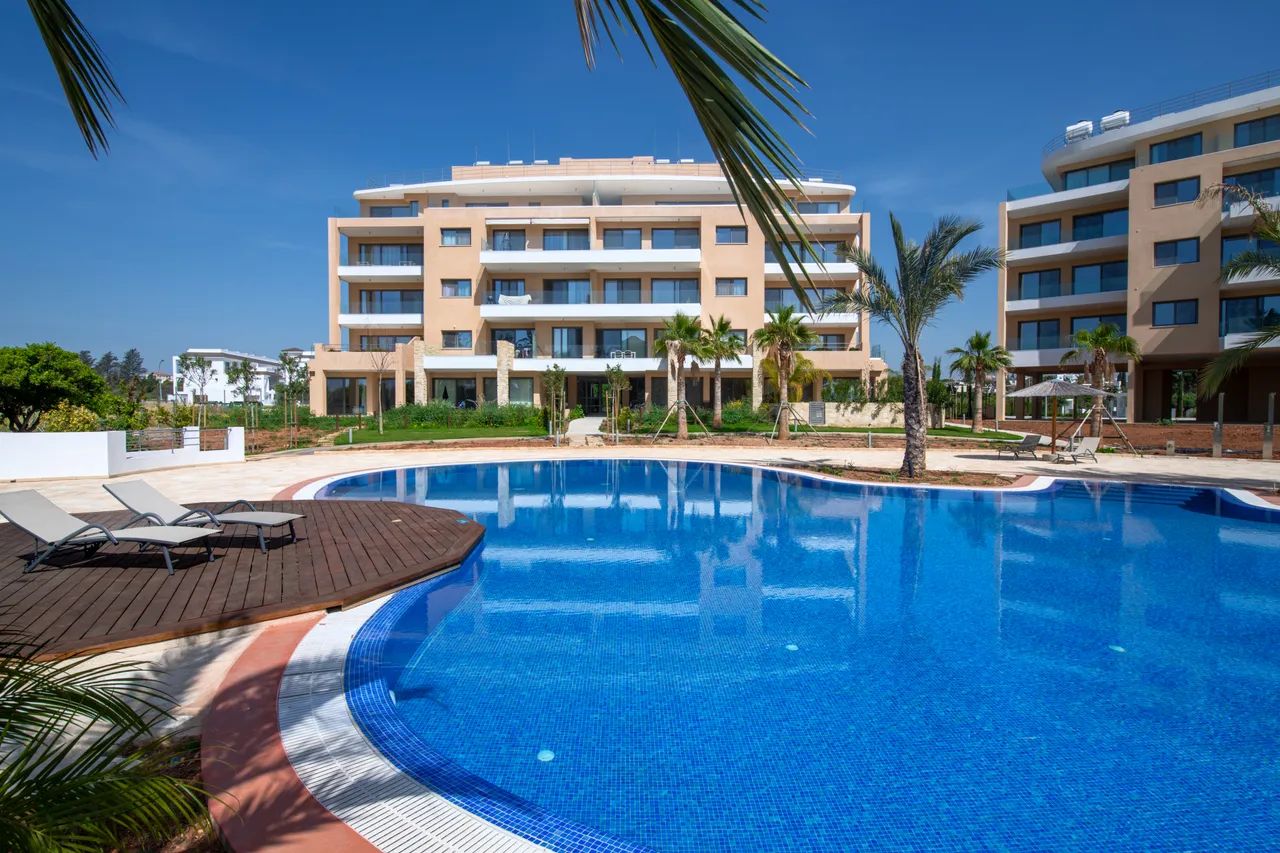 Apartment
Limassol Park
Limassol · Trachoni
 Apartment
Plus 75
Larnaca · Kiti
No. Section 2 of Cap. 109 excludes citizens of EU member states, citizens of EEA states and legal persons formed in a member state with a seat in the EEA from the definition of an alien, and section 3 forbids only an alien to acquire property without permission. A bill to tighten the rules for third-country nationals was still in committee on 22 October 2026.
About €371,965 as a new-build main residence at 5% VAT (VAT €17,500, legal fee €4,165, registry €300), €420,965 as a second home at 19% VAT, and €365,065 as a resale with a €10,600 transfer fee. Stamp duty is zero for contracts signed from 1 January 2026.
No conversion, because both countries use the euro. In the assumed schedule there are six transfers to the developer (€91,875, three of €55,125, €91,875 and €18,375, totalling €367,500) and the lawyer's fee and registry charges are paid separately. Each transfer goes through the Verification of Payee check.
In the example, signed before a notary on Thursday 4 February 2027, stamped at the Department of Foreign Affairs counter on Friday 5 February (2 × €40 = €80) and delivered three working days later, the contract can be signed on Friday 12 February 2027, with the Land Registry deposit due by 12 August 2027. By post, the Department's average is 3 to 7 working days from receipt.
Normally no. Revenue says you normally pay no Irish Stamp Duty on an instrument transferring foreign land and buildings to you, and you must fully declare all the money used to buy it.
In the example, Cyprus charges 20% on €70,000 after the €30,000 exemption, which is €14,000. If Ireland only allows a deduction, which is the outcome Revenue's treaty table points to, Irish CGT at 31% on €84,730 (the gain less the €14,000 Cyprus tax and the €1,270 exemption) is €26,266.30 and the total is €40,266.30. If a credit applied, Irish CGT at 31% on €98,730 is €30,606.30, which falls to €16,606.30 after the credit, so €30,606.30 in total.
No. The 5% rate is for a buyer's main and permanent residence, with a ten-year use condition, and a second home pays 19%. On a €350,000 price that is €17,500 against €66,500.
The 2021 census counted 443: 149 in Paphos district, 92 in Limassol, 80 in Larnaca, 69 in Nicosia and 53 in the government-controlled part of Famagusta district.
Sources, all read on 18 November 2026. CyLaw consolidated text (Cyprus Bar Association): Acquisition of Immovable Property (Aliens) Law, Cap. 109, sections 2 and 3, in the Greek consolidated text. Revenue (revenue.ie), Foreign property section, all published 16 December 2025: overview, opening a foreign bank account, acquiring a foreign property, taxes paid on a foreign property, Capital Gains Tax when disposing of a foreign property, foreign CGT relief and losses on the disposal of foreign property; Revenue's page on how to calculate CGT (published 7 October 2026); Revenue's page on the Cyprus convention (published 21 December 2020) and the Convention between Cyprus and Ireland signed in London on 24 September 1968, Articles 2, 12 and 21. Cyprus Ministry of Finance (gov.cy/mof): list of double tax treaties. Central Bank of Ireland: explainer on sending a payment instantly and Verification of Payee. Competition and Consumer Protection Commission (ccpc.ie): instant payments. European Commission: single euro payments area page. Department of Foreign Affairs (ireland.ie): authentication and Apostille of Irish public documents for use abroad. Hague Conference on Private International Law: status table of the Apostille Convention, updated 30 June 2026. Statistical Service of Cyprus (CYSTAT-DB): Census of Population 2021, table 1891221E, queried through its public interface. Cyprus Mail, 22 October 2026. Our own database, read-only, on 18 November 2026, for the listings table. Our guides on the cost of buying, VAT, property law for foreign buyers, how many properties you can own, powers of attorney, mortgages, large transfers, Cyprus tax for individuals and moving from Ireland supplied the Cyprus rates and procedures used in the examples.
What conflicts or could not be confirmed. Two Revenue pages describe the Form 11 duty for a foreign bank account differently, and I did not resolve which applies to a Cyprus account. Article 2 of the 1968 convention does not name capital gains taxes, and Revenue's dates-of-effect table for Ireland's tax treaties shows no capital gains tax date for the Cyprus convention, so the deduction outcome is the working assumption and the credit outcome is shown for comparison. I found no Irish official page that sets a limit or a permission step for sending euros to a Cyprus account, no stated per-payment limit for instant transfers, no Irish bank fee schedule and no official notary fee. The Cyprus embassy in Dublin's consular page could not be read because the old address redirects, and I did not examine Irish main-residence relief for a home abroad. The two-hour time difference comes from time-zone reference pages. Article 80 of Regulation (EU) 2024/1624 was read in an extract of the EUR-Lex text, which I could not open directly. The cost figures use the legal-fee and registry planning figures of our cost guide, and the payment schedule, the dates, the 120 m² size, the €450,000 sale price and the three-working-day courier are assumptions. This guide is general information and not legal or tax advice; a licensed lawyer or tax adviser should confirm your own position. Cyprus VIP Estates assists investors in choosing new developments; legal and immigration advice comes from licensed professionals.