
Guides/Visa & residence guides
Moving to Cyprus from Ireland: Moving Money, Selling the Irish Home, Irish Tax on Leaving, the State Pension, Banks and a Worked Budget

An Irish citizen moves to Cyprus with no visa, and both countries use the euro, so money travels by an ordinary transfer that the bank must charge at the domestic price. The Irish home is the largest tax question: Revenue taxes a gain on a sale at 31% (the rate for disposals from 7 October 2026) after an exemption of €1,270 per person, and main-residence relief covers the whole gain when the home is sold within 12 months of leaving. In the worked example below, a couple who wait two years pay €2,467.60 of capital gains tax on a €231,000 gain, plus €3,852 of Local Property Tax and Vacant Homes Tax on the empty house, against nothing in tax if they had sold within the year. The Irish State Pension (€299.30 a week at the maximum rate, €309.30 from January 2027) can be paid into a Cyprus account and is taxed where you are resident, while Irish social assistance payments stop when you leave. The 2021 census counted 443 Irish citizens in Cyprus, 149 of them in Paphos district, and a first-year budget for a couple in Paphos with one car comes to €37,570 under the assumptions set out below. Registration, the yellow slip, EHIC and GESY are in our guide for Irish and EU citizens, and this guide covers what that one does not (sources read on 13 November 2026). Costs, euro payments and Revenue reporting for an Irish buyer are in our guide to buying property in Cyprus from Ireland.
Moving money from Ireland to Cyprus: what EU law says about euro transfers and cash
Ireland and Cyprus are both euro-area members, so a transfer between two euro accounts needs no currency conversion. EU law sets the rules in the table, and the Revenue and Department of Social Protection pages read for this guide describe no Irish permission or reporting step for sending your own money to a Cyprus account. The checks come from the banks, which identify the customer and the source of the funds; the documents are in our guide to opening a bank account in Cyprus.
| Question | What the rule says | Source |
|---|---|---|
| What does a euro transfer to Cyprus cost? | A payment service provider must charge the same for a cross-border euro payment as for the corresponding national payment of the same value | Regulation (EU) 2021/1230, Article 3(1) |
| Does the equal-charge rule cover currency conversion? | Article 3(4) excludes currency conversion charges from it; a transfer from a euro account to a euro account has no conversion | Regulation (EU) 2021/1230, Article 3(4) |
| Can a member state restrict capital or payments? | All restrictions on the movement of capital and on payments between member states are prohibited | Treaty on the Functioning of the EU, Article 63(1) and (2) |
| When must cash be declared? | A carrier of €10,000 or more declares it to the authorities of the member state through which the cash enters or leaves the Union | Regulation (EU) 2018/1672, Article 3(1) |
| Are there controls on cash moving inside the EU? | Member states may provide additional national controls on cash within the Union, within the Union's fundamental freedoms | Regulation (EU) 2018/1672, recital 9 |
Cash is the weak route. A flight from Dublin to Larnaca or Paphos stays inside the Union, so the declaration in the table applies at the Union's external border and recital 9 leaves national controls to national law. I found no Irish or Cypriot official page on such controls inside the Union, and a Cypriot bank asks for the source of cash it receives, so a transfer from your own Irish account leaves the clearest record. Keep the sale contract and the solicitor's closing statement of the Irish house with the bank file.
Selling the Irish home before moving to Cyprus: capital gains tax at 31% and main-residence relief
Revenue says that when you sell a house you may have to pay Capital Gains Tax (CGT) on the gain. The chargeable gain is the sale price less the purchase price and allowable expenses, which are money you spent that added value to the asset and the solicitor and auctioneer fees on buying and on selling. Each individual has a personal exemption of €1,270 a year, and a jointly owned house is taxed on each owner's share of the gain. Revenue's calculation page (published 7 October 2026) gives the rate as 31% for most gains and shows 33% for disposals from 6 December 2021 to 6 October 2026, so the worked examples on its older pages, which still show 33%, describe sales before the change.
Principal Private Residence (PPR) relief is what usually removes the tax. Revenue says a house or apartment you own and occupy as your only or main residence is exempt from CGT if you lived in it as your main residence and used all of it as your home for the entire period of ownership. If you did not live in it throughout, the relief is restricted to the time you did, and Revenue's table of what counts is below.
| Situation | What Revenue says about the relief |
|---|---|
| Lived in the house as the only or main home for the whole time you owned it, using all of it as your home | Full exemption from CGT |
| The last 12 months of ownership | Counted as occupation, which allows for a move into a new home before the old one is sold |
| Your employer required you to live elsewhere | Counted as living in the property, up to a four-year maximum |
| You had a job all of whose duties were performed outside Ireland | Counted as living in the property |
| The house stayed empty while you were in a hospital, nursing home or convalescent home, or in a fee-paying retirement home | Counted as living in the property |
| Part of the house was used for business | Relief only for the part used as your home |
| Land above one acre around the house, or a price that includes development value | Land above one acre is outside the relief, and development value restricts it |
The list on Revenue's page does not name a move abroad in retirement, so for a couple who leave Ireland to live in Cyprus the extra period that counts is the last 12 months, and the worked example below uses only that. Even when no tax is due you must file a return. Revenue's payment page sets the dates: the return is due by 31 October of the year after the sale, and tax on a disposal made from 1 January to 30 November is due by 15 December of the same year, or by 31 January of the next year for a disposal in December. A written contract usually fixes the date of disposal at the contract date.
Two buyer-side rules apply. A CG50A clearance certificate is required when a house or apartment is sold for more than €1 million (and for other assets above €500,000), and without it the buyer must withhold 15% of the price. For a vendor who is non-resident in Ireland, Revenue's eBrief 090/26 of 18 May 2026 updated the clearance process for disposals of land and buildings: a clearance request must be submitted when the property had been rented during ownership, even if there is no chargeable gain, and where no request is needed the vendor gives the solicitor written confirmation that the property was not rented. The same eBrief states that a non-resident individual's CGT on such a disposal is due by the later of three months after the disposal or two months after the assessment issues (section 1042(1) of the Taxes Consolidation Act 1997), which differs from the general 15 December date, so ask the solicitor which applies to a sale made after you have left.
Cyprus does not tax the gain. Cyprus capital gains tax applies at 20% only to gains on Cyprus-situated immovable property and to shares in companies that own it, as our guide to Cyprus tax for individuals sets out. The 1968 convention agrees with that split for property: its Article 12(1) lets the state where immovable property is situated tax the gain from its sale.
Worked example: an Irish couple sell their home in Ireland two years after moving to Cyprus
The scenario is an assumption throughout. Two spouses own their Dublin home jointly and have lived in it since they bought it on 1 September 2007 for €280,000 including costs. They leave for Cyprus on 6 September 2027 (the date used in our guide for Irish and EU citizens) and the house is sold on 1 September 2029 for €520,000, with €9,000 of solicitor and auctioneer fees on the sale. They owned the house for 22 years and lived in it for 20, and the last 12 months of ownership count as occupation, so 21 of the 22 years are relieved. Prices are assumed not to change.
| Step | Calculation | Result |
|---|---|---|
| Chargeable gain | €520,000 − €280,000 − €9,000 | €231,000 |
| Relief for 21 of 22 years | €231,000 × 21 ÷ 22 | €220,500 exempt |
| Gain left in charge | €231,000 × 1 ÷ 22 | €10,500 |
| Each owner's share | €10,500 ÷ 2 | €5,250 |
| After each owner's exemption | €5,250 − €1,270 | €3,980 |
| CGT at 31% for each owner | €3,980 × 0.31 | €1,233.80 |
| CGT for the couple | 2 × €1,233.80 | €2,467.60 |
If the same couple had sold by 31 August 2028, within 12 months of leaving, all of the ownership period would count as occupation and the CGT would be €0, with a return still due. Revenue's page rounds the fraction to two decimals in its own examples, and the exact fraction is used here. Without any relief the same gain would produce 2 × (€115,500 − €1,270) × 0.31 = €70,822.60, which is why the date of sale deserves attention before the date of departure. Cyprus adds no tax on the sale, so €2,467.60 is the whole tax bill; the cost of waiting for the price to move is in the next section.
Keeping the Irish home while living in Cyprus: Local Property Tax, Vacant Homes Tax and Irish tax on rent
Two Irish taxes follow a house that stays in the family. Local Property Tax (LPT) has a liability date of 1 November each year: a residential property on that date is liable for LPT for the following year, and Revenue's example shows that an owner who sells in December still owes the full LPT for the next year. LPT clearance must be in place before a sale closes, and any unpaid LPT is a charge on the property. For 2026 to 2030 the charge follows the valuation band of the property on 1 November 2025: the basic charge is €235 for a value of €240,001 to €315,000, €333 for €315,001 to €420,000, €428 for €420,001 to €525,000 and €523 for €525,001 to €630,000.
Vacant Homes Tax (VHT) is the second. Revenue says it applies to a residential property that is in use as a dwelling for fewer than 30 days in a 12-month chargeable period running from 1 November to 31 October, and the return is due by 7 November after the period ends. The rate is a multiple of the basic LPT charge, before any local adjustment: 3 times for the period ending 31 October 2023, 5 times for 2024 and 7 times for the periods ending 31 October 2025, 2026 and 2027. VHT does not apply if the property is sold in the period, is subject to a qualifying tenancy registered with the Residential Tenancies Board between unconnected parties, or is exempt from LPT; Revenue also lists exemptions, for example for a property left unoccupied because of the owner's illness, which are claimed in the return.
The worked example continues. The couple's house falls in band 4 (€420,001 to €525,000), so the basic LPT is €428. It stands empty from 1 November 2027 to 31 October 2028, and VHT is 7 × €428 = €2,996, assuming the 7-times multiple continues, which Revenue has not published for periods after 31 October 2027. LPT for 2028 and 2029 is 2 × €428 = €856, because they are the liable persons on 1 November 2027 and 1 November 2028. The period from 1 November 2028 ends after the sale of 1 September 2029, so VHT does not apply to it. Holding costs are €2,996 + €856 = €3,852 before insurance and upkeep, and with the €2,467.60 of CGT the two years of waiting cost €6,319.60, against nothing for a sale inside the first 12 months.
Rent from an Irish property is taxed by Ireland regardless of where the owner lives, and Revenue's pages on non-resident landlords describe the mechanics. Since 1 July 2023 a tenant who pays rent directly to a non-resident landlord must deduct 20% and remit it through Revenue's Non-Resident Landlord Withholding Tax system, a collection agent may opt to use it, and the landlord files an annual return and claims the withheld amount as a credit. Revenue's non-resident page adds that an EU citizen receives full tax credits if at least 75% of worldwide income is taxable in Ireland and a proportion otherwise. Article 5 of the 1968 convention lets the state where immovable property is situated tax the income from it, including from its letting. Cyprus taxes its residents on worldwide income, and the text of Article 21 that I read gives only Ireland's credit for Cyprus tax; how Cyprus credits Irish tax is a matter of Cyprus law that I did not confirm on a Tax Department page, so see our Cyprus tax return guide and ask a licensed adviser before the first rent arrives.
Irish tax on leaving Ireland for Cyprus: what Revenue says about the year you go and the three years after
Revenue's Leaving Ireland section sets out what changes. The table lists its statements, all read on 13 November 2026.
| Item | What Revenue states | Page date |
|---|---|---|
| Employment income in the year you leave | Split-year treatment is available for the year of departure if you are resident that year and not resident the next; it applies to employment income only | 20 January 2026 |
| Tax refund after leaving | If you worked part of the year and went abroad, you may be due a refund, claimed in PAYE Services in myAccount or on Form P50 with a Form 12 or Form 11 and a statement that you will live abroad permanently or not be resident the following tax year | 25 November 2025 |
| Contact details and job | Update your address in myAccount or ROS; your employer ceases your employment with Revenue | 25 November 2025 |
| Private sector occupational pension | Taxed in the country where you are resident if you are non-resident in Ireland and resident in a country with a Double Taxation Agreement with Ireland; a PAYE Exclusion Order can stop Irish deduction | 25 November 2025 |
| Irish public sector pension | In general taxed in Ireland regardless of residence; check the Government Services article of the treaty | 25 November 2025 |
| Approved Retirement Fund and vested PRSA | Tax is charged at source regardless of residence; no PAYE exclusion orders are issued for them | 25 November 2025 |
| Irish State Pension | Taxed by the country you are resident in | 25 November 2025 |
| Ordinary residence | After three consecutive tax years of residence you are ordinarily resident from the fourth; if you leave you stay ordinarily resident for three consecutive tax years, taxable on worldwide income except foreign employment or trade performed wholly abroad and foreign investment income of €3,810 or less (above that the whole amount is taxable) | 24 November 2025 |
Residence itself follows days. Revenue says you are resident if you are present for 183 days or more in a tax year, or 280 days or more taking the current and preceding tax years together, and you are not resident if you are in Ireland for 30 days or less in a tax year; any part of a day counts, and the tests are set out in our guide for Irish and EU citizens. For a couple who leave on 6 September 2027, the days in Ireland in 2027 are 243 from January to August plus 6 in September, which is 249, so they are resident for 2027 and split-year treatment does not reach pension income. In 2028 the 280-day test is reached at 249 + 31 = 280, so 31 days in Ireland would make them resident again, and 30 days or fewer keeps them non-resident. The budget below allows two trips of ten days.
Revenue's ordinary-residence page says the status continues for three consecutive tax years after you leave, which for this couple I read as 2028, 2029 and 2030. Cypriot deposit interest above €3,810 a year would fall into the Irish charge in those years under that page, and the page does not mention the treaty. Article 20 of the 1968 convention says income not expressly mentioned in its articles, arising in one state to a resident of the other, is taxable only in the state of residence, and the text of Article 3 defines a resident of Cyprus as a person resident for Cyprus tax and not resident in Ireland for Irish tax. How an ordinarily resident person who lives in Cyprus uses those articles is not answered on a Revenue page that I read, so take it to Revenue or a licensed adviser. Article 22(1) gives residents of Cyprus the personal allowances, reliefs and reductions that an Irish citizen not resident in Ireland receives for Irish tax.
No exit tax on a house appears on the Revenue pages that I read. The one deemed disposal in Revenue's manual for people who leave (Part 02-03-02, reviewed December 2024, section 29A) covers holdings of shares of 5% or more or worth more than €500,000, for an Irish-domiciled individual who becomes taxable in Ireland again within five years of leaving; a house is outside its list of assets. Cyprus residence follows its own tests, set out in tax residency in Cyprus.
Irish State Pension and social welfare in Cyprus: what is paid abroad and what stops
The Irish State Pension (Contributory) is the payment most Irish retirees move with. The Department of Social Protection says it starts at 66, is not means-tested, needs between 520 and 2,080 reckonable contributions, and pays the maximum personal rate to someone with at least 2,080 full-rate contributions: €299.30 a week, with €199.40 for a qualified adult under 66 and €268.40 for one aged 66 or over. Budget 2027 adds €10 a week to the maximum rate from January 2027, which the Department's press release puts at €309.30. If you live or plan to live outside the State, the Department can pay the pension into an Irish account or into an account in the country you choose, and you apply about six months before you wish to start. Our guide for Irish and EU citizens covers S1 healthcare, combining contributions and the treaty.
Citizens Information (page edited 28 October 2026) lists which payments follow you and which do not.
| Payment | Paid while living outside Ireland? |
|---|---|
| State Pension (Contributory), Invalidity Pension, Disablement Benefit, Guardian's Payment (Contributory), Bereaved Partner's (Contributory) Pension, Bereaved Parent Grant | Yes, listed as payable outside the State |
| State Pension (Non-Contributory), Bereaved Partner's (Non-Contributory) Pension, Blind Pension | Only for an absence in exceptional circumstances for a limited period, reviewed on return |
| Supplementary Welfare Allowance, Guardian's Payment (Non-Contributory), Health and Safety Benefit | No, not paid outside the State |
| Rent Supplement | Not normally payable while you are outside the country |
| Child Benefit | Only for volunteer development workers, Defence Forces and Civil Service members serving abroad, and people temporarily working abroad for an Irish employer who pay Irish social insurance |
| Carer's Allowance, Disability Allowance, One-Parent Family Payment | Only in limited cases, for example medical treatment or a holiday of a few weeks |
The social assistance rule is the dividing line: Citizens Information says most social insurance payments can be paid outside the State, while to get a social assistance payment you must live in the State. For the payments that follow you, you must notify the Department when you move abroad for a long period or permanently, give your contact address abroad and your foreign bank details, and be ready to show that you still meet the conditions, for example that a Bereaved Partner's pension holder is not married, in a new civil partnership or cohabiting. The Department's page lists extras such as the Living Alone Increase, the means-tested Fuel Allowance and the Age 80 Allowance. The pages I read do not say which of those continue in Cyprus; Citizens Information says only that increases may continue where the qualified adult or child is the one abroad.
A person under 66 who wants to keep building a contributory pension record while abroad can ask the Department about voluntary contributions, which Citizens Information describes (page edited 13 February 2026). The conditions are at least 520 paid PRSI contributions under compulsory insurance, an application within 60 months of the end of the last year of compulsory insurance, and no cover by compulsory or voluntary insurance in another EU country; as I read the page, that excludes a person who pays Cypriot social insurance. A person whose last contributions were Class A, E or H pays 6.6% of reckonable income in the previous tax year with a minimum of €500; with an assumed €45,000 of income that is 6.6% × €45,000 = €2,970 a year. Class S pays a flat €650, and the low rate of 2.6% (minimum €250) does not cover the State Pension (Contributory). Contributions stop at 70, on claiming a State Pension, or on returning to PRSI. If you will claim an insurance-based benefit in Cyprus, you can request your Irish social insurance record on a U1 form from the Department's International Records Section before you leave.
Irish and Cypriot bank accounts for an Irish citizen in Cyprus: deposit guarantees, DIRT and interest
Open the Cyprus account early. The Payment Accounts Directive, Article 16(2), gives consumers legally resident in the Union the right to open a payment account with basic features at credit institutions in Cyprus, and the bank must open or refuse it at the latest 10 business days after a complete application; our bank account guide lists the banks and documents. Our rental guide adds that rent in Cyprus has had to be paid electronically since 1 July 2026, so a tenant needs an account or a transfer route before the first payment.
Irish accounts can stay in use for the State Pension, since the Department pays into an Irish account or one in your country of residence. I found no Irish bank page or Central Bank of Ireland rule on what happens to an account when the holder's address moves to Cyprus, and terms differ by bank, so ask yours before you give the new address. Revenue's DIRT page says a person who is not resident in Ireland for tax, and who lives in a country with which Ireland has a Double Taxation Agreement, can claim a refund of Deposit Interest Retention Tax on Form IC5, and that to avoid the deduction in the first place the person completes a declaration of non-residence, which the financial institution provides. Ireland has that agreement with Cyprus. Cyprus taxes the interest of a resident on worldwide income, and the rates for a domiciled and a non-domiciled resident are in our guide to Cyprus tax on dividends and interest.
Deposit guarantees matter when the proceeds of a house sale sit in one bank. The table sets out the two schemes.
| Scheme | Cover | Source |
|---|---|---|
| Ireland, Deposit Guarantee Scheme | Up to €100,000 per person per institution; deposits in a bank authorised in another EEA state are covered by that state's scheme | Central Bank of Ireland; depositguarantee.ie |
| Cyprus, Deposit Guarantee and Resolution Scheme | €100,000 per depositor per credit institution, including accrued interest, with each joint holder treated separately | Central Bank of Cyprus |
| Cyprus, temporary high balances | Additional cover of up to €300,000 for at most 12 months for deposits resulting from real estate transactions relating to private residential properties | Central Bank of Cyprus FAQ (October 2022 file) |
The Cypriot FAQ's own example has two holders of a joint deposit who prove that the source of funds is the sale of a private residential property and receive €100,000 + €150,000 each. It does not say whether the sale of a home in another country qualifies, and the Irish scheme's FAQ refers to temporary high balances without stating an amount on the page read, so ask the bank how a sale of an Irish house is treated before you deposit €520,000 in a single institution.
Where Irish citizens live in Cyprus: the 2021 census by district
The Statistical Service of Cyprus (CYSTAT) counted the population by country of citizenship in the census of 1 October 2021 (table 1891221E), the latest count by district that I found. It counted 443 Irish citizens, which places Ireland 14th among the 26 other EU nationalities counted, ahead of Spain and Austria and behind the Netherlands. Of the 443, 247 are women and 196 men. The table shows how they are spread.
| District | Irish citizens, 2021 | Share of all Irish citizens | Residents, 2021 | Irish citizens per 1,000 residents |
|---|---|---|---|---|
| Paphos | 149 | 33.6% | 101,106 | 1.47 |
| Limassol | 92 | 20.8% | 262,157 | 0.35 |
| Larnaca | 80 | 18.1% | 155,765 | 0.51 |
| Nicosia | 69 | 15.6% | 350,035 | 0.20 |
| Famagusta (government-controlled area) | 53 | 12.0% | 54,318 | 0.98 |
| Cyprus total | 443 | 100% | 923,381 | 0.48 |
Paphos holds a third of the Irish citizens while holding 10.9% of the island's residents, and its density of 1.47 per 1,000 is three times the island's 0.48. Famagusta district, which includes Ayia Napa and Protaras, has the fewest Irish citizens by number (53) and the second-highest density (0.98 per 1,000). The census cannot show where Irish households have moved since 2021, why they chose a district, or how many hold a second passport; it counts citizens, so Irish-born residents who hold another passport fall outside the figure. For comparison the same table lists 18,918 British citizens, 9,284 of them in Paphos district. Our guides to the best places to live in Cyprus for couples and to the cost of living by city compare the towns, and the homes for sale in Paphos are on our property page.
Schools in Cyprus for Irish children and the way back into Irish schools
Irish children are EU citizens, and any child who lives in Cyprus can enrol in a state primary school whatever the nationality or residence status of the parents, as our cost of living by city guide states. State schools are free and teach mainly in Greek, with integration support for children who do not speak it, and schooling is compulsory from pre-primary (4 years 4 months in 2026/27) to age 15, according to our guide to moving with school-age children. Fee-paying English-medium schools teach British, American or International Baccalaureate curricula; I did not find a school in Cyprus that teaches the Irish curriculum, and I did not open the Department of Education's own list of Irish schools abroad. The Ministry-based tuition for Year 5 or 6 in 2026/27 runs from €6,751 to €9,900 across the four English-medium schools in Paphos and from €6,242 to €10,200 in Limassol, and Numbeo's averages are €7,962 and €10,585 for international primary tuition. The schools in Paphos guide covers the four English-medium schools there.
A family that may return to Ireland should read the exemption from Irish. Citizens Information (page edited 29 April 2026) says a child educated outside Ireland for three or more consecutive years without the opportunity to learn Irish can get an exemption if the child is 12 or over on the day of enrolment or re-enrolment, or completed primary education in another country. The school principal decides within 21 working days, an appeal goes to the Irish Exemptions Appeal Committee within 30 days, and the exemption is not available in a Gaelscoil. It does not carry over to third level: some courses, such as primary teacher training in a state-funded institution, need a Leaving Certificate grade in Irish, and the CAO site lists exemptions.
Worked example: a first-year budget for an Irish couple moving to Paphos
The scenario is the couple from the sale example, now in Paphos, with every assumption stated. Both are 67 and receive the maximum State Pension (Contributory), at the €309.30 a week that Budget 2027 gives from January 2027 (assumed to be enacted as announced, and assumed to be 2,080 full-rate contributions each). They rent a one-bedroom flat in the centre of Paphos at €1,131 a month, the Numbeo average of 6 November 2026 in our cost of living by city guide, and run one car. Their monthly running cost in that guide is €2,342 for a couple with one car, which covers rent, groceries, utilities, mobile and broadband, eating out, a gym membership and the running costs of one car, and leaves out the price of the car, health insurance premiums and Irish property costs.
| Line | Basis | Amount |
|---|---|---|
| One-way flights, two adults | Assumption: €200 each. No timetable or fare page for the Dublin routes was read, and fares change daily | €400 |
| Shipping a two-bedroom household | Assumption: UK removal firms' published prices of £2,200 to £4,385 for about 20 m³ in our shipping guide are about €2,530 to €5,043 at an assumed £1 = €1.15; no Irish-origin price list was found | €4,000 |
| Registration, two MEU1 certificates | €20 each | €40 |
| Rent deposit, refundable | Two months at €1,131, the upper end of the usual one to two months | €2,262 |
| Agent commission | One month plus 19% VAT paid by the tenant: €1,131 × 1.19 | €1,346 |
| Electricity supply transfer | Deposit €200 for EU nationals who are not owners, plus €15 and 19% VAT (€17.85) | €218 |
| One-off costs | Sum of the six lines above | €8,266 |
| Twelve months of running costs | 12 × €2,342 | €28,104 |
| Two return trips to Ireland | Assumption: €300 per person per trip, ten days each, within the 30-day limit for 2028 | €1,200 |
| First-year total | €8,266 + €28,104 + €1,200 | €37,570 |
The pensions come to 2 × €309.30 × 52 = €32,167.20 a year. That covers the running costs with €4,063.20 to spare, and leaves a gap of €37,570 − €32,167.20 = €5,402.80 against the first-year total, which the sale proceeds fund. The deposit of €2,262 comes back at the end of the lease if the contract says so. On tax, Revenue says the State Pension is taxed by the country of residence, and each pension of €16,083.60 lies inside the 0% band of €22,000 in Cyprus, so the normal bands give €0 and the 5% election would cost 5% × (€16,083.60 − €5,000) = €554.18 for each partner, which makes the normal bands the cheaper choice (the rules are in our Cyprus tax guide above). The health contribution of 2.65% would be up to €852.43 on both pensions if no exemption applies, and the pages read do not confirm whether an Irish S1 removes it. The shipping rules for goods from an EU state are in our shipping guide, the lease terms are in our rental guide and the order of the other steps is in our moving to Cyprus checklist.
Moving to Cyprus from Ireland: questions Irish households ask
Apartments and houses for Irish buyers in Paphos, Limassol and Larnaca: eight projects
 Studio · Apartment
Eden Golf
Paphos · Geroskipou
 Apartment · Studio
Avalon Park
Paphos · Empa
 Apartment · Commercial
Bel Air Gardens
Paphos · Geroskipou
 Apartment · Penthouse
Coast View Residence
Paphos · Geroskipou
 Apartment · Penthouse
Bronte
Paphos · Kato Paphos
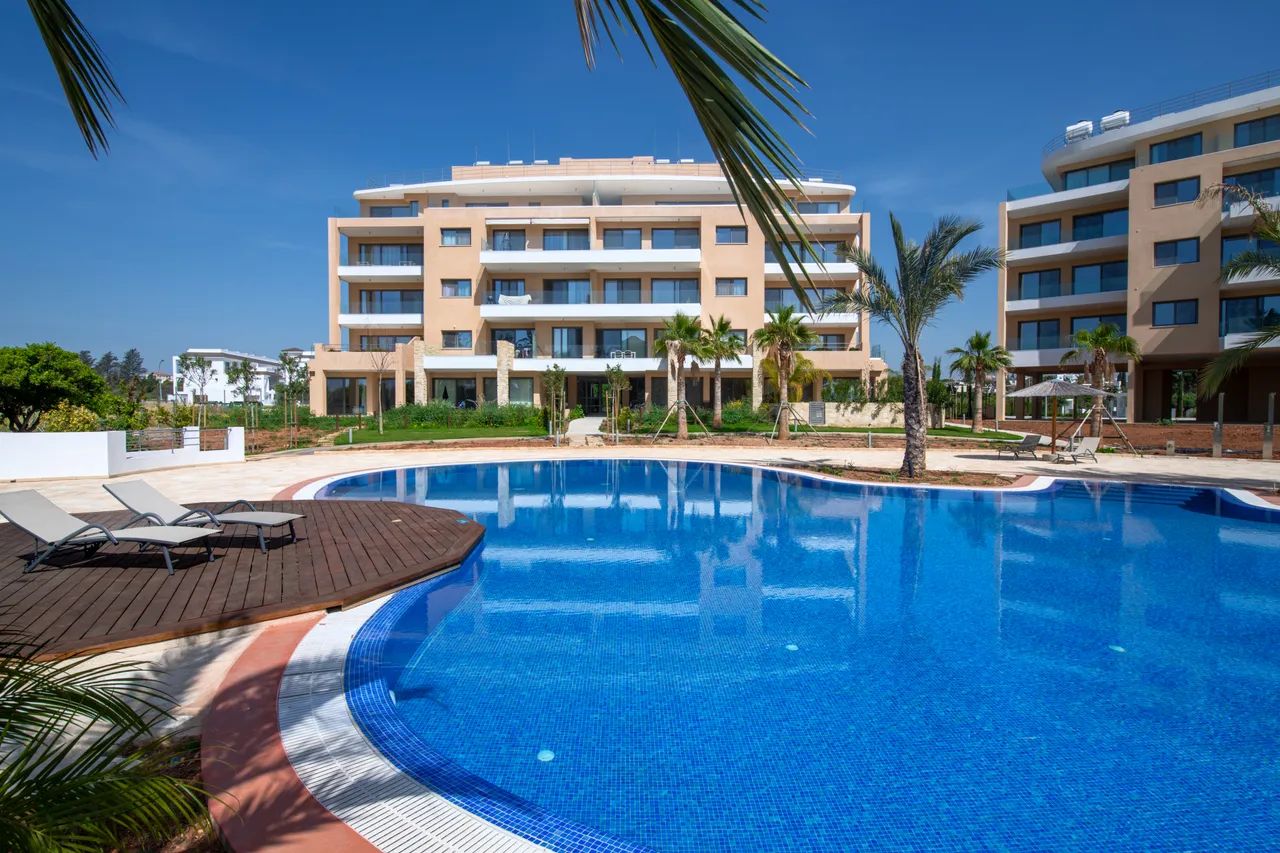 Apartment
Limassol Park
Limassol · Trachoni
 Apartment · Penthouse · Studio
Nest
Limassol · Germasogeia Village
 Apartment
Carisa Melora Park
Larnaca · Livadia
If you lived in it as your main residence for the whole time you owned it, the exemption is full, and the last 12 months of ownership count as occupation, so a sale within 12 months of leaving is exempt. A return is still due by 31 October of the following year. In the worked example a sale after two years costs €2,467.60 and a sale inside the first year costs €0.
Revenue gives 31% for most gains, after a personal exemption of €1,270 a year for each individual. The rate was 33% for disposals from 6 December 2021 to 6 October 2026.
30 days or fewer keeps you non-resident for 2028. With 249 days in Ireland in 2027, 31 days in 2028 reach the 280-day total and make you resident again for Irish tax.
Yes. The Department of Social Protection pays it into an Irish account or into an account in the country you choose. The maximum personal rate is €299.30 a week, rising by €10 to €309.30 from January 2027, and Revenue says the State Pension is taxed by the country you are resident in.
Citizens Information lists Supplementary Welfare Allowance and the non-contributory Guardian's Payment as not paid outside the State, Rent Supplement as not normally paid, and the non-contributory State Pension as payable abroad only for a limited absence in exceptional circumstances. The contributory State Pension, Invalidity Pension and Bereaved Partner's (Contributory) Pension continue.
For a house in LPT band 4 (€420,001 to €525,000), the basic LPT is €428 and Vacant Homes Tax is 7 times that, €2,996, for each 1 November to 31 October period in which the house is used as a dwelling for fewer than 30 days, a total of €3,424 before any local adjustment, insurance and upkeep.
The census of 1 October 2021 counted 443 Irish citizens, 149 of them in Paphos district, 92 in Limassol, 80 in Larnaca, 69 in Nicosia and 53 in the government-controlled part of Famagusta district.
Under the assumptions in the worked example, €37,570: €8,266 of one-off costs (of which €2,262 is a refundable deposit), €28,104 of running costs and €1,200 for two trips to Ireland. Two maximum State Pensions of €32,167.20 a year cover the running costs.
Sources, all read on 13 November 2026. Revenue (revenue.ie): Leaving Ireland (overview, if you are leaving Ireland, retired and moving abroad, split-year treatment in your year of departure, refund of tax, letting Irish property; pages dated 25 November 2025 and 20 January 2026); how to know if you are resident, ordinarily resident, and tax and tax credits for non-residents (24 November 2025 and 26 January 2026); Capital Gains Tax on the disposal of an asset (overview 28 October 2026, how to calculate 7 October 2026, when and how to pay and file 27 October 2026, CG50A clearance 25 November 2024); Principal Private Residence relief (21 January 2026); Selling a house (29 September 2025); eBrief 090/26 of 18 May 2026; Tax and Duty Manual Part 02-03-02 on temporary non-residents (reviewed December 2024); Local Property Tax liability (22 October 2026), selling a property (5 November 2026) and valuation bands for 2026 to 2030; Vacant Homes Tax overview, rates and exemptions (October 2026 and March 2026 pages); non-resident landlords (12 June 2026) and Non-Resident Landlord Withholding Tax (11 September 2024); DIRT for non-resident account holders (24 April 2026); the Convention between Cyprus and Ireland signed in London on 24 September 1968 as published by Revenue. Department of Social Protection (gov.ie): State Pension (Contributory), updated 5 November 2026, and the Budget 2027 publication and press release. Citizens Information: going abroad and social welfare payments (edited 28 October 2026), leaving Ireland and your social security entitlements (3 February 2026), voluntary social insurance contributions (13 February 2026), exemption from studying Irish (29 April 2026). EU law on EUR-Lex: Regulation (EU) 2021/1230 Article 3, Regulation (EU) 2018/1672 Article 3 and recital 9, Directive 2014/92/EU Articles 15 and 16, and Article 63 TFEU. Central Bank of Ireland and depositguarantee.ie: the Deposit Guarantee Scheme. Central Bank of Cyprus: the Deposit Guarantee and Resolution Scheme page and its FAQ file of October 2022. Statistical Service of Cyprus (CYSTAT-DB): Census 2021, table 1891221E, population enumerated by country of citizenship, sex and district, 1 October 2021. Our own guides on Cyprus tax for individuals, the cost of living by city, renting an apartment, shipping household goods, the bank account guide, moving with school-age children and Irish and EU citizens in Cyprus supplied the Cyprus rates, rents, tuition and fees used in the examples. Not confirmed on an official page: any airline fare or timetable for Dublin to Cyprus, a price list for shipping from Ireland, whether Irish CGT falls under Article 12 of the 1968 convention, how the convention applies to an ordinarily resident person living in Cyprus, how Cyprus credits Irish tax on Irish rent, which Irish allowances (Living Alone, Fuel, Household Benefits) are paid in Cyprus, whether an Irish S1 removes the Cyprus health contribution, whether the Cyprus temporary-high-balance cover applies to the sale of a home in another country, and any Irish bank's rules for account holders who move abroad. This guide is general information and not tax or legal advice; a licensed tax adviser or lawyer should confirm your own position. Cyprus VIP Estates assists investors in choosing new developments; legal and immigration advice comes from licensed professionals.