Guides/Buying guides
Buying Agricultural Land or a Farm in Cyprus as a Foreigner: Permits, What You Can Build, Water, Division Rules and Costs

EU and EEA citizens buy agricultural land in Cyprus without a permit. Citizens of other countries need the permission of the District Administration, which the Ministry of Interior describes only for a plot of up to 4,000 m² on which to build an own home, or for up to two units, and its page has no category for a farm. Owning a field gives no right to build on it: outside a village boundary a single house is possible if the parcel was registered by 1 December 1990 or arose from such a parcel, at a floor-area ratio of 0.10, which is 400 m² on 4,000 m² (240 m² at the 0.06 that applies in irrigation and consolidation areas). Agricultural land outside the VAT definition of building land carries no VAT, so the buyer pays the transfer fee on the 3%, 5% and 8% scale at half rate: €900 on €60,000 and €4,600 on €200,000. Borehole water needs an abstraction licence, and in 2026 the Water Development Department began collecting an abstraction fee with arrears back to 2017. A bill that would exclude buyers from outside the EU from agricultural and rural zones is still in committee (latest report 27 October 2026). The rules, the arithmetic and the checks follow, with sources read on 11 November 2026. The general land rules sit in buying land and building a villa in Cyprus; this guide covers what is specific to agricultural land and farms.
Can a foreigner buy agricultural land in Cyprus? Who needs a permit
The rule comes from the Acquisition of Immovable Property (Aliens) Law, Cap. 109. Section 3(1) prohibits the acquisition of immovable property by an alien, whether by purchase or on death, without the prior permission of the Council of Ministers. Section 3(3) gives a sale contract no effect for the alien until that permission exists, and section 3(5) makes any registration in breach void. The Ministry of Interior's page applies the permit to citizens of non-EU member states, including foreign companies and companies controlled by foreign nationals, and says that permission comes from the local District Administration on form COMM 145, with no fee, in 2 to 3 weeks. The Department of Lands and Surveys' sale page asks for a permit issued by the competent authority to which the Council of Ministers has delegated its power whenever the buyer is a foreign person, which joins the two descriptions: the law names the Council, and the District Administration exercises the delegated power.
| Buyer | Permit under Cap. 109 | What the sources say about land |
|---|---|---|
| Citizen of an EU member state | None. The Ministry's page applies the permit to non-EU citizens | Planning rules still decide what may be built on the parcel |
| Citizen of a non-EU country, alone or as a couple | District Administration permission on form COMM 145, no fee, 2 to 3 weeks | Listed purposes: a plot or undivided land of up to 4,000 m² to build an own dwelling, or up to two units. A farm or an investment holding is not among them |
| Company controlled by non-EU nationals | The same permission, with company certificates and information on activities and staff | Counts as foreign under the Ministry's wording |
| Lease or shares as the route to the land | Treated as an acquisition | Section 3(6): a lease that is or can become longer than 33 years, and shares that would make a Cypriot company foreign-controlled, count as acquisition |
The text of Cap. 109 does not mention agricultural land. Section 3(1A) adds a rule by area: when the acquisition exceeds the area absolutely necessary to build a dwelling or business premises, and in any case exceeds two donums (about 2,670 m²), the permission carries further conditions, restrictions and criteria set by regulations of the Council of Ministers approved by the House. Two figures conflict. The Ministry gives 4,000 m²; Cyprus Mail of 14 February 2024 quoted about 4,011 m² under Regulation 78/97. We use the Ministry's current figure and ask the District Administration to confirm the area in writing for each file.
For a buyer from outside the EU, a purchase to farm, with no home planned, is not among the purposes the Ministry lists, and above roughly 2,670 m² the permit carries extra conditions. We found no official page that states a rule for farmland bought as a farm, so the answer comes from the District Administration for the specific parcel, before any deposit. The permit documents include a survey, a copy of the title deed, the sale contract and proof of the applicant's financial standing.
Proposed ban on foreign purchases of agricultural land in Cyprus: where the bill stands
Several bills from DISY, AKEL and DIKO and a Ministry of Interior framework would change the rules for buyers from outside the EU. On 6 February 2026 Cyprus Mail reported that the Ministry had begun drafting a revised framework. On 27 February 2026 it reported the committee text: acquisitions in agricultural and rural zones would be prohibited, as would acquisitions near military camps, ports, airports and beaches, homes and shops would stay permitted up to a maximum area that was not stated, and the Ministry proposed a five-year holding period and five years of residence. The same report says the law would not be retroactive, so completed purchases and applications already filed with the Land Registry would remain unaffected.
On 22 October 2026 the committee was still examining amendments; consolidated drafts of April were interrupted by the May election, and the chairman hoped to finish by the end of the year. A Cyprus Mail editorial of 27 October 2026 says no comprehensive government bill has been submitted, and names the aims as protecting farmland and the countryside and stopping purchases in which Cypriot companies act as facilitators. Nothing has been passed. EU and EEA buyers fall outside the proposals as reported. The reports tie the protection to completed purchases and filed applications, so the date of filing at the Land Registry matters, and a non-EU buyer should ask the lawyer in writing which date applies on the day of signing.
What can be built on agricultural land in Cyprus: zones, parcel dates and floor area
Buying a field and building on it are two separate questions. The Town Planning and Housing Department's Policy Statement for the countryside and villages (approved text of June 2024) governs areas without a Local Plan; where a Local Plan or a published zone applies, its coefficients replace the Statement. The table sets out the cases that matter for a field. The step-by-step enquiry route through the IPPODAMOS portal is in our guide to buying land and building a villa, and a stone house inside a village is a different case, covered in village and stone houses in Cyprus.
| Situation of the parcel | What the Policy Statement allows | Paragraph |
|---|---|---|
| Inside a village development boundary | Floor-area ratio 0.90 and coverage 0.50 where building is sparse; 1.00 and 0.50 where dense | 9.4, village policy, rules 2(b) and 2(c) |
| Approved building plot outside the boundary | Ratio 0.60 and coverage 0.35 | 9.4, village policy, rule 3(a) |
| Field outside the boundary, no zone published, registered by 1 December 1990 (or arising from such a parcel), up to 4,000 m² | One dwelling, ratio 0.10, two floors, height 8.30 m. If the parcel had several co-owners before 1 December 1990, a second dwelling is possible with 1,500 m² and one house per co-owner | 9.4, isolated dwelling policy, rules 1(a)(i) and 2(e) |
| Same field above 4,000 m² | Up to four dwellings with at least 4,000 m² per dwelling; for 4,000 to 16,000 m² owned by co-owners from before 1 December 1990, up to four dwellings at 2,000 m² per co-owner | 9.4, isolated dwelling policy, rule 1(a)(ii) |
| Parcel divided from a larger parcel after 1 December 1990 | One dwelling per new parcel of at least 2,500 m², touching a public road or with a right of way of at most 100 m and at least 6 m wide; the original parcel had to touch a public road at least 4 m wide; at most ten dwellings per original parcel | 9.4, isolated dwelling policy, rule 1(d) |
| Field in a government irrigation area or a consolidation area | Ratio 0.06. A parcel created in consolidation after 1 December 1990 needs at least 4,000 m² for one dwelling; a parcel of 2,680 to 4,000 m² that had a building right before consolidation keeps it. No permit on parcels divided since 14 October 1994 in government irrigation areas | 9.4, isolated dwelling policy, rules 1(c), 2(e) and 3(a) |
| Coastal and nature protection areas, protected landscapes, industrial, craft and quarry zones | No permit for an isolated dwelling | 9.4, isolated dwelling policy, rule 3 |
The arithmetic is area times ratio. At 0.10, a parcel of 4,000 m² allows 400 m² of floor area counted in the ratio, and at 0.06 it allows 240 m². The text sets conditions on top of the parcel history: the dwelling must be of acceptable technical and aesthetic standard and fit the character of the area, and an adequate, continuous and suitable water supply is required (public water, with private supply named for second, third and fourth dwellings on one parcel). A field advertised as agricultural land may therefore be buildable or may not, and the listing does not show which.
One tension is worth knowing. Paragraph 6.3(a) of the same text says that building and other development not directly related to agriculture is generally not allowed on high-quality land, meaning land irrigated by a government project or consolidated for agriculture, unless it demonstrably contributes substantially to the economic and social upgrading of the wider area. Rule 2(e) of the isolated dwelling policy in paragraph 9.4 still gives a ratio of 0.06 for houses in the same areas. The authority applies both, so a preliminary enquiry answers the case before the purchase. We read the June 2024 text; the partial amendment of December 2024 is covered in our guide to buying land and building a villa.
Is there a farmer's house on farmland in Cyprus? Buildings the policy allows on a farm
The June 2024 text has no category called a farmer's house for crop farming. A person who farms crops on a field is in the same position as any other owner and uses the isolated-dwelling rule above. Livestock farming has its own rules. In a livestock zone the text allows one dwelling in addition to the livestock premises for a person whose main occupation is livestock farming, at up to 150 m² of counted floor area, two floors and 8.30 m, and up to 180 m² for a licensed pig unit with the consent of the Department of Agriculture. In a livestock area it allows a dwelling only for the farmer's emergency overnight stay, at up to 36 m².
Farm buildings have a wider allowance. Paragraph 6.3(b) permits development that relates directly to agricultural production and modernises farming if it is sited in a suitable location. In livestock zones, paragraph 9.5.11 lists water-collection tanks, pumping stations, feed silos, an agricultural store, a shed for machinery, a cold room for produce, a greenhouse, a beekeeping building and any other structure that helps farming after consultation with the Department of Agriculture. For the continuous water supply condition, paragraph 3.1(d) gives small agricultural stores as an example where the authority may waive it. Paragraph 6.3(d) rules out development likely to pollute groundwater or surface water. A shed or a store is therefore an application of its own, with its own permit, even on land where a house cannot be built.
Minimum plot sizes for farmland in Cyprus: the division rule and undivided shares
Cyprus controls the fragmentation of farmland through section 27 of the Immovable Property (Tenure, Registration and Valuation) Law, Cap. 224. The Department of Lands and Surveys states that agricultural land can be divided only if each new plot has at least the area below for its class.
| Class of land (Land Registry wording) | Minimum area of each new plot | Equal to |
|---|---|---|
| Plantations, vines, gardens, forests, land irrigated by a perennial or seasonal source, or capable of perennial irrigation | 1,338 m² | 1 donum |
| Land capable of irrigation by a seasonal source | 2,676 m² | 2 donums |
| Dry land | 6,689 m² | 5 donums |
A dry field of 6,000 m² therefore cannot be split in two, since each part would need 6,689 m²; an irrigated plantation of 6,000 m² can be split into two parts of 3,000 m². The Land Registry's fees for a division are €20 for the local enquiry, €10 for each new plot, €5 per title deed for each owner and €110 of cadastral field work per new plot (€35 with a licensed surveyor). Planning law adds a second test. Policy 9.3.3 allows the division of land into building plots only in listed areas: certain published zones, village development boundaries, industrial, craft and livestock zones, holiday-residence zones, existing approved plots, golf developments and tourist zones. Agricultural land is not in the list, so a field cannot be turned into building plots by splitting it.
Undivided shares are the second result of fragmentation. The Land Registry describes Cyprus farmland as small, split into many plots and usually held indivisibly by several owners, with dual or multiple ownership and plots that lack access. Where land is held in undivided shares and cannot be partitioned without breaching section 27, any co-owner can apply for a certificate that it cannot be partitioned (€10 plus €50 per property). A share sold to someone who is not a registered co-owner needs the written consent of the registered co-owners on form N254A that they do not wish to buy at that price; without it, the buyer must publish the planned sale in two official newspapers within 60 days. The transfer fee calculator takes the amount of the share: its own example enters €20,000 for a one-third share of a property worth €60,000. The existing guide to village and stone houses explains how co-owners' rights play out when heirs hold the land.
Land consolidation schemes on Cyprus farmland: 85 areas listed by district
Consolidation is the state's remedy for fragmentation. Under the Consolidation and Reallocation of Agricultural Land Laws 24/1969 to 70(I)/2018, the Land Registry's Land Consolidation Section regroups scattered holdings into viable parcels with access and irrigation. The Department's table of schemes, published in August 2026, lists 85 areas.
| District | Schemes | Irrigated | Dry | Mixed |
|---|---|---|---|---|
| Nicosia (Lefkosia) | 14 | 13 | 1 | 0 |
| Larnaca | 19 | 16 | 0 | 3 |
| Limassol (Lemesos) | 25 | 19 | 6 | 0 |
| Paphos (Pafos) | 27 | 24 | 1 | 2 |
| All districts | 85 | 72 | 8 | 5 |
Two schemes, Astromeritis and Choirokoitia, are marked as in progress. For a buyer, a parcel inside a scheme carries the 0.06 ratio and the 4,000 m² rule for parcels created after 1 December 1990 described above, and transfers inside a scheme use the Land Registry's consolidation forms (K.A. 28 for a transfer under section 29, K.A. 37 for a temporary title). Ask the lawyer whether the parcel lies in one of the listed areas.
Water on a farm in Cyprus: boreholes, abstraction licences and the water fee
Private boreholes supply most irrigation. An Audit Office report covered by Cyprus Mail on 18 September 2026 puts it at 76% of irrigation supply, with 46,353 abstraction points holding approved limits that total about 149.4 million m³ a year, about two thirds of them capped at 500 m³ or less, and 14 of 22 groundwater bodies in poor condition. The Audit Office also says the state cannot determine how much groundwater is actually pumped.
Drilling is regulated under the Integrated Water Management Law of 2010 as amended. The government's Business in Cyprus page on drilling rig operators states that drilling, widening, deepening or repairing a borehole must be carried out by a licensed drilling rig operator, who must give the Water Development Department three days' written notice and confirm before starting that the person commissioning the work holds a valid water abstraction licence. The landowner's licence therefore comes before the drilling. A well or borehole can also be registered against the title at the Land Registry, on the strength of the water permit and the certificate of approval for the well, so ask whether it is. A buyer who relies on a borehole needs the licence, its permitted quantity and the registration, and the seller can show all three.
The recent change is the water fee. In February 2026 Cyprus Mail reported that the Water Development Department is demanding a water abstraction fee of one cent per tonne, with arrears back to 2017 that farmers say were never enforced, and bills from a few thousand euro to more than €100,000, due in early April; MPs asked the government to suspend it. The table applies that rate to three assumed volumes, taking one m³ as one tonne and eight years of arrears (2017 to 2024).
| Assumed annual abstraction | Fee per year at €0.01 per tonne | Eight years of arrears |
|---|---|---|
| 500 m³ (the cap for about two thirds of abstraction points) | €5 | €40 |
| 10,000 m³ | €100 | €800 |
| 500,000 m³ | €5,000 | €40,000 |
A bill submitted by the Ministry of Agriculture on 6 April 2026 and reported by Politis on 6 September 2026 would let owners of illegal wells apply for a licence at twice the standard cost, would allow the Department to order a well sealed or permanently closed if the application is rejected, and would add a fixed penalty of up to €3,000 within 30 days of an offence, rising by 50% if unpaid after 15 days. If the offender cannot be identified, the penalty could fall on the landowner or manager. That last point matters to a buyer: an unlicensed borehole on the land can become the new owner's problem, which is a reason to obtain the licence documents before the deposit.
Title deeds, access and the Land Registry check on agricultural land in Cyprus
The title deed and the Land Registry record are the documents that show what is for sale; what a title deed is in Cyprus explains the document. Three Land Registry facts are specific to farmland. First, the registry's portal does not show who owns a plot. A search certificate under section 51A of Cap. 224 is issued on application by the owner or an agent with a power of attorney, so the seller's cooperation is needed to obtain it. Second, access is a registered right: a right of way is granted under section 11 of Cap. 224 with the written consent of the parties, on a plan signed by the grantor and the grantee, with form N251A signed by the owner of the burdened plot and the written consent of any mortgagee, and the fees are €10 for the application, €5 per title deed for each owner, €10 for the easement record per plot and, between non-relatives, a valuation-based fee on the 3%, 5% and 8% scale divided by two. Third, wells, boreholes and trees can be registered on the title, and the registry lists separate applications for each.
At transfer the seller supplies a tax clearance certificate (form N313) covering the taxes and levy the form lists, certificates of payment of municipal, sewerage and water supply fees or a certificate that the parcel is outside the water supply authority's limits, and the lender's consent if the land is mortgaged. The Land Registry records mortgages, court-judgment encumbrances and interim orders, and a search certificate shows them; a lawyer who is independent of the seller reads it, and our guide to choosing a property lawyer in Cyprus says what the fee should cover. The Department also publishes a notice titled Legal Consequences for Foreign Citizens Purchasing Greek Cypriot Owned Property in the Area of Cyprus Occupied by Turkey; every rule in this guide concerns the area the Republic of Cyprus controls.
Costs of buying agricultural land in Cyprus: VAT, transfer fee and other charges
VAT depends on the land. The supply of immovable property is exempt in principle, and the exception is non-developed building land supplied in the course of an economic activity, which paragraph 1(b)(iii) of the Eighth Schedule of the VAT Law (95(I)/2000) makes taxable. The 2017 Regulations (KDP 441/2017, in force from 2 January 2018) define that term. Regulation 3 lists plots under creation or construction, approved plots, parcels that resemble plots by location, zone or infrastructure and are registered under names such as building and yard, site or threshing floor inside a development area, and parcels outside a development area with a permit for a large development. Regulation 4 excludes parcels in a livestock zone and parcels in a zone outside a development area that is basically not intended for development, such as environmental protection, archaeological or agricultural zones. A field in an agricultural zone without a permit is therefore outside the definition and exempt, as our reading of the regulation. If the seller does charge VAT, no transfer fee applies, and the Tax Department's certificate proves it; Cyprus property VAT explained covers the building rates.
The transfer fee, paid by the buyer, is 3% on the price up to €85,000, 5% from €85,001 to €170,000 and 8% above that, with a 50% reduction in all cases the Land Registry lists. The Director can value the property if the declared price does not reflect the market value; the buyer pays on that value and can object, with the valuation made within three months of the transfer. The permit for a non-EU buyer has no fee. Stamp duty does not apply to contracts signed from 1 January 2026, and the Land Registry asks for stamp duty on a power of attorney only if it was signed before that date. The legal fee is the remaining cost; our planning figure is 1% plus 19% VAT, as in the cost of buying property in Cyprus.
| Declared price | Fee at full scale | Fee after the 50% reduction |
|---|---|---|
| €60,000 | €1,800 | €900 |
| €120,000 | €4,300 | €2,150 |
| €200,000 | €9,200 | €4,600 |
| €350,000 | €21,200 | €10,600 |
The €120,000 row in steps: 3% × €85,000 = €2,550 and 5% × €35,000 = €1,750, which is €4,300, and half of it is €2,150. The €350,000 row: €2,550 + 5% × €85,000 = €4,250 + 8% × €180,000 = €14,400, which is €21,200, and half is €10,600. Annual property tax to the state does not exist, as taxes on real estate in Cyprus sets out.
Worked example: 4,000 m² of farmland in Cyprus for €60,000, from purchase to resale
The inputs are assumptions. A buyer who is an EU citizen buys 4,000 m² of dry agricultural land from a private seller for €60,000, which is €15 per m². The parcel was registered in 1990, touches a public road, lies outside any village boundary, any published zone and any irrigation or consolidation area, and has a lawyer at 1% plus VAT.
| Item | Calculation | Result |
|---|---|---|
| Purchase price | 4,000 m² × €15 | €60,000 |
| VAT | Exempt, agricultural zone and no permit | €0 |
| Transfer fee | 3% × €60,000 = €1,800, halved | €900 |
| Legal fee | 1% × €60,000 = €600 + 19% VAT of €114 | €714 |
| Cash cost | €60,000 + €900 + €714 | €61,614 |
| Cost per m² of land | €61,614 ÷ 4,000 | €15.40 |
| Floor area allowed (ratio 0.10) | 0.10 × 4,000 m² | 400 m² |
| Floor area allowed at 0.06 | 0.06 × 4,000 m² | 240 m² |
| Land cost per m² of floor area | €61,614 ÷ 400, or ÷ 240 | €154, or €257 |
The result: €61,614 buys the right to apply for one house of up to 400 m² of counted floor area on two floors, if the planning authority confirms the parcel history, the access and the water supply, and 240 m² if a government irrigation scheme or consolidation applies. A non-EU buyer in the same case applies to the District Administration for the 4,000 m² own-dwelling permit before the transfer.
The resale shows what the farmer's exemption is worth. Under section 5(1) of the Capital Gains Tax Law 52/1980, as amended, no tax is due when the total gain of a natural person does not exceed €30,000, or €50,000 on the disposal of agricultural land by a person whose main occupation is farming; the tax rate is 20% (section 4). The example deducts the exemption from the gain, as our tax guides do; the statute's wording in section 5(1) is that no tax is due while the total gain stays within the amount, with gains of all years added together, so a tax adviser should confirm the method. Take the gain as the sale price less the €61,614 cost, before any inflation adjustment and selling costs, which would reduce it.
| Sale price | Gain | Tax for an investor (€30,000 exemption) | Tax for a farmer (€50,000 exemption) |
|---|---|---|---|
| €100,000 | €38,386 | 20% × €8,386 = €1,677 | €0 |
| €150,000 | €88,386 | 20% × €58,386 = €11,677 | 20% × €38,386 = €7,677 |
At a €150,000 sale the farmer pays €4,000 less, which is 20% of the extra €20,000 of exemption. Section 5(2) allows a person only one of the main-residence exemption (€150,000) and the section 5(1) exemption, whichever is greater. Our guides to Cyprus tax for individuals and the Cyprus tax reform describe the 2026 exemptions, and the commentary we read applies the €50,000 figure to disposals from 1 January 2026.
Farm subsidies and farmer status in Cyprus: what the official pages confirm
Farmer status matters twice, and the pages we read answer only one of the two. The Capital Gains Tax Law uses a test of main occupation, and a law-firm note we read warns that proof of professional farming activity is essential for the €50,000 exemption; we found no official page that defines the proof. The Cyprus Agricultural Payments Organisation lists an electronic application submission system (EAS) among its services. We found no official page that says whether a foreign owner of land can claim them, so a buyer who counts on subsidies in the price should ask the Organisation in writing and should treat any figure from a seller or a listing as unconfirmed.
Checks before paying a deposit on a farm in Cyprus
- Permit position. Establish whether the buyer is an EU or non-EU citizen, and for a non-EU buyer get the District Administration's answer in writing for this parcel, with the area against the 4,000 m² figure and the roughly 2,670 m² threshold of section 3(1A).
- Parcel history. Was the parcel registered on 1 December 1990, or did it arise by division after that date (2,500 m² minimum, access and a right of way of at most 100 m)? The planning right depends on the answer.
- Zone and class. Village boundary, published zone, government irrigation area or one of the 85 consolidation schemes, since the ratio is 0.10 or 0.06.
- Division and shares. If the plan is to split, check the section 27 minimum for the land class; if the title is a share, obtain the co-owners' consent on form N254A.
- Water. Ask for the abstraction licence, its permitted quantity, the registration of the well and the fee statements with any arrears, because arrears and penalties can follow the land.
- Access. The right of way should be registered on the title under section 11 of Cap. 224, with the plan and the owner's consent on file.
- Search certificate and tax clearance. Ask the seller to order the search certificate or to authorise the lawyer, and check mortgages, memos and the N313 clearance.
- VAT and price. Obtain the seller's VAT status in writing, and keep the declared price close to the market value, since the Director can revalue it.
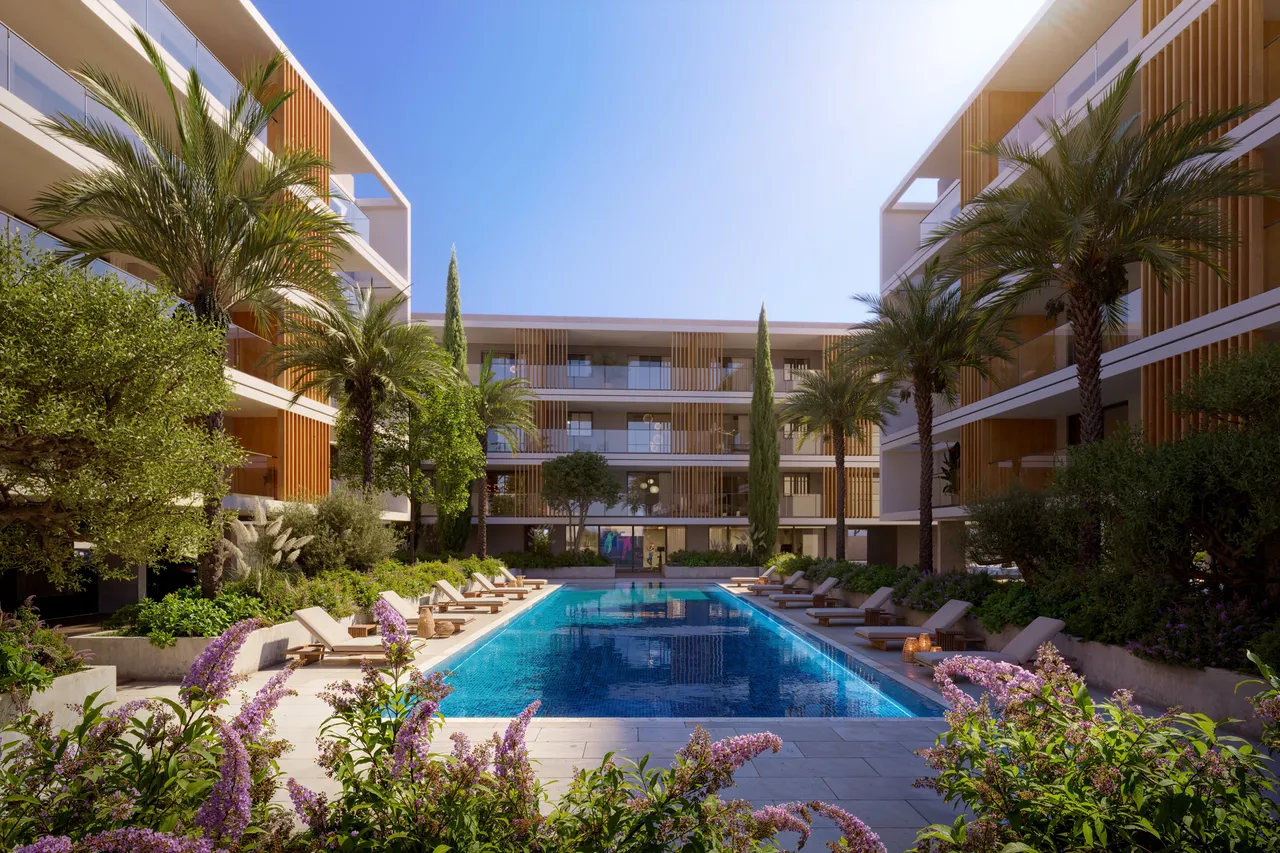
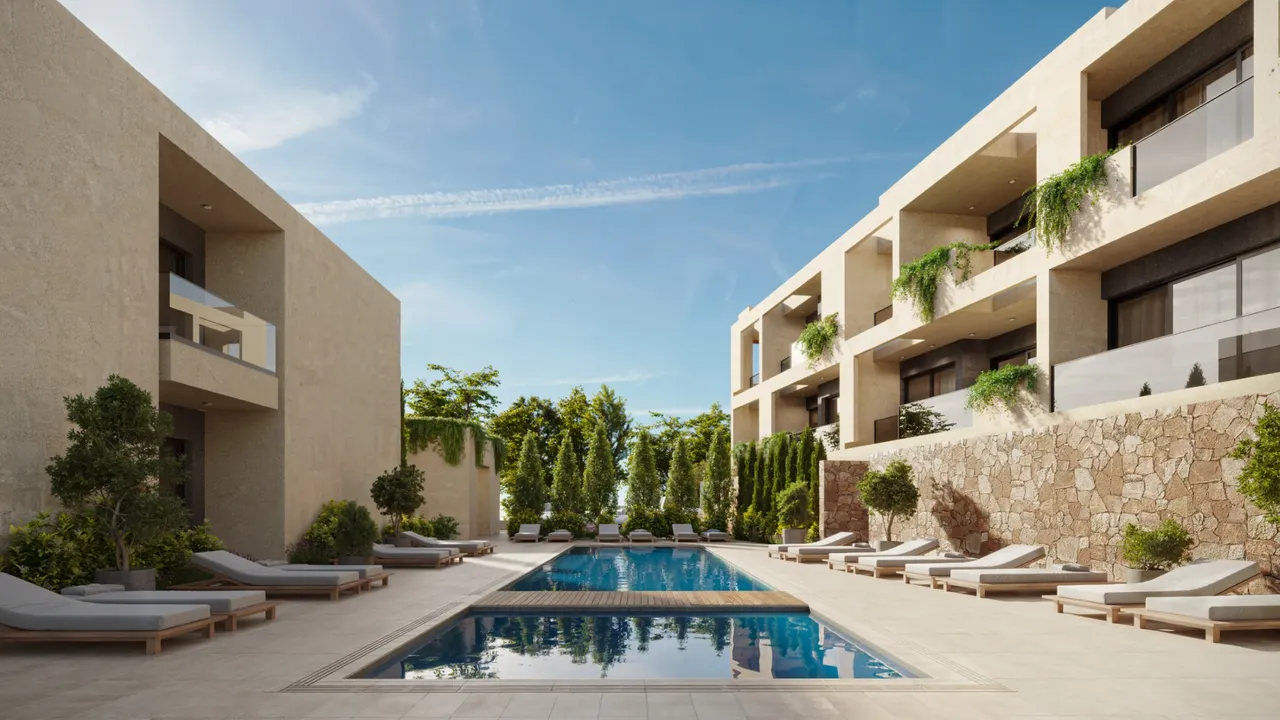
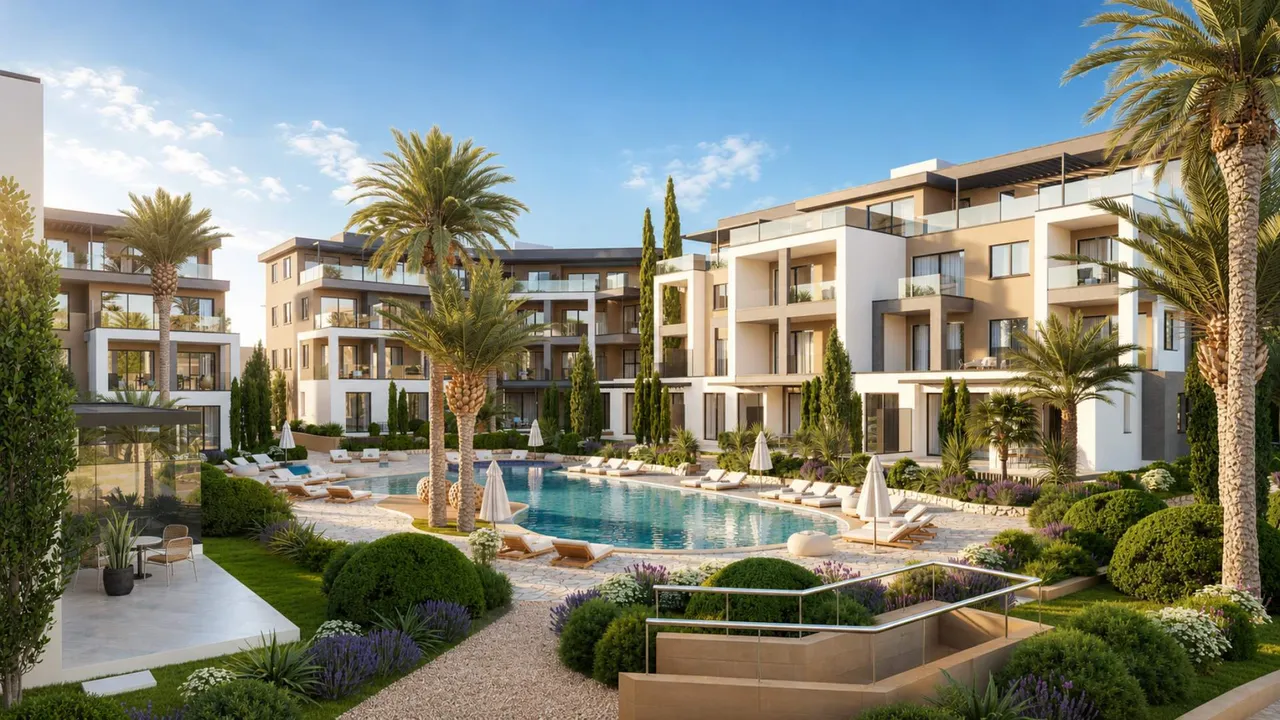
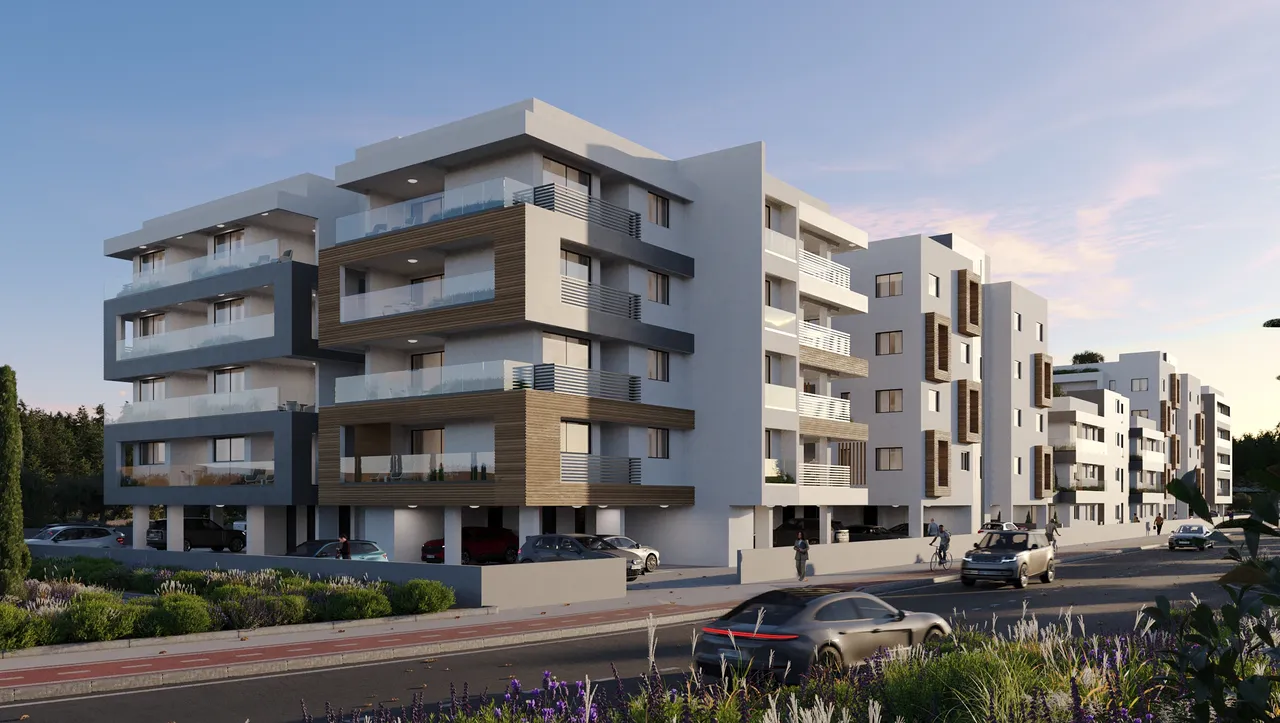
A finished home with a registered title, such as the ones in our guide to buying a holiday home in Cyprus, carries none of the planning, water or share risks above, and the projects below are examples of new homes with their own title.
Buying farmland in Cyprus: questions people ask
New homes with their own title in Paphos, Limassol and Larnaca: eight projects


The Ministry of Interior lists permission for a plot of up to 4,000 m² on which to build an own dwelling, or up to two units, and has no category for a farm. Above about 2,670 m² (two donums) section 3(1A) of Cap. 109 adds conditions set by regulation. The District Administration answers for the specific parcel.
At the ratio of 0.10, up to 400 m² of counted floor area on two floors and 8.30 m high; at 0.06 in an irrigation or consolidation area, 240 m². This needs a parcel registered by 1 December 1990, access and water.
€900 on €60,000 (3% = €1,800, halved) and €4,600 on €200,000 (€9,200 on the full scale, halved). The buyer pays it, and no fee applies if the seller charges VAT.
A field in an agricultural zone without a permit is outside the definition of non-developed building land in KDP 441/2017 and is exempt, which is our reading of the text. Regulation 3 lists the plots that count as building land, so ask the seller for the VAT position in writing.
A dry field cannot: each new plot needs 6,689 m². An irrigated plantation can, since the minimum is 1,338 m², and seasonally irrigable land needs 2,676 m² per plot. Planning law also forbids turning agricultural land into building plots.
A bill reported on 6 September 2026 would let the Water Development Department seal an illegal well that fails licensing, charge twice the licence cost to existing offenders and put a fixed penalty of up to €3,000 on the landowner if the offender is unknown. The abstraction fee since 2017 is one cent per tonne.
No. The law applies it to a person whose main occupation is farming; an investor has the €30,000 exemption. On a gain of €88,386 the tax is €11,677 for an investor and €7,677 for a farmer.
Cyprus Mail reported on 27 February 2026 that the law would not be retroactive, so completed purchases and applications filed with the Land Registry would remain unaffected. The bill had not passed when we read the latest reports on 27 October 2026.
Sources, all read on 11 November 2026. Ministry of Interior (gov.cy/moi): Purchasing Property. Acquisition of Immovable Property (Aliens) Law, Cap. 109, consolidated Greek text on CyLaw. Department of Lands and Surveys (portal.dls.moi.gov.cy): sale and exchange page (documents, fees, co-owner consent, tax clearance), transfer fee calculator, partition of agricultural and rural property (section 27 minimum areas and fees), certificate of undivided shares (section 28(1)), grant of right of way (section 11), registration of a well or borehole and of trees, search certificates (FAQ), Land Consolidation page and table of consolidation schemes (August 2026), Rights and Fees list. Town Planning and Housing Department: Policy Statement for the countryside and villages, approved text of June 2024 (chapters 3, 6, 9.3, 9.4, 9.5). VAT Regulations KDP 441/2017 (CyLaw, Greek) and Chambers and Partners note of 23 February 2018. Capital Gains Tax Law 52/1980, consolidated text on CyLaw, amendments to 242(I)/2025. Business in Cyprus (businessincyprus.gov.cy): drilling rig operator page. Cyprus Agricultural Payments Organisation: services page. Cyprus Mail: 14 February 2024, 3 February, 6 February, 27 February, 18 September, 22 October and 27 October 2026. Politis: 6 September 2026. Chambers and Co: capital gains tax exemptions 2026. The figures and the examples draw on our guides to land and building, village houses, the cost of buying, taxes and VAT. Not confirmed on an official page: the rule for non-EU buyers of farmland bought as a farm, the proof of main occupation in farming for the capital gains exemption, and foreign owners' eligibility for area subsidies. Conflicts: the Ministry gives 4,000 m² and Cyprus Mail of 2024 quotes about 4,011 m²; our earlier guides describe a combined lifetime limit of €150,000 for the capital gains exemptions, while section 5(2) of the law text allows only the greater of the two exemptions. This guide is general information and not legal or tax advice; a licensed lawyer or tax adviser should confirm your own position. Cyprus VIP Estates assists investors in choosing new developments; legal and immigration advice comes from licensed professionals.