Guides/Buying guides
Cyprus vs Montenegro for a Property Purchase: Prices, Taxes, Residency and EU Access

Cyprus is an EU member state in the euro area; Montenegro is an EU candidate that uses the euro without being in the euro area, and neither country is in the Schengen area. Montenegro is cheaper per square metre: the Statistical Office's average contract price for a new dwelling was €2,838 on the coast in the second quarter of 2026, against median asking prices of €4,218 to €5,564 in Cyprus's three large districts before VAT (two different series, so read the comparison with care). On a €250,000 resale, with the same 1% lawyer assumed in both countries, the taxes and fees come to €9,875 in Cyprus (3.95%) and €13,247 in Montenegro (5.3%). For a non-EU buyer the residence outcome differs most: Cyprus Category 6.2 gives permanent residence from a €300,000 new-build plus VAT, while Montenegro's property permit lasts one year, needs property valued at €150,000 or more since 17 January 2026 and does not count toward permanent residence. Montenegro's government aims to join the EU in 2028; no official EU accession date exists (sources read on 9 November 2026).
Cyprus vs Montenegro at a glance: prices, purchase taxes, residence and EU status
The table gives the main values; the section named after each row sets out the source and the arithmetic. Cyprus values come from our own guides (rates in force for 2026), Montenegro values from the primary sources listed at the end.
| Topic | Cyprus | Montenegro |
|---|---|---|
| EU status | Member state | Candidate (status granted December 2010); negotiations opened 29 June 2012; all 33 chapters opened, 23 provisionally closed after 6 November 2026 (Eunews) |
| Currency | Euro, member of the euro area | Euro since March 2002, outside the euro area; the central bank is not in the European System of Central Banks |
| Schengen area | Participates in the cooperation but internal border controls are not lifted; the government expects full membership in 2027 | Not a member: it is not among the four non-EU countries (Iceland, Liechtenstein, Norway, Switzerland) in the Commission's list of 29 Schengen countries |
| Foreign buyers | EU citizens buy as Cypriots; non-EU citizens need Council of Ministers permission, and the rules were under review in 2026 | Apartments and houses are open to foreigners; agricultural land, forests, land within 1 km of the border and islands, and other listed categories are closed to foreign persons |
| New-build price per m² | Median asking apartment price before VAT on 6 November 2026: Larnaca €4,218, Paphos €5,100, Limassol €5,564 | Average contract price, second quarter of 2026: country €2,557, Podgorica €2,510, coastal region €2,838 |
| Price change over a year | +7.9% on the official index, second quarter of 2026 | +16.2% on the Statistical Office's new-build average, second quarter of 2026 against 2025 (my calculation) |
| Tax on a new-build | VAT 19%, or 5% on the first 130 m² of a qualifying main home; no transfer fee | VAT 21% on the first sale of a new building; no transfer tax |
| Tax on a resale | Transfer fee 3%, 5% and 8% by price band, halved at present; no VAT: €6,600 on €250,000 | Transfer tax 3% up to €150,000, then €4,500 plus 5% to €500,000 and €22,000 plus 6% above: €9,500 on €250,000 |
| Notary and legal costs | Lawyer about 1% plus 19% VAT; €50 to lodge the contract; no stamp duty on contracts signed from 1 January 2026 | Notary tariff of 9 April 2026, paid by the buyer in practice: about €597 plus 21% VAT on €250,000; cadastre fees nominal |
| Annual property tax | No state tax since 2017; municipal charges of about €76 to €105 a year on a €300,000 valuation | Municipal tax of 0.25% to 1% of market value; 0.3% to 1.5% on a second home |
| Residence for a non-EU owner | Category 6.2: permanent residence from a new-build of €300,000 plus VAT and €50,000 income from abroad | Temporary residence for one year, renewable, from property valued at €150,000 or more since 17 January 2026 |
| Permanent residence | Granted with Category 6.2 | After 5 consecutive years of temporary residence; years on a property permit are excluded |
| Citizenship by residence | 7 of the last 10 years plus 12 continuous months, Greek B1 and an exam; investor route closed | 10 years of legal uninterrupted residence, release from other citizenship (2008 law), basic Montenegrin |
Buying property in Montenegro as a foreigner: what you can and cannot own
The Chambers Real Estate 2026 guide to Montenegro, written by the law firm Keker, Bujković & Pejović, states that foreign persons, natural or legal, cannot acquire certain categories of immovable property. The list is agricultural land, forests and forest land (with one exception: a foreign individual may acquire up to 5,000 m² of such land when the transfer includes a residential building on it), natural resources, assets in public use, cultural heritage of exceptional importance, property within one kilometre of the state border or on islands, and strategic national-security areas. The Multilaw real estate guide, prepared with the law firm Karanović & Partners in August 2025, says foreigners can own and occupy real estate without restrictions apart from land designated as forest or agricultural. An apartment or house outside those categories is therefore open to a foreign buyer.
Both guides add practical points. A sale and purchase agreement must be notarised, and the buyer usually pays the notary. Foreign investors often hold property through a Montenegrin company; Chambers notes that a limited liability company needs share capital of only €1. Multilaw adds that once Montenegro joins the EU, EU citizens will hold restricted property on the same conditions as Montenegrin citizens. Neither guide mentions a reciprocity condition, and I found no source that confirms one.
Cyprus is simpler for an EU buyer and slower for a non-EU buyer. EU citizens buy on the same terms as Cypriots. A non-EU citizen needs permission from the Council of Ministers, which the lawyer applies for after the contract is signed at no government fee; published guidance covers one house or apartment, or a plot of up to 4,014 m² to build a home. A bill in spring 2026 proposed caps on the area foreigners may acquire and a ban on agricultural and rural land, and we could not confirm its outcome. The steps are in how to buy property in Cyprus.
Montenegro property prices against Cyprus: price per m² and what €250,000 buys
The Montenegrin Statistical Office (MONSTAT) published its second-quarter 2026 release on 20 August 2026. It counts only dwellings in new residential buildings that were sold for the first time, takes the price from the signed sales contract and expresses it per m² of useful area. The table divides €250,000 by each figure to show the floor area it buys.
| Market | Price per m² | Source and date | Area for €250,000 |
|---|---|---|---|
| Montenegro, coastal region (Bar, Budva, Herceg Novi, Kotor, Tivat, Ulcinj) | €2,838 | MONSTAT, average contract price, Q2 2026 | 88 m² |
| Montenegro, Podgorica | €2,510 | MONSTAT, Q2 2026 | 100 m² |
| Montenegro, whole country | €2,557 | MONSTAT, Q2 2026 | 98 m² |
| Cyprus, Larnaca | €4,218 | Our catalogue, median asking price before VAT, 6 November 2026 | 59 m² |
| Cyprus, Paphos | €5,100 | Our catalogue, 6 November 2026 | 49 m² |
| Cyprus, Limassol | €5,564 | Our catalogue, 6 November 2026 | 45 m² |
At these figures a Cyprus apartment costs 1.5 times (Larnaca) to 2.0 times (Limassol) the Montenegrin coastal average per m². The series are not like for like. The Cyprus figures are asking prices before VAT per m² of interior area in 3,221 homes in 340 projects; the Montenegrin figure is a contract average. The MONSTAT release lists VAT among the cost elements but does not show whether the full 21% sits inside the €2,838, so confirm the VAT treatment of any quoted price. MONSTAT's regional average also moves with the share of subsidised solidarity housing, which was nil in the second quarter of 2026. I found no official MONSTAT figure for single towns such as Budva, Kotor or Tivat.
Both markets are rising. The MONSTAT country average climbed from €1,756 in the first quarter of 2024 to €2,557 in the second quarter of 2026, which is 45.6% in nine quarters, and was €2,201 a year earlier, so the year-on-year rise is 16.2%. Cyprus house prices were 7.9% higher in the second quarter of 2026 on the official index. Our Cyprus apartment prices by district show the medians behind the Cyprus figures.
Montenegro purchase costs: transfer tax, VAT and notary fees
A resale in Montenegro pays a real estate transfer tax. A first sale of a new building pays VAT at 21% and no transfer tax (Chambers, 2026). The tax has been progressive since 1 January 2024 under the law published in the Official Gazette no. 28/23: 3% on a value up to €150,000; €4,500 plus 5% of the value above €150,000 up to €500,000; and €22,000 plus 6% of the value above €500,000 (Chambers and Multilaw give the fixed amounts; KPMG and RSM give the rates). The statutory taxpayer is the buyer, and the base is the market value of the property, which can differ from the contract price.
| Price | Montenegro transfer tax on a resale | Share of price | Cyprus transfer fee on a resale, after the 50% reduction | Share of price |
|---|---|---|---|---|
| €100,000 | €3,000 | 3.0% | €1,650 | 1.65% |
| €150,000 | €4,500 | 3.0% | €2,900 | 1.9% |
| €250,000 | €9,500 | 3.8% | €6,600 | 2.6% |
| €300,000 | €12,000 | 4.0% | €8,600 | 2.9% |
| €500,000 | €22,000 | 4.4% | €16,600 | 3.3% |
| €750,000 | €37,000 | 4.9% | €26,600 | 3.5% |
The Cyprus fee is 3%, 5% and 8% on the bands up to €85,000, up to €170,000 and above, halved while the 50% reduction applies, as set out in our cost of buying property in Cyprus. A new-build in Cyprus carries VAT and no transfer fee, as in Montenegro; Cyprus property VAT explained covers the 5% and 19% rates.
Notary fees follow the tariff of the Notary Chamber of Montenegro adopted on 8 April 2026 and published in the Official Gazette on 9 April 2026, which replaced the 2012 tariff. For a sale contract drawn as a notarial deed the fee is €180 up to a value of €19,999.99, €250 to €39,999.99, €350 to €59,999.99, €420 to €79,999.99 and €480 to €119,999.99. Above that, the fee rises by €13 for every started €15,000, up to a maximum of €8,000. Chambers says the buyer typically bears the notary fees, and that registering the new owner in the cadastre costs a nominal fee. An agency FAQ says the notary's fees carry 21% VAT; I did not find that line in the tariff itself. I found no official source for estate-agent commission or lawyer fees in Montenegro and give none.
From 1 April 2026 the sale of construction land for which a building permit has been issued, alone or with the first sale of a new building, is a supply of goods subject to VAT, under the VAT law amendments published on 6 February 2026 (KPMG tax alert of 17 March 2026). Land without a building permit stays outside VAT.
Worked example: what a €250,000 purchase costs in Cyprus and in Montenegro
Assumptions: a cash buyer; €250,000 is the contract price, and on a new-build it is the price before VAT; a lawyer at 1% of the price in both countries (an assumption; I found no published scale), with 19% VAT in Cyprus and 21% in Montenegro; €300 of Cyprus Land Registry charges (the assumption used in our Cyprus guides); Montenegrin cadastre fees are described as nominal and left out.
| Line | Cyprus resale | Cyprus new-build, 5% VAT | Cyprus new-build, 19% VAT | Montenegro resale | Montenegro new-build, 21% VAT |
|---|---|---|---|---|---|
| Price | €250,000 | €250,000 | €250,000 | €250,000 | €250,000 |
| VAT on the price | €0 | €12,500 | €47,500 | €0 | €52,500 |
| Transfer fee or tax | €6,600 | €0 | €0 | €9,500 | €0 |
| Notary, with 21% VAT | none | none | none | €722 | €722 |
| Lawyer at 1% plus VAT | €2,975 | €2,975 | €2,975 | €3,025 | €3,025 |
| Registry charges | €300 | €300 | €300 | nominal | nominal |
| Extra on top of the price | €9,875 | €15,775 | €50,775 | €13,247 | €56,247 |
| Share of the price | 3.95% | 6.3% | 20.3% | 5.3% | 22.5% |
The arithmetic. Cyprus resale: 3% × €85,000 = €2,550, 5% × €85,000 = €4,250 and 8% × €80,000 = €6,400, which is €13,200 at the statutory rates and €6,600 after the 50% reduction; the lawyer is 1% × €250,000 = €2,500 plus 19% VAT of €475, which is €2,975; the total is €6,600 + €2,975 + €300 = €9,875. Montenegro resale: 3% × €150,000 = €4,500 and 5% × €100,000 = €5,000, which is €9,500; the notary fee is my reading of the tariff: the value is €130,000 above €119,999.99, which is 9 started blocks of €15,000, so €480 + 9 × €13 = €597, and with 21% VAT €722.37; the lawyer is €2,500 plus 21% VAT of €525, which is €3,025; the total is €9,500 + €722.37 + €3,025 = €13,247.37.
The result: on a resale Montenegro costs €3,372 more than Cyprus on a €250,000 price, of which €2,900 is the higher transfer tax (€9,500 against €6,600). The difference is the 50% reduction on the Cyprus fee, which our Cyprus guides describe as currently in force. On a new-build, Montenegro's 21% VAT of €52,500 compares with €47,500 at 19% in Cyprus and €12,500 at 5%, a rate that needs a main home and the size and value limits in our VAT guide. If a Montenegrin developer's price already includes VAT, the VAT is inside the €250,000 and the extras fall to the notary and lawyer, €3,747; I could not confirm how developers there quote prices, so ask for the price with and without VAT in writing.
Property taxes after you buy and when you sell: Montenegro and Cyprus
Montenegro charges an annual municipal property tax on the owner registered on 1 January. Under the Law on Real Estate Tax the rate is 0.25% to 1.00% of market value (Article 9), and 0.3% to 1.5% for a secondary home, meaning a home that is not the taxpayer's residence or that a legal entity owns (Articles 10 and 11). The municipality sets the rate. The tax is paid in two equal instalments, on 30 June and 31 October, and the owner files a return within 30 days of acquiring the property. A home that is the owner's residence gets a 20% reduction, plus 10% per household member, up to 50% (Article 12). The amendment promulgated on 15 October 2025 deleted the separate 0.3% to 5% band for undeveloped building land and left the secondary-home band unchanged; PwC (reviewed 7 August 2026) and Chambers (2026) both give 0.25% to 1%. I read the consolidated text to 2022 plus the 2025 amendment, not the amendment of December 2022.
Worked example: a €250,000 apartment owned by a non-resident, so a second home. If the municipality's assessed value equals the price (an assumption), the tax is 0.3% × €250,000 = €750 at the lowest rate and 1.5% × €250,000 = €3,750 at the highest. The owner of an only home with registered residence pays 0.25% to 1%, which is €625 to €2,500 before the residence reductions. Cyprus has no state property tax since 2017; our tax guide for real estate puts the municipal charges at about €76 to €105 a year on a €300,000 valuation in the four municipalities we checked in October 2026, plus sewerage, refuse and communal charges.
| Tax | Cyprus | Montenegro |
|---|---|---|
| Gain on selling property | 20% of the gain after inflation indexation and lifetime exemptions of €30,000 (any property) or €150,000 (main home lived in for 5 years or more); plus a 0.4% levy on the sale price | 15% of the difference between sale and purchase price; exemptions include the taxpayer's only and main residence (PwC); non-residents face a 15% withholding (Chambers) |
| Income tax of a resident | 0% to €22,000, then 20%, 25%, 30% and 35% above €72,000; employee social insurance 8.8% and health contribution 2.65% | Salary: 0% up to €700, 9% to €1,000, 15% above (monthly, as I read PwC; its entrepreneur bands of €8,400 and €12,000 are the same figures times 12); a municipal surtax of 13%, or 15% in Podgorica and Cetinje |
| Dividends | No income tax; a domiciled resident pays 5% Special Defence Contribution on 2026 profits, a non-domiciled one pays none; health contribution 2.65% applies | 15% |
| Tax residence | More than 183 days, or the 60-day rule | A domicile or centre of interests in Montenegro, or 183 days in the tax year |
| Standard VAT rate | 19% | 21%; reduced rates 15% and 7% |
Worked example of a sale. Assume you bought for €250,000, sell for €300,000 after five years, the home is not your main residence, and costs and inflation indexation are ignored. Montenegro: 15% × €50,000 = €7,500. Cyprus: the €30,000 exemption leaves €20,000, 20% × €20,000 = €4,000, plus the 0.4% levy of €1,200 on the €300,000 price, a total of €5,200 before indexation and costs lower it. If it were your main home, Montenegro exempts a taxpayer's only and main residence and Cyprus's €150,000 exemption covers the €50,000 gain, leaving only the €1,200 levy. PwC lists the municipal surtax on personal income tax; I could not confirm whether it is added to the 15% on gains. Our guides cover Cyprus tax for individuals for the Cyprus side.
Residence permit for a property owner: Cyprus Category 6.2 and Montenegro temporary residence
| Topic | Cyprus | Montenegro |
|---|---|---|
| Who qualifies | A non-EU buyer of a new first-sale residential property of at least €300,000 plus VAT from a developer, with the money transferred from abroad and income from abroad of €50,000 a year (plus €15,000 for a spouse and €10,000 per child) | A foreigner who owns real estate in Montenegro; since 17 January 2026 the property must be worth at least €150,000, as set in the Tax Administration's transfer tax decision (BDK Advokati, 22 January 2026) |
| Status granted | Permanent residence, no expiry date, one entry every two years | Temporary residence for one year, renewable while the conditions are met (Government of Montenegro page) |
| EU citizens | Register with the yellow slip; no property requirement | Exempt from the value requirement, as are citizens of Iceland, Liechtenstein, Norway and Switzerland |
| Permits issued before the change | Not applicable | Permits issued before 17 January 2026 on the basis of property can be extended without showing the value |
| Work | Salaried work in Cyprus is not allowed on this permit | Not stated on the official page; I did not confirm the work rights |
The Government of Montenegro's page on temporary residence says a permit for exercising the right to dispose of real estate the foreigner owns is issued for one year on a property certificate from the cadastre; it states no value. The €150,000 comes from law-firm reports (BDK Advokati: amendments adopted on 31 December 2025, in force 17 January 2026, implementing regulations due within 12 months). A November 2025 Government announcement of the draft quoted in search results gave €200,000, and later reports give the lower figure, so check the gazette text with a Montenegrin lawyer before you rely on it. For the Cyprus conditions see our guide to Cyprus permanent residency under Category 6.2.
Permanent residence and citizenship: Cyprus vs Montenegro timelines
| Step | Cyprus | Montenegro |
|---|---|---|
| Permanent residence | Granted at once with Category 6.2 | Five consecutive years of lawful residence on temporary residence before applying; continuity allows absences of 10 months in total or 6 months at one time |
| Time that does not count | Not applicable | Years on temporary residence for secondary education or study, for owning real estate, and for seasonal or seconded work |
| Other conditions | Entry once every two years; clean record; health insurance | Valid travel document, no sentence above six months, means of subsistence, health insurance, accommodation |
| Citizenship by residence | 7 years of legal residence in the 10 years before a final 12 continuous months (about 8 years in practice), Greek at B1, a knowledge exam at 60% | 10 years of legal and uninterrupted stay, release from foreign citizenship, guaranteed residence and permanent income, active Montenegrin at a basic level (Article 8, 2008 law) |
| Citizenship for a buyer | No route through the purchase; the investor scheme closed on 1 November 2020 and the legal power was repealed in December 2025 | I found no source on whether property-permit years count toward the 10 years |
The practical reading: a Montenegro buyer who relies only on the property permit does not build up time toward permanent residence, because the Government page excludes those years from the five. The archived copy I read is dated 21 November 2025, before the January 2026 amendments. The citizenship text I read is the English translation of the 2008 law, which has been amended since, most recently in 2024; I did not read the amendments. Cyprus citizenship is set out in Cyprus citizenship after the investor programme closed.
Montenegro EU membership: where accession stands on 9 November 2026
The European Commission's country page says Montenegro is a candidate, that negotiations opened on 29 June 2012 and that all 33 screened chapters have been opened. Its summary line shows 16 chapters provisionally closed, which predates the latest closures in its own milestone list: chapter 32 in January 2026, chapter 21 in March, chapters 2 and 28 in June, chapters 8 and 29 in July, and a further round on 12 October and 6 November. Eunews counted 18 closed on 2 October 2026, then chapters 17, 18 and 19 on 12 October and chapters 1 and 12 on 6 November, which makes 23 of 33 closed. The Commission page gives no accession date.
The dates come from officials. Eunews reports that the Montenegrin government aims to conclude the negotiations in 2026, sign the accession treaty in 2027 and join in 2028 as the 28th member state, and that Commission President Ursula von der Leyen repeated the 2028 goal in Podgorica. Enlargement Commissioner Marta Kos said Montenegro could meet all the criteria by the end of 2026 or early 2027, if reforms deliver. Montenegro's chief negotiator, Maida Gorčević, called closing all remaining chapters by the end of 2026 a realistic goal and said the timetable largely rests with the member states. So 2028 is the government's aim, not an agreed EU date.
For a buyer the sourced consequences are narrow. EU citizens already skip the €150,000 value rule for residence, and after accession EU citizens will hold currently restricted property on the same terms as Montenegrins (Multilaw, August 2025). I found no source on what accession changes for non-EU buyers, so none is claimed.
Schengen and the euro: what EU access means for a buyer in Cyprus or Montenegro
EU membership and Schengen membership are separate. The Commission's Schengen page says the area has 29 countries, 25 EU member states and Iceland, Liechtenstein, Norway and Switzerland, and that Cyprus participates in the cooperation while the Council has not lifted internal border controls. Cyprus Mail reported in October 2026 that Cyprus's deputy migration minister expects full membership in 2027, a year later than planned; the Justice and Home Affairs Council left the matter off its early-October agenda, and doubts remain over how the entry-exit system would work at the crossings along the Green Line. A Cyprus Category 6.2 permit carries no Schengen travel rights, as our comparisons with Greece and Turkey also state.
Montenegro is not in the Schengen area. It uses the euro, but the Central Bank of Montenegro states that euro use as legal tender differs entirely from euro-area membership. The euro became the official means of payment in March 2002; until accession the central bank is not in the European System of Central Banks, cannot use the liquidity facilities of euro-area central banks and relies on a EUREP repo line of up to €250 million (available since 31 July 2020) and a €100 million repo line with the Bank for International Settlements. A buyer who pays in euros carries no exchange-rate difference in either country; the difference lies in the institutions behind the currency.
Montenegro property rules that changed in 2025 and 2026
- 17 January 2026: the amended Law on Foreigners sets a minimum property value of €150,000 for property-based temporary residence for non-EU buyers; earlier permits renew without it (BDK Advokati, 22 January 2026).
- 6 February 2026, with effect from 1 April 2026 for land: VAT law amendments in Official Gazette no. 12/26 bring construction land with a building permit into VAT (KPMG, 17 March 2026).
- 9 April 2026: a new notarial tariff replaces the 2012 tariff, with a €180 minimum and €13 per started €15,000 above €120,000.
- 15 October 2025: the property tax amendment, re-adopted by parliament on 13 October after the President returned it, deletes the 0.3% to 5% band for undeveloped building land.
- 1 January 2024: the progressive transfer tax of 3%, 5% and 6% replaces the earlier flat rate (Official Gazette no. 28/23).
Cyprus changed too: stamp duty was abolished for contracts signed from 1 January 2026, the capital gains exemptions rose to €30,000 and €150,000, and from 1 September 2026 the VAT test for a new home turns on first use. The details are in taxes on real estate in Cyprus.
Seven new-build projects in Cyprus with apartments from €160,000
 Apartment · Commercial
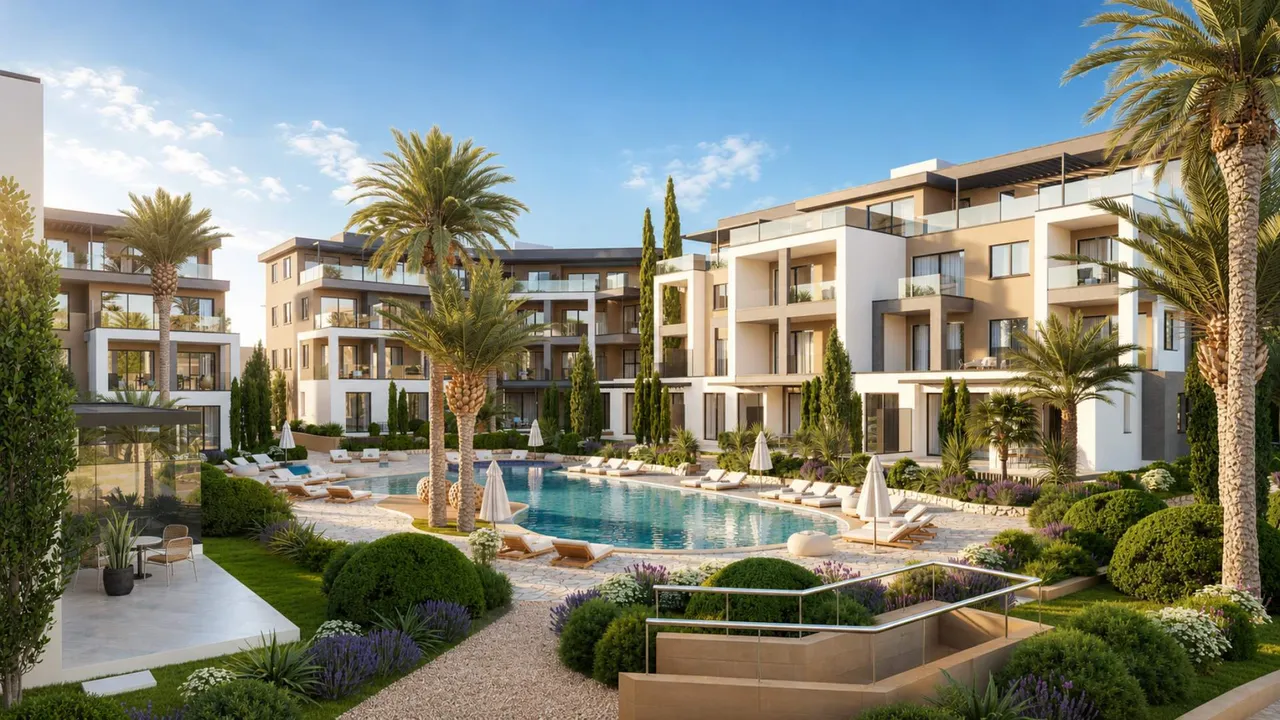
Bel Air Gardens
Paphos · Geroskipou
 Apartment · Studio
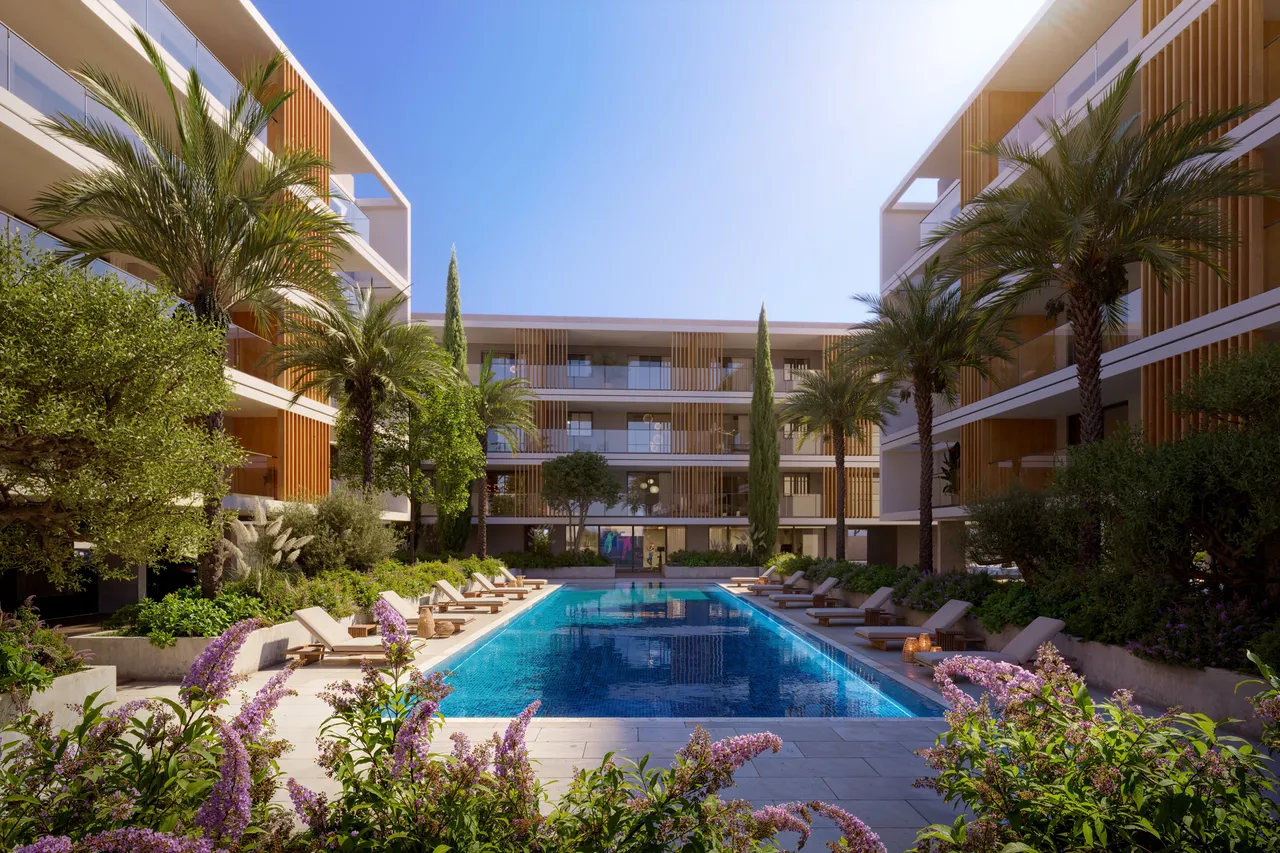
Eden Golf
Paphos · Geroskipou
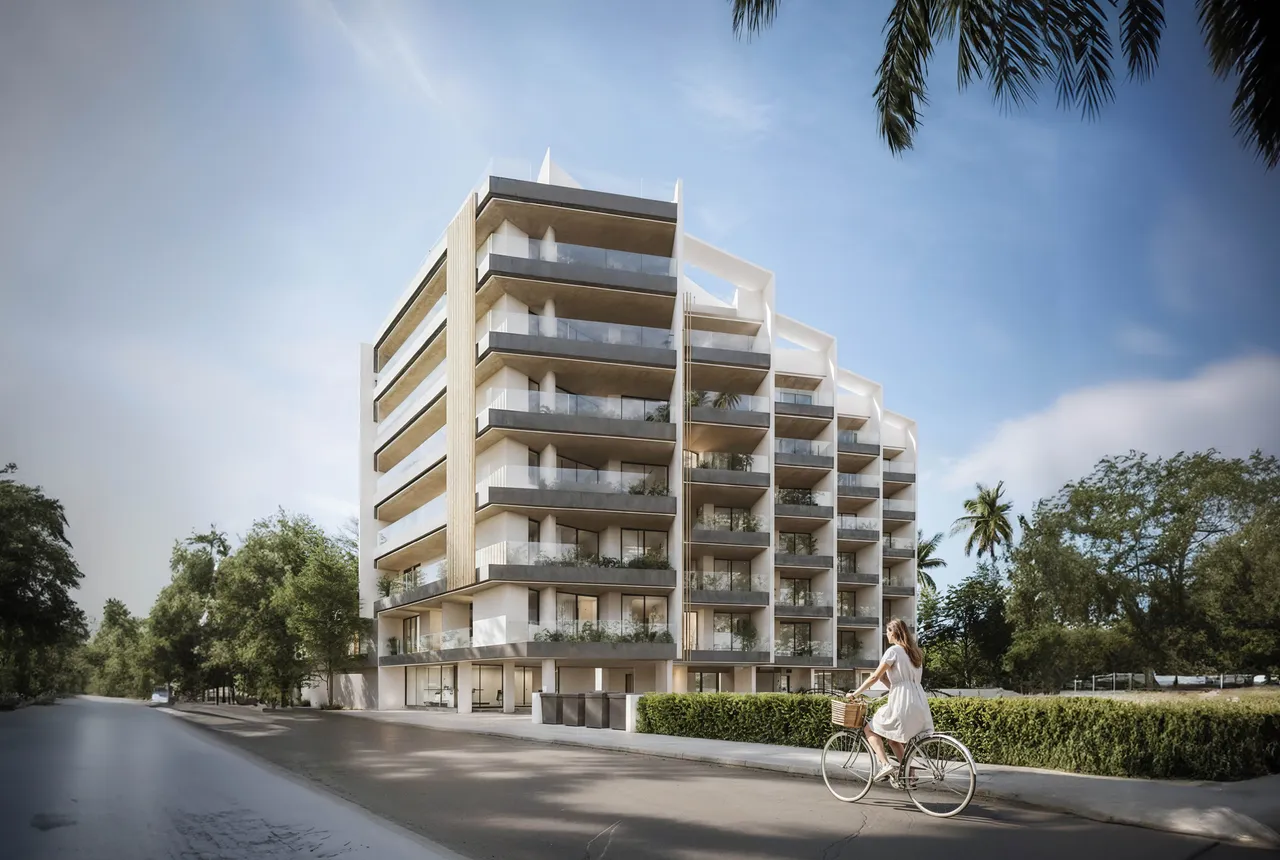 Studio · Apartment
Plus 82
Larnaca · Downtown
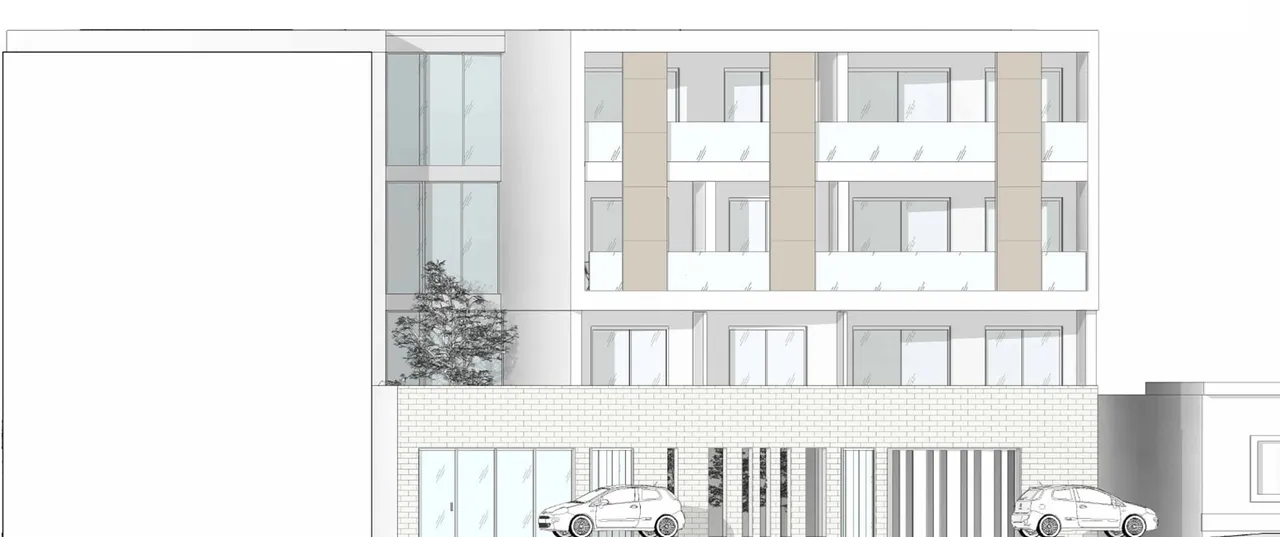 Apartment · Shop
Thalassa Residences 2
Limassol · City centre
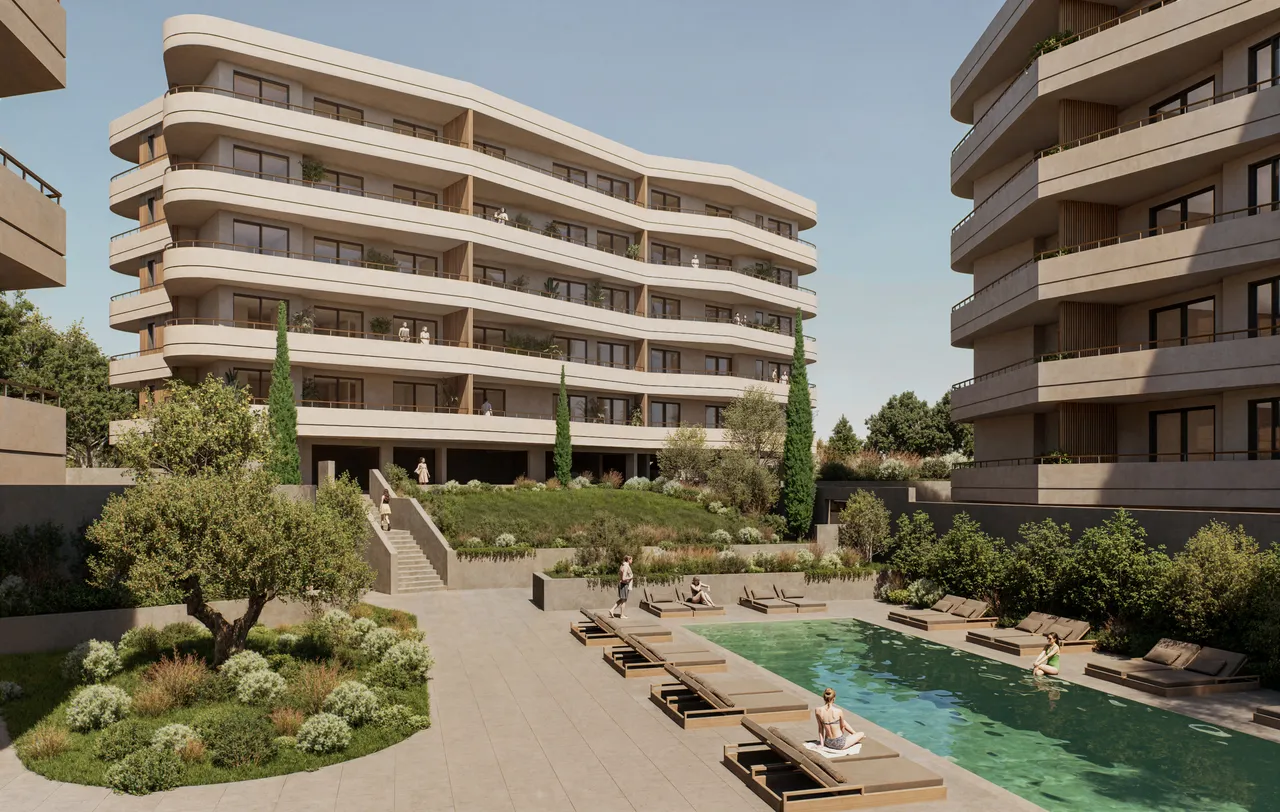 Studio · Apartment · Penthouse
Nest
Limassol · Germasogeia Village
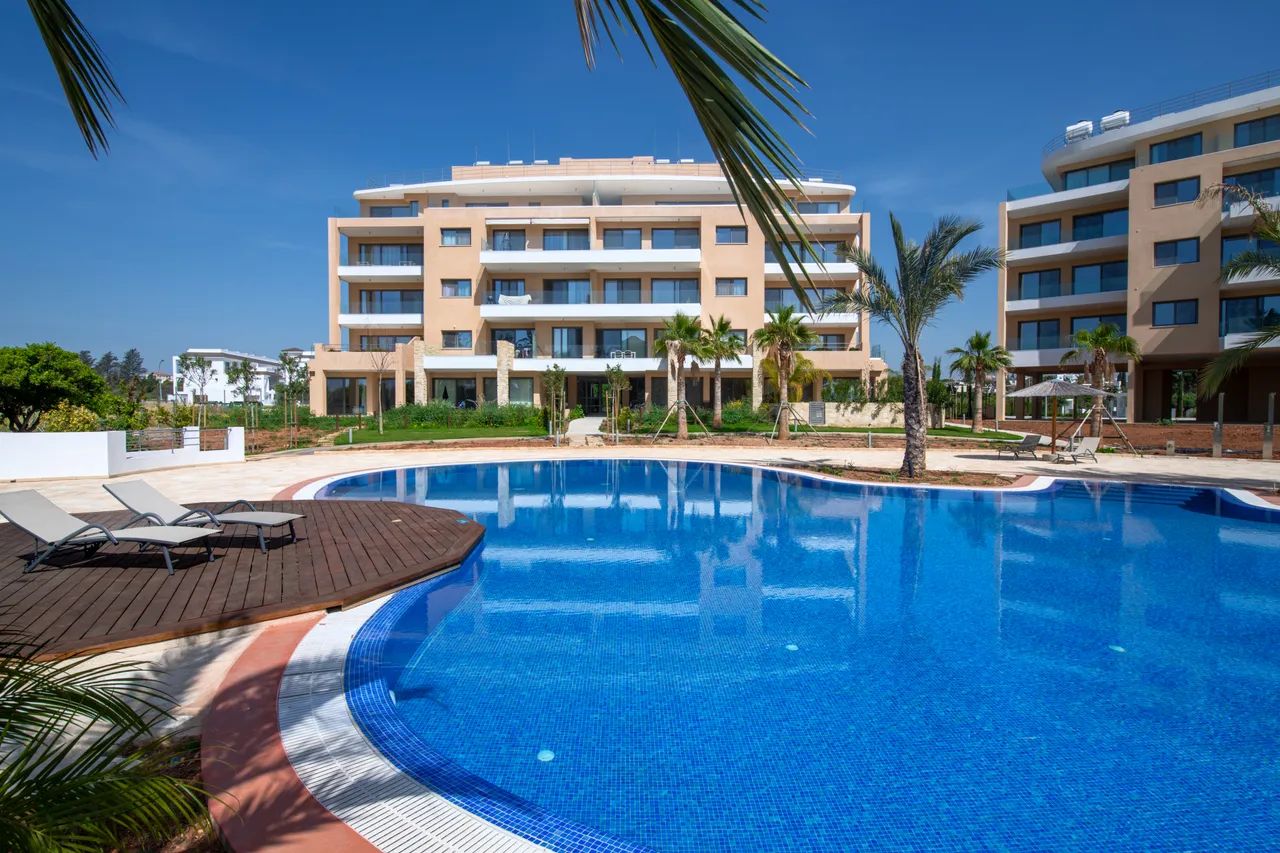 Apartment
Limassol Park
Limassol · Trachoni
 Apartment
Carisa Melora Park
Larnaca · Livadia
Who suits Cyprus and who suits Montenegro: a buyer-by-buyer comparison
| Buyer | Better fit | Reason from the figures above |
|---|---|---|
| Non-EU buyer who wants permanent residence through a property | Cyprus | Category 6.2 gives permanent residence from €300,000 plus VAT; Montenegro's property permit lasts one year and its years are excluded from the five for permanent residence |
| Buyer with €250,000 who wants the most floor area | Montenegro | About 88 m² at the coastal average against 45 to 59 m² at the Cyprus medians (different series) |
| Buyer who wants an EU member state in the euro area today | Cyprus | Cyprus is a member; Montenegro is a candidate whose government aims for 2028 |
| Buyer who needs Schengen travel today | Neither | Neither country is in the Schengen area; Cyprus expects full membership in 2027 |
| Buyer who wants low yearly holding costs | Cyprus | About €76 to €105 a year on a €300,000 valuation against an estimated €750 to €3,750 on €250,000 in Montenegro |
| Buyer with a main home and a gain on sale | Either | Both exempt a main home within limits; Cyprus caps the exemption at €150,000 |
| Buyer who wants citizenship by residence | Cyprus, on the time needed | About 8 years against 10 years plus release from the other citizenship; both need years of real residence |
| EU citizen buying an apartment or house | Either | EU citizens are exempt from the Montenegrin value rule; restricted land categories stay closed until accession |
If Cyprus fits, our properties in Cyprus page lists the projects with prices per m² set against the district medians.
What this Cyprus vs Montenegro comparison could not confirm
- The official text of the January 2026 Law on Foreigners. The €150,000 threshold rests on law-firm reports; the Government page I read states no value.
- The Government of Montenegro website refused connections from my environment. I read an archived copy of its permanent residence page dated 21 November 2025 and of its temporary residence page dated 28 October 2026.
- A reciprocity condition for foreign buyers: not mentioned in the two law-firm guides.
- Whether the municipal surtax applies to gains and dividends, inheritance and gift tax, estate-agent commission and lawyer fees: no official source found.
- Whether Montenegrin developers quote prices with or without VAT, and whether the MONSTAT figure includes the full 21%.
- My notary computation follows the wording of the April 2026 tariff; a notary gives the exact fee.
- Whether property-permit years count toward the 10 years for citizenship, and the content of the 2024 citizenship amendment.
- Official price levels for single Montenegrin towns.
- An accession date: the Commission names none, and its chapter count differs between its summary line and the press reports.
Cyprus vs Montenegro: questions about a €250,000 purchase
With a 1% lawyer in both countries, €9,875 in Cyprus (3.95%) and €13,247 in Montenegro (5.3%). The gap is the transfer tax: €9,500 in Montenegro against €6,600 in Cyprus after its 50% reduction.
A non-EU owner can apply for one-year temporary residence if the property is valued at €150,000 or more, a threshold in force since 17 January 2026 according to BDK Advokati. It renews while the conditions hold and its years are excluded from the five needed for permanent residence.
Not under Category 6.2, which needs a new first-sale home of at least €300,000 plus VAT and €50,000 of income from abroad. EU citizens need no permit.
Not agricultural land, forests, land within one kilometre of the border or on islands, and other listed categories; the exception is up to 5,000 m² of agricultural or forest land when a residential building is part of the transfer (Chambers, 2026). Since 1 April 2026 the sale of construction land with a building permit is subject to VAT.
The government aims for 2028, after closing all chapters in 2026 and signing the treaty in 2027. The Commission names no date, 23 of 33 chapters were closed by 6 November 2026 according to Eunews, and the timetable depends on the member states.
Not yet. The Commission says Cyprus takes part in the cooperation but internal border controls are not lifted, and the Cyprus government expects full membership in 2027.
€750 to €3,750 for a second home, if the assessed value equals the price (0.3% to 1.5%), against about €76 to €105 on a €300,000 valuation in Cyprus.
About 88 m² at Montenegro's coastal average of €2,838 per m², and 59 m² in Larnaca, 49 m² in Paphos or 45 m² in Limassol at the Cyprus medians of 6 November 2026.
Other comparisons: Cyprus vs Malta, Cyprus or Greece and Cyprus vs Turkey.
Sources, all read on 9 November 2026. Montenegro: MONSTAT, Prices of dwellings in new residential buildings, second quarter 2026 (release of 20 August 2026) and the first-quarter series; Chambers Real Estate 2026, Montenegro (Keker, Bujković & Pejović), sections on taxes, foreign investors and construction; Multilaw real estate guide, Montenegro (Karanović & Partners, August 2025); PwC Worldwide Tax Summaries, Montenegro, individual and corporate sections (reviewed 7 August 2026); KPMG Montenegro on the 2023 tax amendments (Official Gazette no. 28/23) and the VAT law amendments (tax alert of 17 March 2026); the Law on Real Estate Tax, consolidated text to 2022 (Pravni ekspert catalogue), and the amending law of 15 October 2025 (Official Gazette); the Notarial Tariff of 8 April 2026 (Official Gazette of 9 April 2026, Notary Chamber of Montenegro); BDK Advokati, 22 January 2026, on the Law on Foreigners; the Government of Montenegro pages on permanent residence (archived 21 November 2025) and temporary residence (archived 28 October 2026); the Montenegrin Citizenship Law of 2008, English translation; the Central Bank of Montenegro on euroisation; the European Commission enlargement page for Montenegro and its Schengen page (updated 27 May 2025); Eunews of 2 October and 6 November 2026; European Western Balkans, 3 November 2026; Cyprus Mail, 16 October 2026; an agency FAQ for the notary VAT line (ntrealty.me). Cyprus: our guides on taxes on real estate, the cost of buying property, property VAT, how to buy, tax for individuals, Category 6.2 and citizenship, and the Cyprus catalogue medians of 6 November 2026 on the property hub pages. This guide is general information and not tax advice; a licensed tax adviser should confirm your own position. Cyprus VIP Estates assists investors in choosing new developments; legal and immigration advice comes from licensed professionals.