

Anyone weighing a move to Cyprus eventually asks the same question: what does it actually cost to live here, month to month, once the holiday-brochure numbers are stripped away? This guide pulls together every figure we could source and verify — Numbeo's September 2026 Cyprus dataset, the Electricity Authority of Cyprus (EAC)'s published tariffs, live fuel-price trackers, private school fee schedules, insurer pricing, and Numbeo's own country-comparison engine run directly against the UK, Germany, Poland and Russia. Where a number could only be estimated, we say so; where it's a hard, sourced figure, we cite it. They won't match everyone's bill exactly — a household with two children and two cars will spend differently from a retired couple in a one-bedroom flat — but together they give the most complete, realistic picture available of what Nicosia, Limassol and Paphos actually cost, the three cities most relocating buyers compare.
Rent in Nicosia, Limassol and Paphos: how far a budget stretches
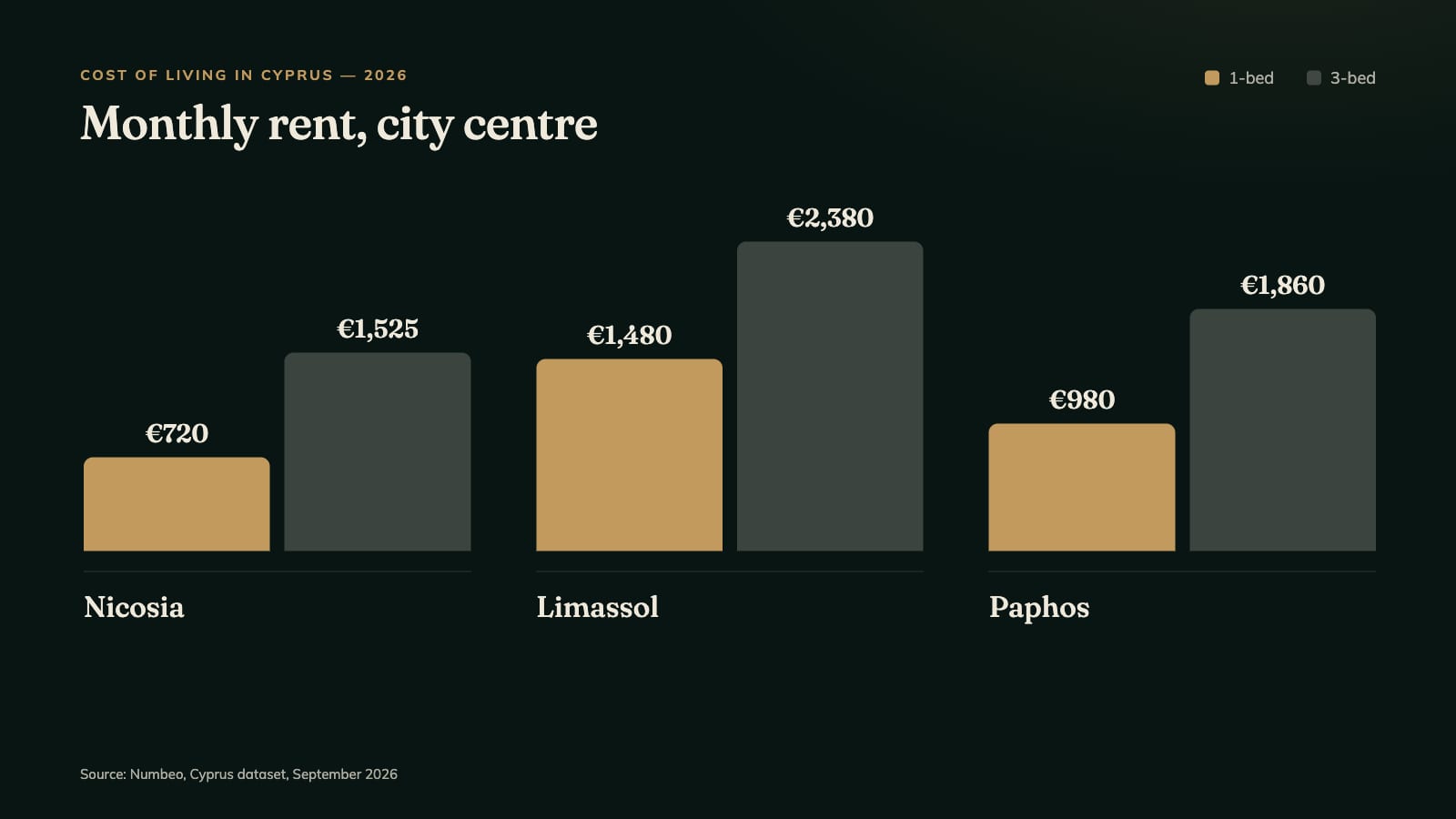
Rent is the single biggest driver of how far a budget stretches, and the gap between cities is wide. Based on current Numbeo data:
- Nicosia — a one-bedroom flat in the centre averages around €720/month (about €620 outside the centre); a three-bedroom in the centre averages around €1,525.
- Limassol — the most expensive of the three: a one-bedroom in the centre averages around €1,480/month (about €1,245 outside the centre); a three-bedroom in the centre averages around €2,380.
- Paphos — a one-bedroom in the centre averages around €980/month (about €875 outside the centre); a three-bedroom in the centre averages around €1,860.
Limassol's rent is roughly double Nicosia's for a comparable flat, with Paphos sitting in between. These are averages across whatever is currently listed in each city, so a specific street or building can sit well above or below them — but they're a fair starting point for budgeting, and they explain why so many relocation guides quote wildly different "typical rent" numbers depending on which city they're actually describing.
Groceries and everyday shopping
A single person typically spends somewhere in the €250–400/month range on groceries; a couple more like €400–700; a family of four commonly lands between €700 and €1,200, with Limassol running toward the higher end of every bracket and Nicosia toward the lower. Numbeo's September 2026 basket puts the everyday staples at: milk €1.64/L, a loaf of white bread €1.76, a dozen eggs €4.03, chicken fillets €7.88/kg, beef €11.94/kg, local cheese €11.81/kg, apples €2.85/kg, tomatoes €2.92/kg, and a bottle of mid-range wine around €7. Food prices have also been rising faster than overall inflation recently — food and non-alcoholic beverages were up over 6% year-on-year as of early 2026 — so it's worth budgeting toward the higher end of these ranges. Shopping around also makes a real difference: discount chains run noticeably cheaper than the premium supermarkets clustered in tourist areas.
Electricity: the one bill that surprises almost everyone
Cyprus electricity is genuinely expensive by European standards, and it's worth understanding why before the first bill arrives. EAC's standard domestic tariff (Tariff 01) charges a base energy rate of about 10.34 cents per kWh — households on the two-zone day/night tariff pay roughly 10.76 cents by day and 9.44 cents overnight, and a separate, lower tariff exists for registered vulnerable consumers (around 8.48 cents, 18–22% below standard). But that base energy charge is only about a third of what actually lands on the bill — network charges, a fuel-cost adjustment, public-service levies and VAT are stacked on top, bringing the real all-in rate to somewhere around 25–32 cents per kWh. That puts Cyprus well above both the EU and world average price per kWh. Air conditioning through the summer months is usually the biggest single driver of a high bill.
There is a genuine bright spot: Cyprus recorded the largest household electricity price drop of any EU country in the second half of 2025, down close to 15% year-on-year, so the trend is currently moving in the right direction even if the absolute level remains high. As a rough monthly range, basic utilities (electricity, water, heating/cooling and garbage) for an average 85m² flat run around €187 (typically €110–300 depending on the city, season and how heavily the AC runs), based on current Numbeo figures for Nicosia, Limassol and Paphos.
Getting around: fuel, public transport, and the true cost of owning a car
As of September 2026, unleaded petrol averages roughly €1.49–1.65 per litre and diesel around €1.90 per litre — both somewhat below the EU average, but still a real monthly cost if you're commuting by car, which most people outside central Nicosia end up doing given how limited the bus network is. A monthly public transport pass costs around €45; a single one-way ticket €2; a taxi starts around €7 plus roughly €2/km.
If a car is part of the household budget, the running costs go well beyond fuel. A new compact car (a Volkswagen Golf 1.5 or Toyota Corolla 1.6, for reference) runs close to €29,000, though most relocating buyers shop the used market instead. Car insurance in Cyprus typically costs €180–1,000+ a year — third-party-only cover starts around €180–300, with fully comprehensive policies running higher depending on the car, the driver's age and claims history, and postcode. Road tax (the annual "circulation licence") is calculated from engine size, fuel type, age and emissions, and ranges from as little as €10 a year for a small, efficient petrol car up to €1,500+ for a large-engine vehicle — older high-emission diesels registered after 2019 can face age-related surcharges of up to €2,000 on top, pushing the total past €3,000/year in the worst case. For a typical mid-size petrol car bought used, budgeting €300–600/year combined for insurance and road tax is realistic.
Mobile, internet and staying connected
Home broadband (60Mbps+) averages close to €29/month island-wide per Numbeo, and mobile plans (10GB+) average around €19/month. In practice, plans from operators like Epic run from around €10/month for a modest data allowance up to roughly €33/month for a generous unlimited-data tariff, with a basic prepaid SIM available for as little as €2. Connectivity is not where relocation budgets get stretched in Cyprus — it's a comparatively small, predictable line item.
Childcare and school fees
For families, this is one of the largest and least-discussed costs of relocating. Cyprus has required at least one year of pre-primary education since 2004, and private preschool averages around €416–439/month (roughly €340–600 depending on the school and city), typically with a one-time registration fee on top.
For older children, the choice is between the free Greek-language public system and a private or international school teaching in English (or another language). Fees vary a lot by school and city:
- Nicosia — one well-established English-medium school publishes 2026/27 tuition of roughly €4,130–6,110 for Junior School and €7,030–7,470 for Senior School, plus separate admission and registration charges.
- Limassol — has the widest choice of international schools. Year 3 tuition examples: Foley's around €9,300 plus a €1,800 refundable deposit; PASCAL Lemesos around €8,335 plus €750 registration and a €50 PTA fee; American Academy Limassol around €6,798 plus €500 application and registration.
- Paphos — has fewer international schools than Limassol, though the offer is expanding; its largest international school serves ages roughly 2.5–18 on the English National Curriculum through IGCSEs and A-Levels, with boarding available.
Across the island, published international-school tuition for 2026/27 spans roughly €4,130 at the low end to €18,550 at the top end depending on school and year group, before extras (uniforms, trips, exam fees, lunch). Some schools, including Highgate in Nicosia and TLC and Aspire in Paphos, don't publish fee schedules at all, so a direct enquiry is the only way to get a current number. Enrolment deposits of around €500 are typical across most schools.
Health insurance: GESY and private cover
Healthcare deserves its own line, and it's more nuanced than a single number. Legal residents can register with GESY, Cyprus's public healthcare system — funded through payroll contributions of 2.65% for employees and up to 4% for the self-employed, capped so the maximum annual contribution is around €7,200. GESY covers most routine and hospital care but has real gaps (dental beyond emergencies, for example), which is why most expats layer a private plan on top: basic private plans typically run €80–150/month, fuller premium plans €200–400/month, and international plans with worldwide coverage €300–600/month. Combined, most residents land somewhere around €150–300/month per person for a realistic hybrid of GESY plus private cover. For the full breakdown of how GESY works, who qualifies, and how to choose a private plan, see our complete guide to health insurance in Cyprus.
Eating out, coffee, and everyday leisure
A cappuccino averages around €3.43, and a meal for two at a mid-range restaurant averages around €60 (typically €40–100). At the casual end, a souvlaki pitta — a full meal on its own — typically costs €3.50–5, and a McDonald's-style combo meal runs about €8. A domestic draft beer at a bar is around €4, an imported one closer to €5; the same bottle from a supermarket shelf is roughly a third of that price. For leisure, a cinema ticket averages €10, a monthly gym membership €65.90 (typically €50–90), and an hour of tennis court hire €24.80. Eating out regularly is affordable relative to rent and utilities on a per-meal basis, but as a daily habit it becomes a meaningful monthly cost, easily €300–500 for a couple who eat out several times a week.
The full price list: everything in one place
For quick reference, here is the complete Numbeo snapshot for Cyprus as of September 2026 — the same dataset behind every figure above, in one table.
| Category | Item | Typical price |
|---|---|---|
| Restaurants | Mid-range meal for two | €60.00 (€40–100) |
| Restaurants | Cappuccino | €3.43 |
| Restaurants | McDonald's combo meal | €8.00 |
| Groceries | Milk (1L) | €1.64 |
| Groceries | Eggs (12) | €4.03 |
| Groceries | Chicken fillets (1kg) | €7.88 |
| Groceries | Local cheese (1kg) | €11.81 |
| Transport | Monthly public transport pass | €45.00 |
| Transport | Petrol (1L) | €1.49 |
| Utilities | Basic utilities, 85m² flat/month | €187.29 (€110–300) |
| Utilities | Mobile plan, 10GB+/month | €18.88 |
| Utilities | Broadband, 60Mbps+/month | €28.92 |
| Sports & Leisure | Fitness club, monthly | €65.90 |
| Sports & Leisure | Cinema ticket | €10.00 |
| Childcare | Private preschool, monthly | €439.20 |
| Childcare | International primary school, annual | €7,549.21 |
| Rent | 1-bed, city centre | €884.45 |
| Rent | 3-bed, city centre | €1,627.10 |
| Salaries | Average monthly net salary | €1,657.80 |
A realistic monthly budget by household
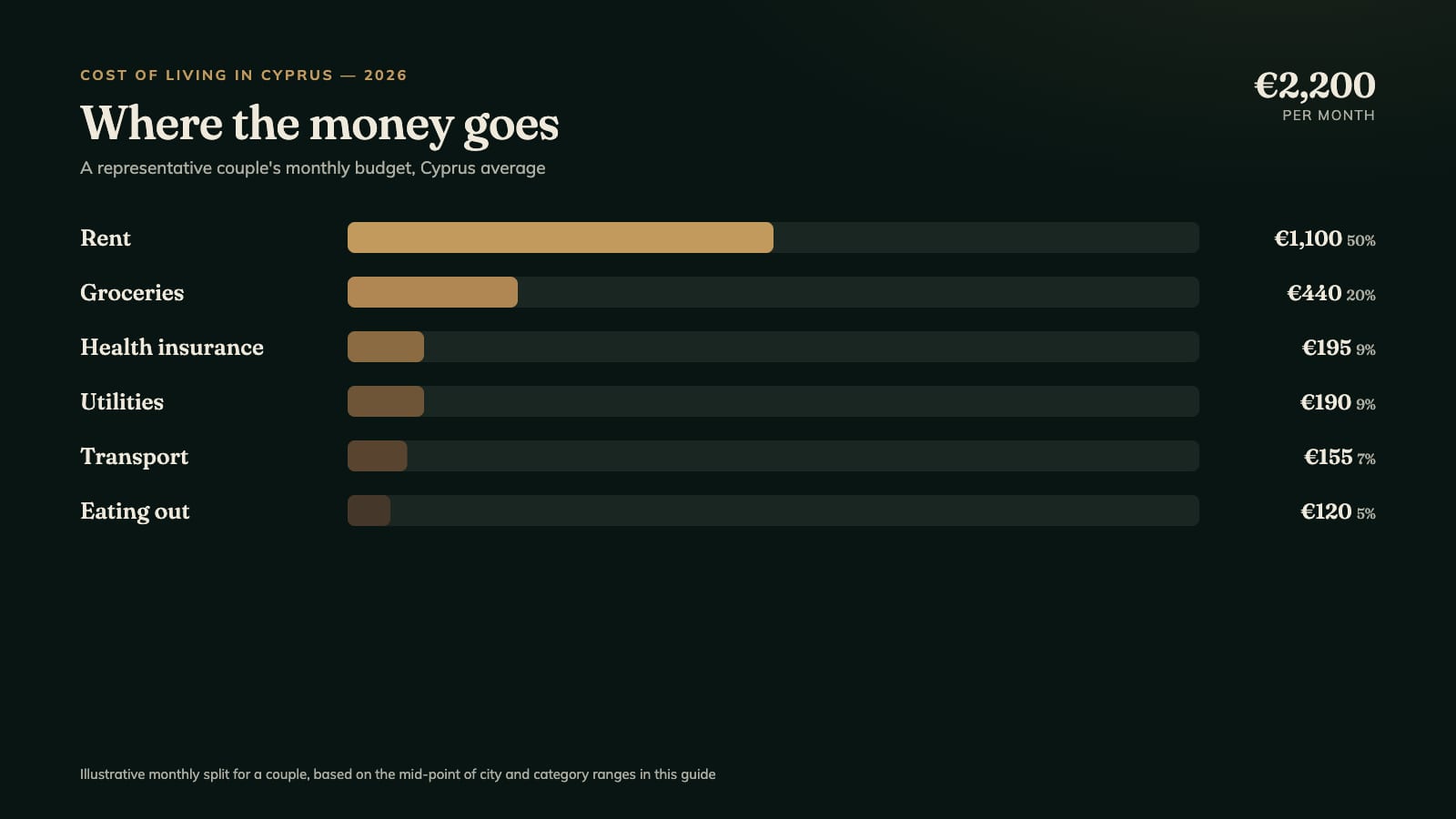
Putting the pieces together, and excluding one-off costs like a property deposit, moving expenses, or a child's school enrolment deposit:
- Single person: roughly €850–965/month excluding rent (city-dependent, per current Numbeo estimates), plus rent of €620–1,480 depending on city and flat size — so a total realistic range of about €1,500–2,400/month.
- Couple: commonly cited in the €1,700–3,200/month range including rent, with Limassol sitting at the top of that band and Nicosia toward the bottom.
- Family of four: excluding rent, current estimates put this around €3,000/month for groceries, utilities, transport and everyday spending; adding a family-sized rent typically brings the realistic total to somewhere between €2,800 and €6,000/month depending heavily on city and lifestyle. A family with a child in private or international school should add that tuition — anywhere from roughly €350/month for local private school up to €1,500/month for a premium international school — on top of these figures.
These ranges are wide because they have to cover a one-bedroom flat in Nicosia and a family villa in central Limassol with the same label. The city and the housing choice, more than any other factor, determine where a household lands within them.
How Cyprus compares internationally
Rather than a single vague comparison, here's what Numbeo's own country-to-country engine shows against the four markets most of our readers come from — run directly, September 2026:
| Country | Overall cost of living | Rent | Groceries | Restaurants | Local purchasing power |
|---|---|---|---|---|---|
| United Kingdom | 18.4% higher than Cyprus | 20.9% higher | 18.4% higher | 24.5% higher | 48.5% higher |
| Germany | 17.5% higher than Cyprus | 11.2% lower | 17.5% higher | 12.2% higher | 61.1% higher |
| Poland | 21.6% lower than Cyprus | 35.0% lower | 26.6% lower | 22.0% lower | 15.9% higher |
| Russia (Moscow) | 31.7% lower than Cyprus | 44.5% lower | 30.9% lower | 34.7% lower | 23.8% lower |
Versus the UK, Cyprus comes out cheaper across the board — consumer prices 18.4% lower, rent 20.9% lower, restaurants 24.5% lower — but UK residents have 48.5% greater local purchasing power, meaning UK salaries stretch further at home even though prices there are higher.
Versus Germany, the picture is more mixed: overall consumer prices are 17.5% lower in Cyprus and restaurants 12.2% cheaper, but rent is actually 11.2% *higher* in Cyprus than the German average — a reflection of Germany's much larger housing stock rather than Cyprus being expensive. German purchasing power is 61.1% higher than Cyprus's, the widest gap of the four.
Versus Poland, Cyprus is meaningfully more expensive on every measure — groceries 26.6% higher, rent 35.0% higher, restaurants 22.0% higher — while Polish local purchasing power is still 15.9% higher than Cyprus's, despite the country's lower price level.
Versus Russia (compared at the Moscow level, since Numbeo doesn't publish a single blended national figure), Cyprus runs 31.7% more expensive on consumer prices and 35.1% more including rent, with rent alone running 44.5% higher in Cyprus — the largest gap in the table. Local purchasing power tells the opposite story here: Cyprus residents have 23.8% more purchasing power than Moscow residents, the only market of the four where that direction reverses.
Planning the move itself
This is the ongoing, month-to-month side of the equation. If you're also weighing the one-time cost of actually buying a property here — deposit, legal fees, VAT, transfer fees — our guide to how much money you need to buy property in Cyprus covers that half of the picture, and the two are meant to be read together: what it costs to buy, and what it costs to live here afterward.
A note on the figures: rent, groceries, restaurant, transport, sports/leisure, clothing and utility prices are drawn from Numbeo's Cyprus dataset as updated in September 2026 — crowd-sourced data, so these are realistic ranges, and an individual lease or bill can fall outside them. The UK, Germany, Poland and Russia comparisons come directly from Numbeo's own country-comparison tool, run in September 2026. Electricity tariff structure is based on EAC's published domestic tariffs (Tariff 01, the two-zone day/night tariff, and the vulnerable-consumer tariff) and current market commentary on the 2025–2026 price trend. Fuel prices reflect the September 2026 island average from fuel-price trackers. Car insurance and road tax ranges are drawn from Cyprus insurance-broker and road-tax-calculator publications current as of September 2026. School fees are drawn from schools' own published 2026/27 fee schedules where available; schools that don't publish fees are noted as such rather than estimated. Health insurance figures are cross-referenced from our own health insurance in Cyprus guide, which draws on official clarifications and insurer pricing. Household budget totals (couple/family) combine several published 2026 estimates and are presented as ranges precisely because they vary this much by city and lifestyle.