Cyprus Insights/Buying Property in Cyprus
Cap St Georges Resort: Buying Inside the Resort or Next to It

Most of what is written about Cap St Georges is written for people booking a room. Search the name and you get hotel listings, review scores and nightly rates. Almost nothing addresses the other audience: people considering buying a villa there, or near there, and trying to work out what the money actually buys.
This guide takes the second question. It uses measured figures from our own listing inventory rather than brochure language, states plainly where the data runs out, and compares the resort against four other villa developments on the same stretch of coast.
Cap St Georges Resort in Peyia: location, scale and travel times
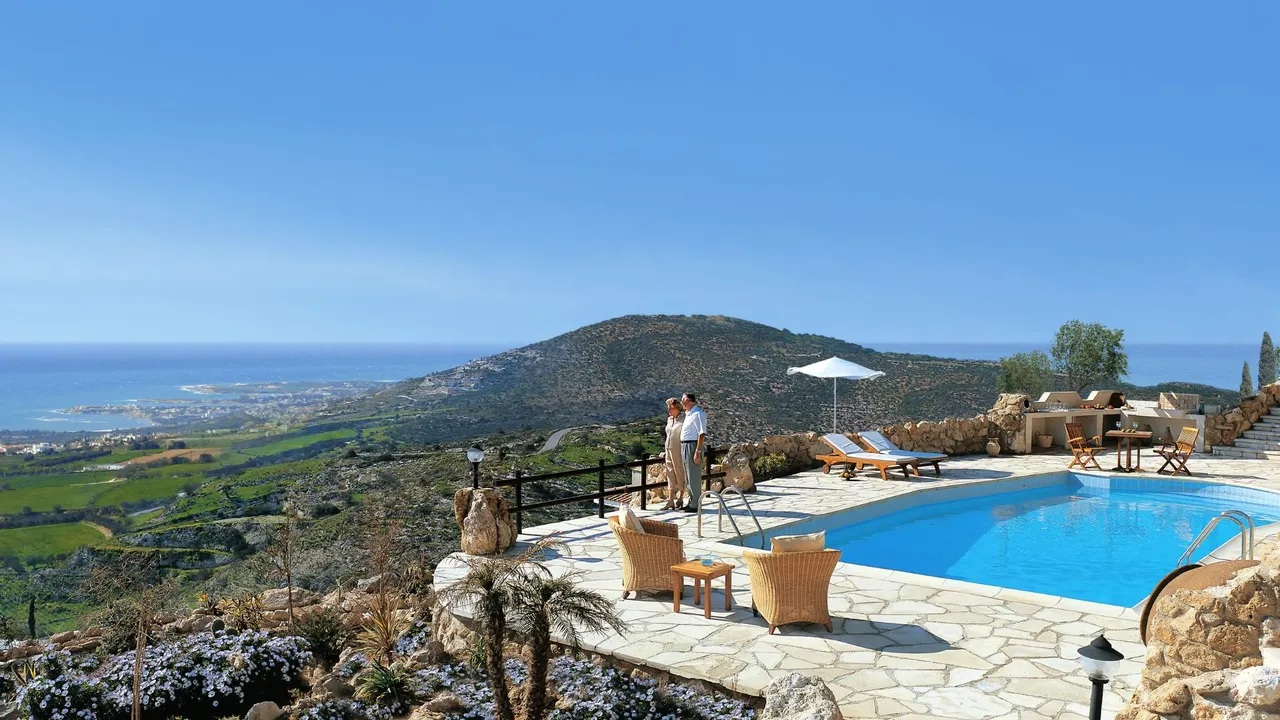
Cap St Georges sits on the southwest coast of Cyprus, in Agios Georgios in the Peyia municipality, on the edge of Akamas National Park. It is a mixed resort: a five-star hotel, a residential villa community, and a shared amenity estate, developed as one masterplan across roughly 580,000 m² with about two kilometres of coastline.
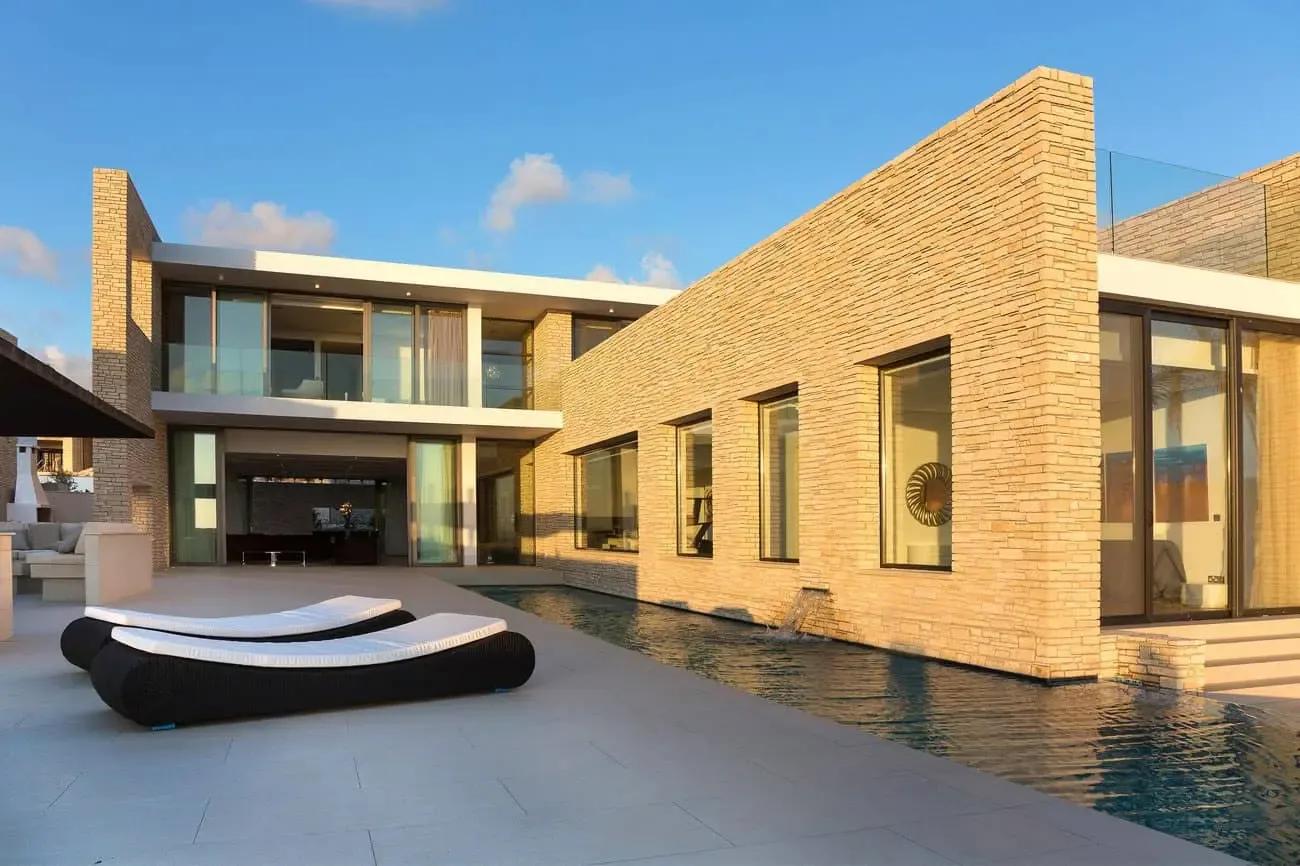
The hotel component holds a little over two hundred rooms and suites and belongs to The Leading Hotels of the World. The residential component is around two hundred villas positioned above the shoreline. For a buyer, that mix matters more than it first appears: you are not buying into a private villa estate that happens to have a pool, you are buying into an operating hospitality property with permanent residents inside it.
Travel times from the resort, in minutes
| Destination | Minutes |
|---|---|
| Beach | 2 |
| Restaurants | 1 |
| Shops | 5 |
| School | 3 |
| Hospital | 5 |
| Paphos city centre | 20 |
| Paphos International Airport | 30 |
| Golf course | 35 |
The pattern here is worth reading properly. Everyday needs are inside or beside the resort, which is what the one-to-five minute figures reflect. City infrastructure is twenty minutes away, the airport thirty. This is a coastal location with its own self-contained services rather than a town-edge address, and the golf figure of thirty-five minutes tells you the courses are on the other side of Paphos, not next door.
Plot size at Cap St Georges: how much land comes with each villa
This is the question the marketing material never answers directly, and it is the one that separates a resort villa from a standard new-build.
Our listing records the following ranges for the villa stock:
| Measure | Range |
|---|---|
| Plot size | 618 – 2,350 m² |
| Covered area | 204 – 375 m² |
| Bedrooms | 4 – 5 |
| Energy rating | B |
Dividing those ranges gives a land-to-house relationship of roughly 3:1 at the smallest end and above 6:1 at the largest.
One honest caveat before that number travels any further. Those are two independent ranges, not paired measurements for individual villas. We do not know which plot belongs to which house. The true spread of per-villa ratios may be narrower than 3:1 to 6:1, and could contain values outside it. Treat the figures as the shape of the stock, not as a specification for any particular property. Anyone comparing specific villas should ask for the plot and covered area of that unit in writing.
Cap St Georges plot sizes measured against the Cyprus villa median
To answer that rather than assert it, we measured our own villa inventory: 186 available villa units that record both plot size and covered area, computed twice through independent methods to guard against arithmetic error.
| Benchmark across our villa inventory | Land-to-house ratio |
|---|---|
| Median | 3.04 : 1 |
| 75th percentile | 3.84 : 1 |
| 90th percentile | 4.43 : 1 |
Set Cap St Georges against that and the picture is more interesting than a simple "more land" claim.
At its smallest-plot end, a Cap St Georges villa sits at roughly the median for Cyprus new-build villas generally. Ordinary, not generous. At its largest-plot end, it exceeds the ninetieth percentile of everything else we list, which is genuinely unusual. The stock spans from typical to exceptional, and the difference between those two ends is where the buying decision lives.
For readers who want the underlying method, we published the full plot-ratio study separately in our analysis of villa plot sizes in Cyprus. Note that the market median moves as inventory turns over, so the figure above is the current one rather than the one in that earlier piece.
Cap St Georges resort facilities and what they cost to maintain
The amenity set is what buyers are paying a premium for, so it is worth listing concretely rather than describing atmospherically.
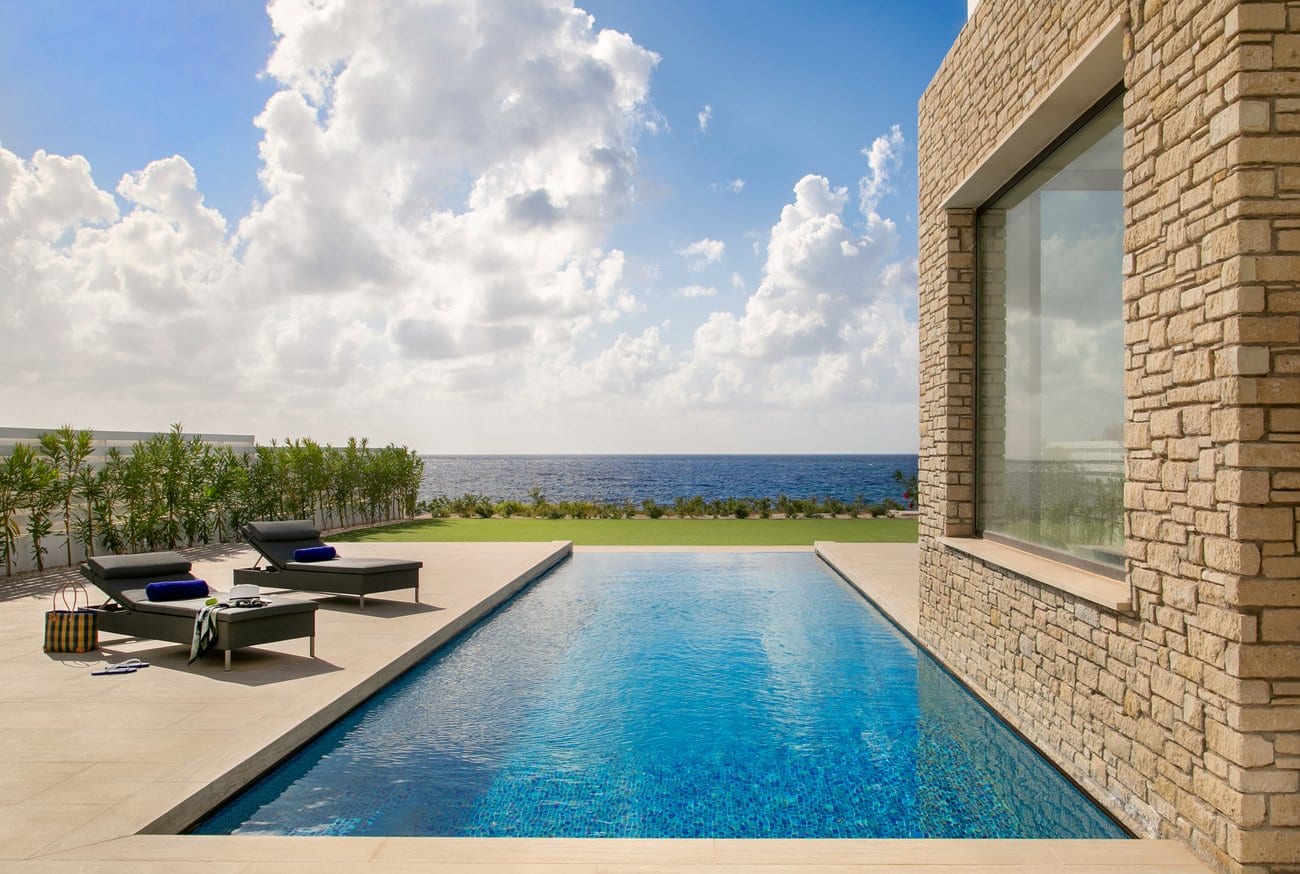
Inside the resort: three outdoor pools and an indoor pool, ten restaurants and bars including a rooftop restaurant, a spa with salon and barbershop, a fitness centre, a private beach along a cove of roughly 130 metres, tennis and basketball courts, a kids' club, playgrounds, water sports, equestrian activities, conference facilities, and 24-hour reception and concierge.
Two practical consequences follow from that list, and they are the ones buyers most often discover late.
First, an amenity estate of this scale has a running cost, and it is shared among owners. Communal service charges at resort developments are materially higher than at a standalone villa, because the pools, landscaping, security, and shared facilities are maintained year-round regardless of occupancy. We do not publish figures for these, because they are set by the management company and change over time. Ask for the current annual service charge in writing, ask what it covers, and ask how it has moved over the past three years, before you commit.
Second, an operating hotel next to your home is a genuine trade-off with two sides. It means restaurants, room service, concierge and maintenance on your doorstep out of season, when a purely residential estate in Cyprus can be close to empty. It also means seasonal footfall, events, and a level of activity that some buyers want and others specifically leave the city to avoid. Which side of that you fall on is not a question data can answer for you.
Cap St Georges or a villa nearby: five Peyia developments compared
This is the real decision for most buyers on this stretch of coast, because the same developer, Korantina Homes, builds both inside the resort and around it. That makes the comparison unusually clean: same builder, same coastline, same standards.
We compared the villa developments in our inventory. Apartment-led projects are excluded, since land ratios are meaningless for them.
| Development | Plot (m²) | Covered (m²) | Bedrooms | Approx. land-to-house | Energy |
|---|---|---|---|---|---|
| Cap St Georges Resort | 618 – 2,350 | 204 – 375 | 4 – 5 | ~5.1 : 1 | B |
| Seascape Villas | 923 – 1,731 | 389 | 6 | ~3.4 : 1 | B |
| Sunset View Villas | 240 – 1,166 | 194 – 395 | 4 – 6 | ~2.4 : 1 | B |
| Hills Residences | 328 – 673 | 230 – 266 | 5 | ~2.0 : 1 | B |
| Sea Caves Villas | 124 – 565 | 119 – 265 | 2 – 4 | ~1.8 : 1 | B |
Ratios are calculated at the midpoint of each stated range and are indicative of the stock, not of individual properties.
The comparison makes one thing clear. What separates these developments is not location — travel times to Paphos and the airport are effectively identical across all of them, twenty and thirty minutes respectively. What separates them is land per house and access to the shared amenity estate.
Sea Caves and Hills Residences are the compact end: a villa with a private pool on a plot proportionate to the house. Sunset View sits in the middle. Seascape and Cap St Georges are the land-heavy end.
If your priority is a private villa on the west coast with a manageable plot and lower running costs, the nearby developments do that job and the drive to the same beaches is a few minutes. If your priority is space around the house plus hotel-grade facilities without leaving the gates, that is specifically what the resort is selling, and the ratio data supports the claim.
One point that needs verifying rather than repeating: some nearby developments are marketed on their proximity to Cap St Georges, and at least one references access to resort amenities. Whether that access is contractual, what it covers, and whether it survives a change of management are questions for the purchase contract, not the brochure. Get the answer in writing before it forms part of your decision.
Buying a resort villa in Cyprus: title deeds, service charges and rental rules to check
The checks that matter for a resort purchase are not the same as for a standalone villa.
Title deeds. Ask whether separate title deeds have been issued for the villas already handed over, and if not, when they are expected. This is the single most useful question you can ask about any Cypriot development, and the answer tells you a great deal about the developer's track record.
What the service charge covers, and what it does not. Some resort charges include access to hotel facilities; some charge separately; some tier access by villa type. Get the schedule.
Whether the amenity access is permanent. Facilities inside a hotel-operated resort are operated by that hotel. Understand what happens to owner access if the operator changes.
Rental permissions. If you intend to let the villa, check what the development rules permit, whether letting must go through the resort's own programme, and what commission applies. Short-term letting in Cyprus also carries its own registration obligations, which we cover in our guide to Cyprus short-term rental rules.
Delivery stage and specification. Ask which phase a villa belongs to, its expected completion, and what the specification includes as standard versus as an upgrade.
Does a Cap St Georges villa qualify for Cyprus permanent residence
For non-EU buyers, this is often the deciding factor, so it is worth stating precisely.
Cyprus operates a Fast-Track Permanent Residence route under Regulation 6(2). The qualifying threshold is an investment of at least €300,000 excluding VAT in new-build property purchased from a developer. Cyprus does not operate a citizenship-by-investment programme; that scheme was discontinued in 2020, and the residence route is a residence permit, not a passport.
Villas in this segment sit comfortably above the threshold, so the qualifying amount is not the constraint here. Two details matter more:
The qualifying sum must come from your own funds transferred from abroad. It cannot be covered by a Cypriot mortgage, which is a point we examine in detail in our guide to mortgages for foreign buyers in Cyprus.
The application also requires evidence of secured annual income from sources outside Cyprus, and the permit covers the applicant, spouse and dependent children under the conditions set out in the regulation.
In practical terms, for a buyer whose main goal is residency, the purchase itself is the qualifying act. You do not need to establish a company, create employment, or hold a specific visa first. Buying a qualifying new-build property from a licensed developer, with the funds properly evidenced, is the route.
Requirements do change, and the details of any individual application depend on nationality, source of funds and family composition. We are a marketing and consulting agency rather than a law firm, so we do not advise on applications ourselves. We introduce buyers to independent Cypriot immigration lawyers, and we recommend that any residency plan is confirmed with one before a purchase is committed to. Our note on how to choose a lawyer in Cyprus explains what to look for.
Peyia and the west coast compared to other Paphos buying areas
If you are still deciding on an area rather than a development, the west coast is one option among several. Peyia and Agios Georgios trade proximity to Paphos town for coastline, quiet and space. Buyers who want walkable urban amenities usually end up looking at Paphos versus Limassol instead, and those focused specifically on the coast may find our overview of beachfront properties in Cyprus and west coast properties more useful starting points.
Buyers considering a purchase before completion should also read our guide to off-plan properties in Paphos, which covers staged payments and what protections do and do not exist.
How a west coast villa purchase runs in practice: a relocation case study
A relocation purchase on this coast is documented in our case study of a UK family relocating to Cyprus, which follows the decision process from shortlist to completion over seven weeks. It is useful mainly for the sequence: how areas were compared, what was prioritised, and where the time actually went.
Buying a Cap St Georges villa at developer pricing, without agency commission
We work directly with licensed Cypriot developers and sell at developer pricing. The price you see through us is the price at the developer's own sales office. There is no agency commission, no markup, and no separate fee for property search, viewings, negotiation, or transaction support.
Our income is a fee paid by the developer, not an addition to what you pay. If you are quoted a higher price and told the difference covers intermediary services, that is not how this works with us.
What we do: shortlist properties against your actual criteria, arrange viewings in person or remotely, provide the measured data behind each development rather than brochure claims, and introduce you to independent lawyers, tax advisers and mortgage brokers who are not connected to the seller. What we do not do: act as your legal representative or advise on your tax position. Those roles belong with professionals you appoint yourself, and we will tell you when you need one.
To see current availability at Cap St Georges Resort, view the villas at Cap St Georges Resort in our catalogue, or contact us with your requirements and we will send a shortlist across the west coast, inside the resort and outside it, with the plot and area figures for each.